William Karl Valentine: The Eaton Fire - LENSCRATCH
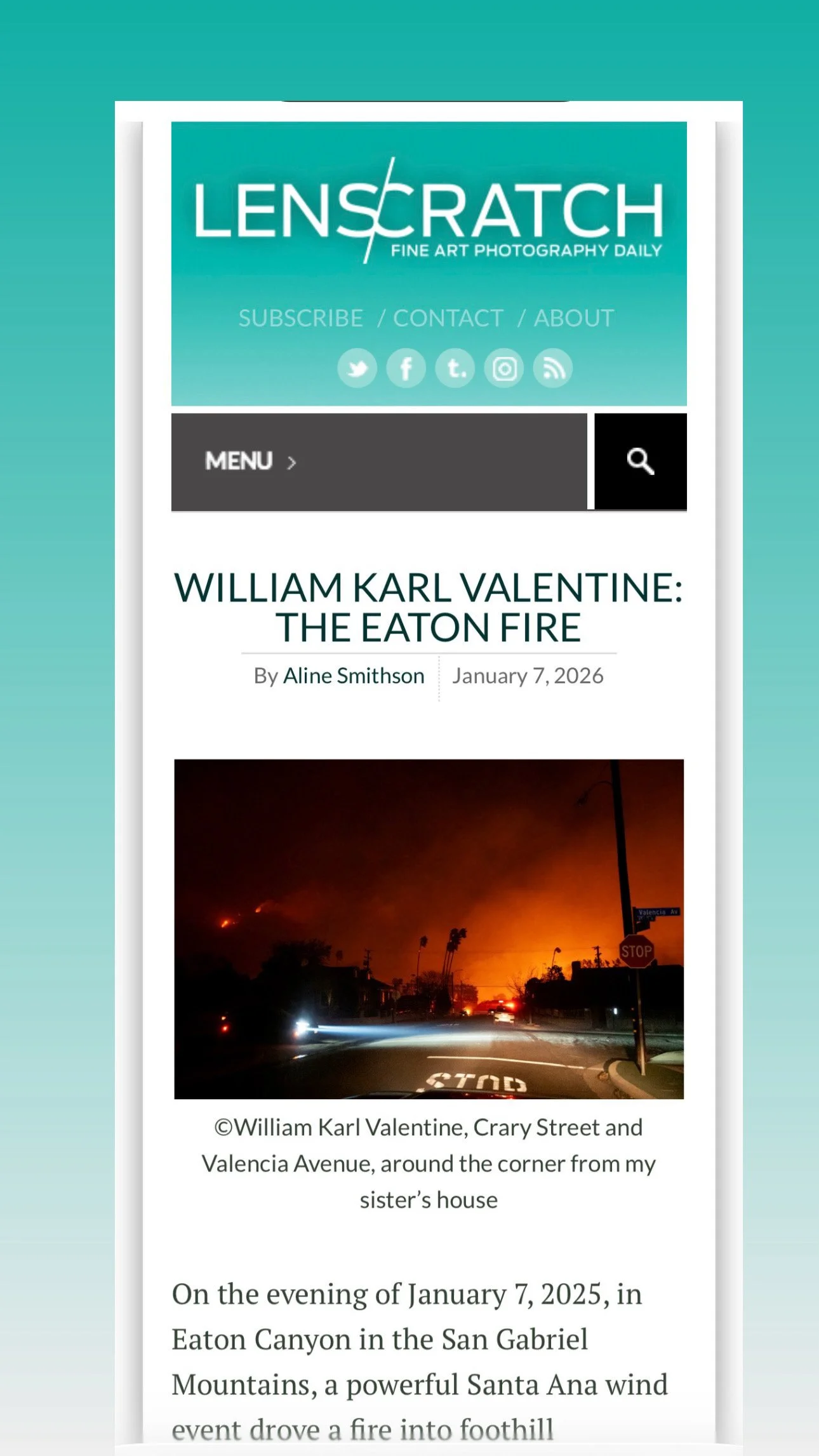
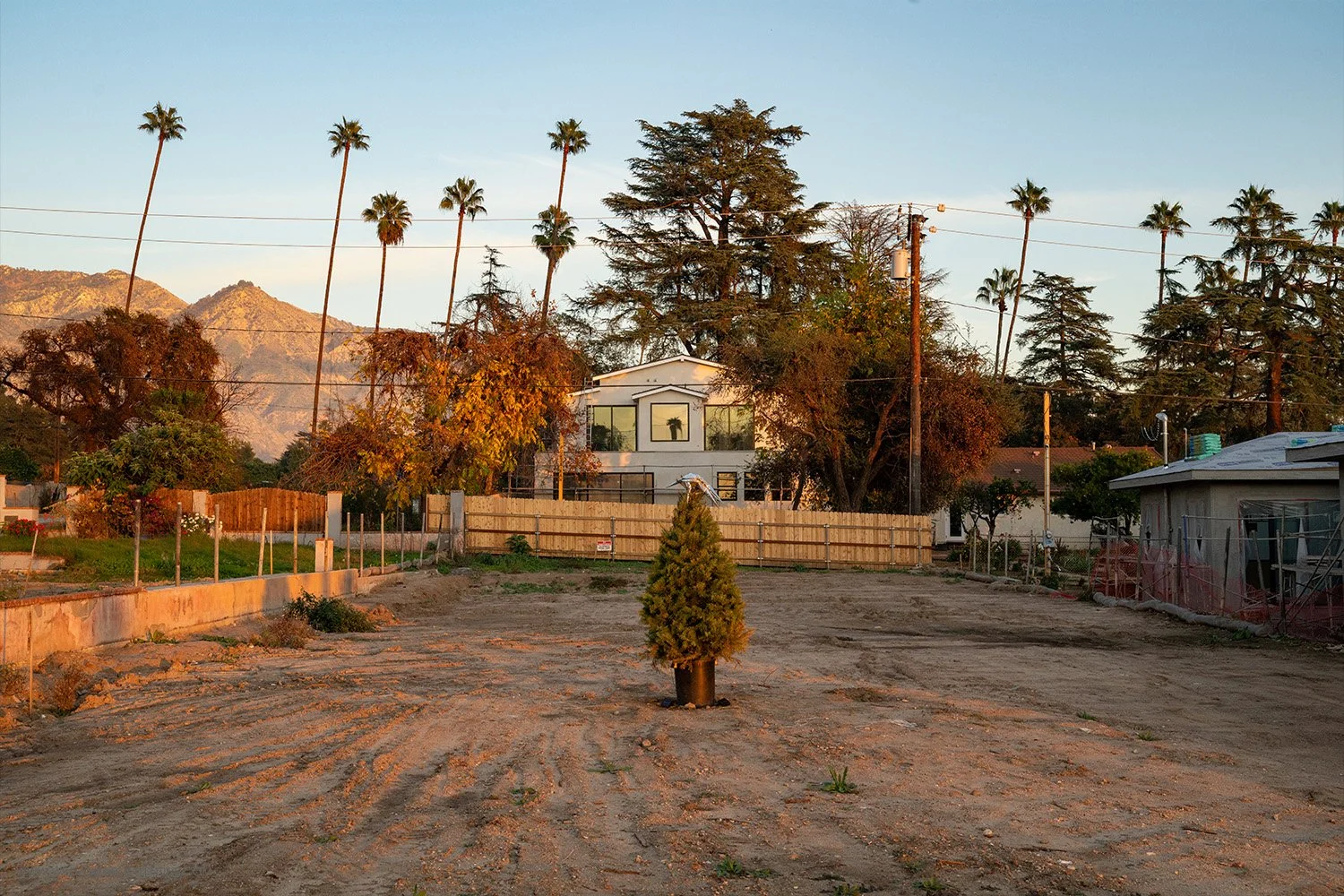
I am pleased to announce that Aline Smithson is showcasing my Eaton Fire Portfolio today, which is the one-year anniversary of the fire.
William Karl Valentine: The Eaton Fire - LENSCRATCH
I am pleased to announce that Aline Smithson is showcasing my Eaton Fire Portfolio today, which is the one-year anniversary of the fire.
CA DSC 8334 12-16-25
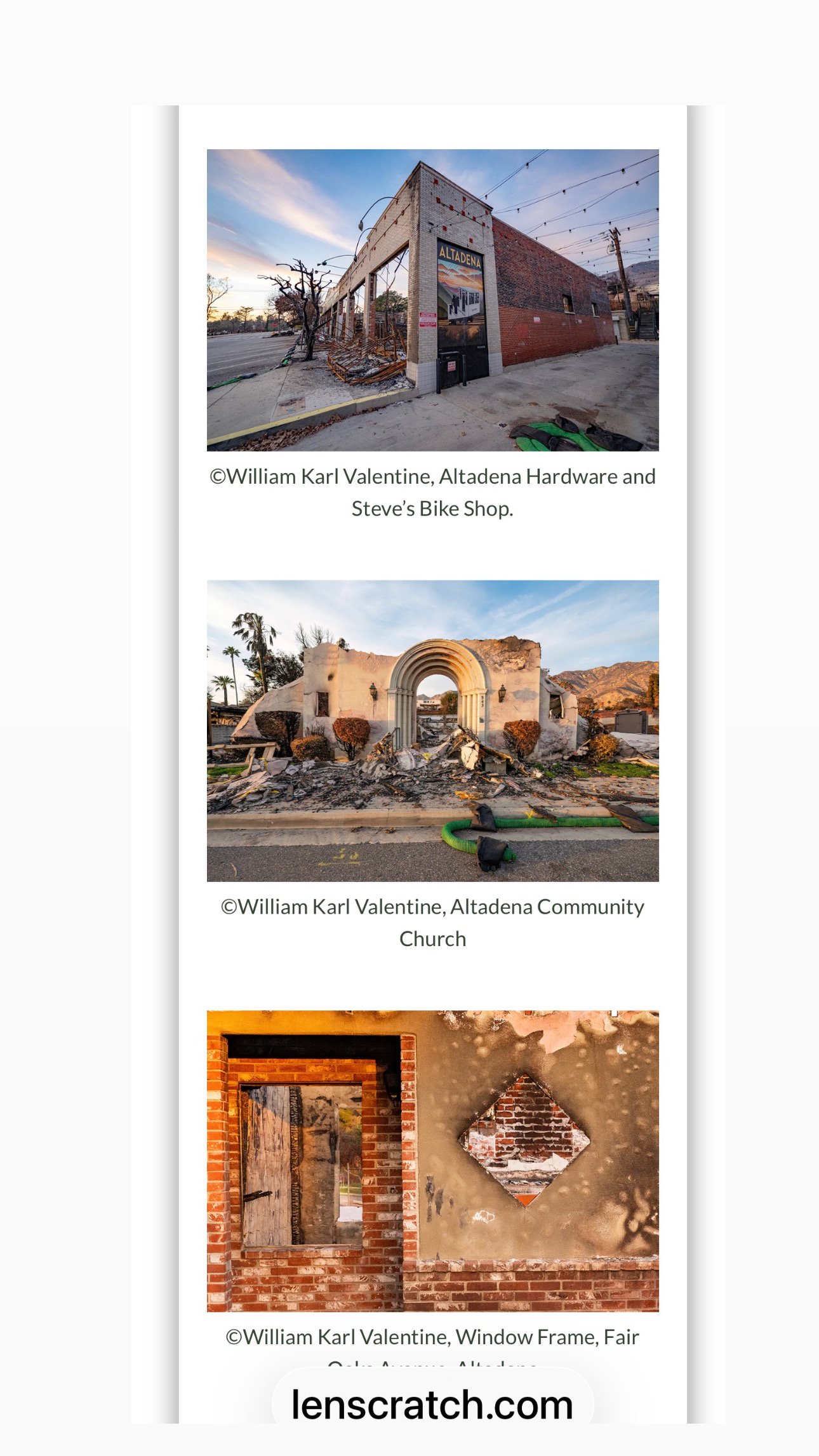
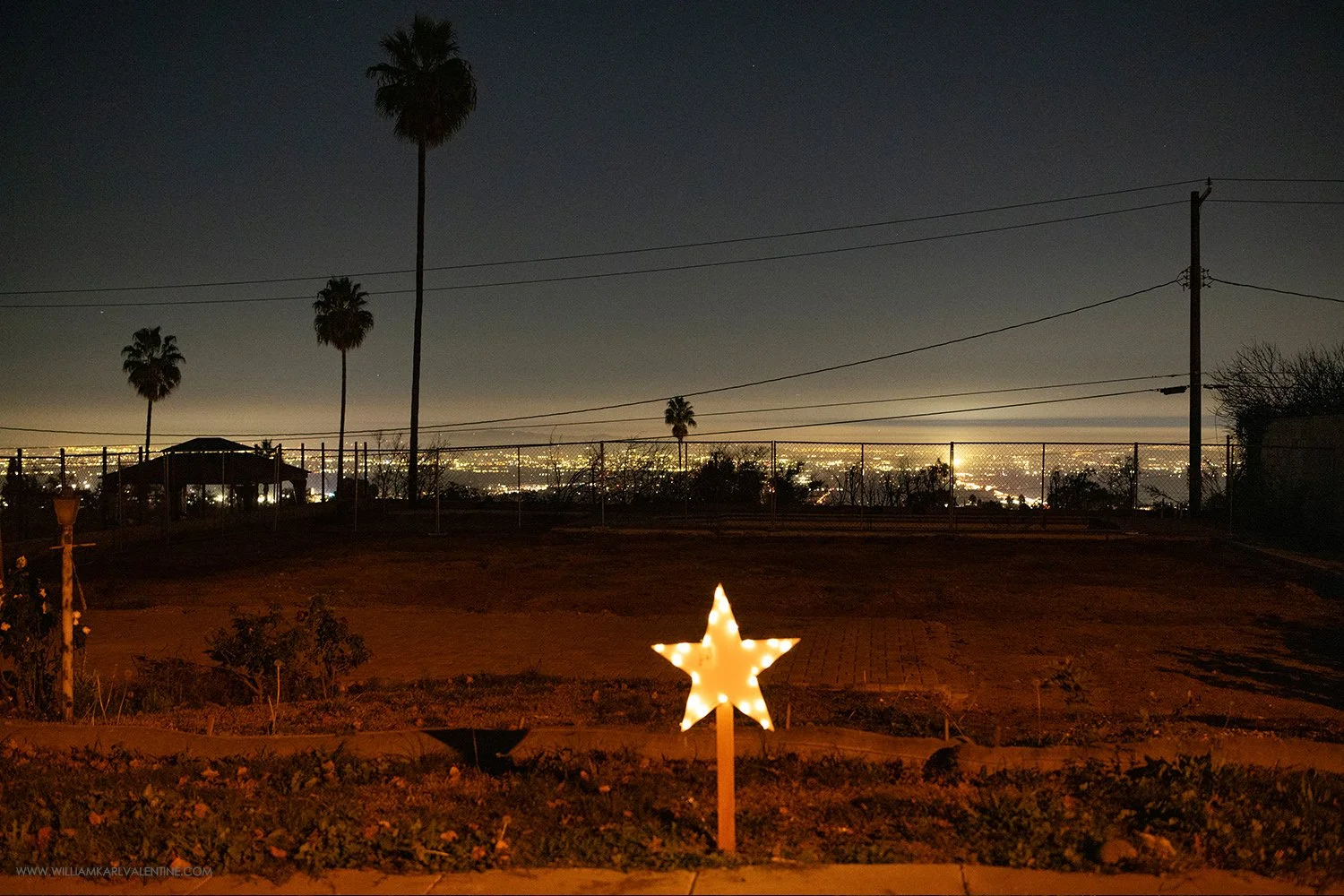
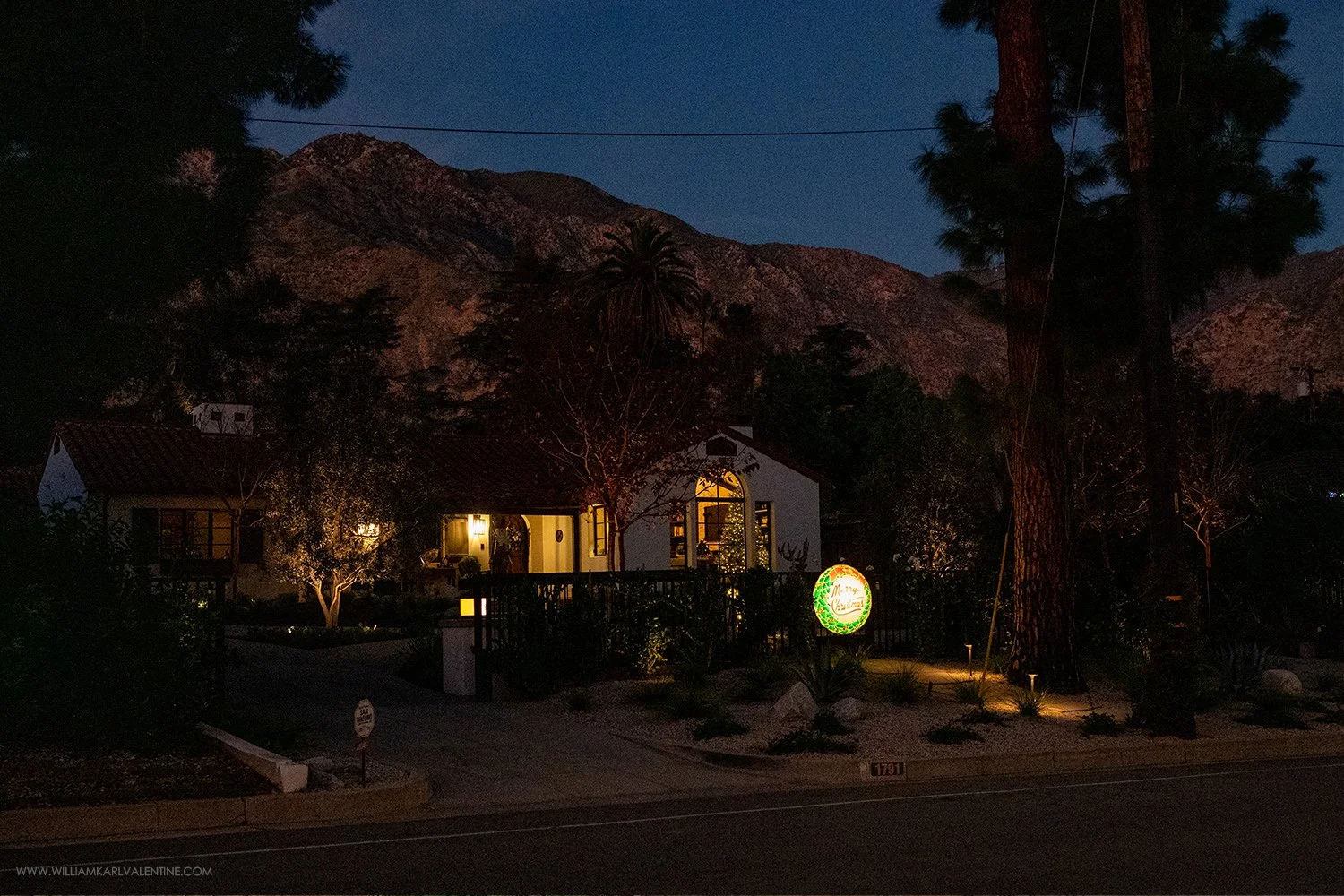
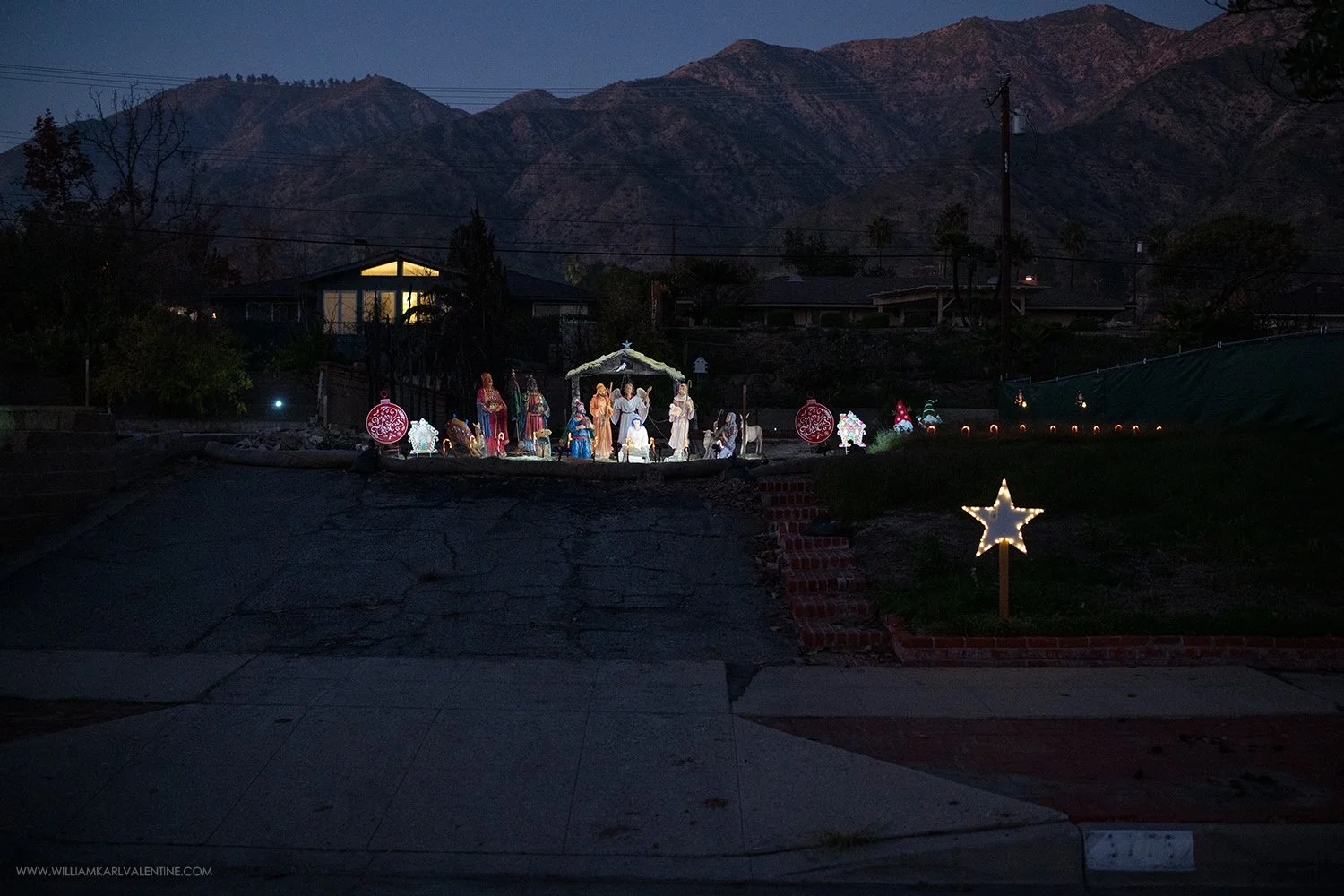
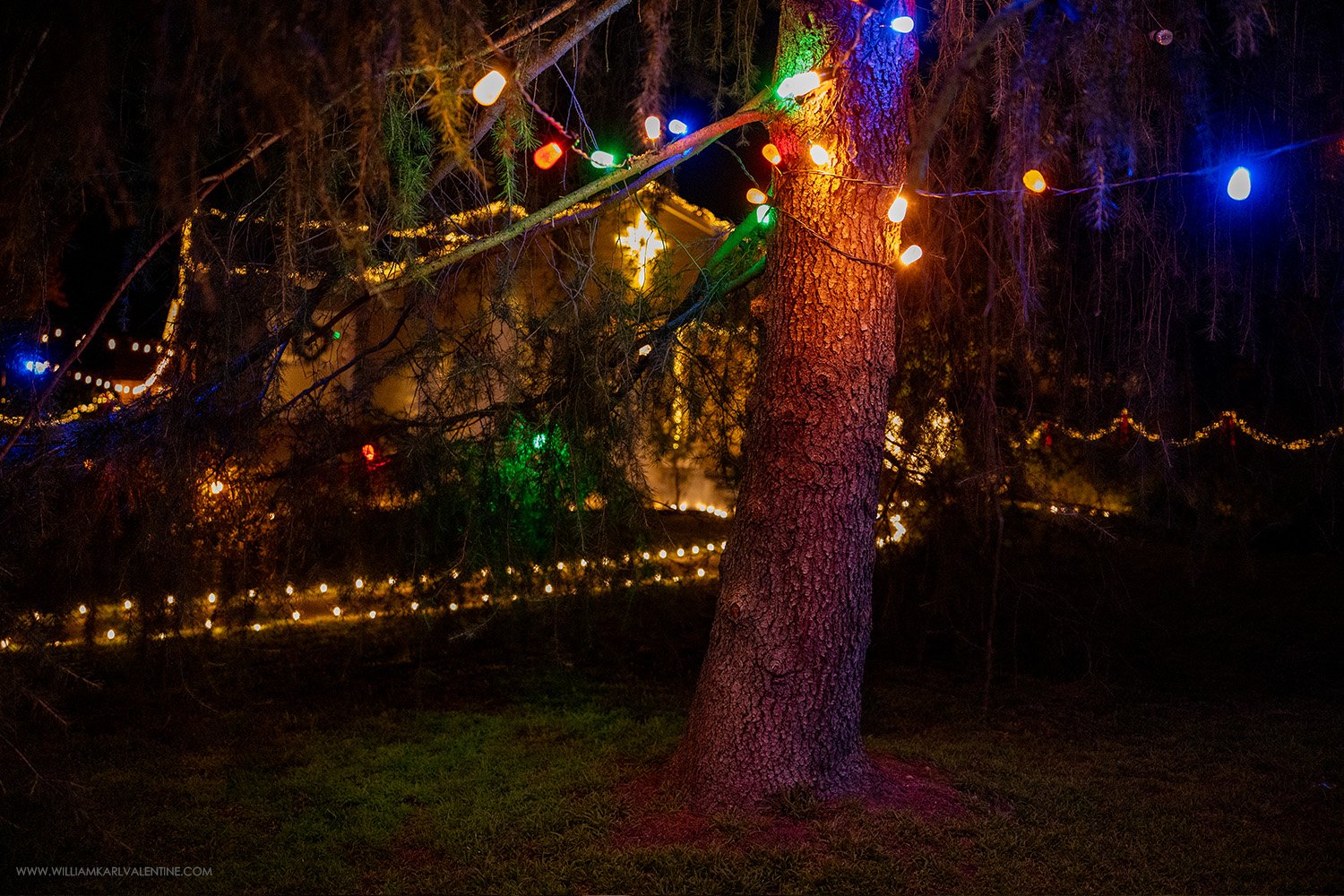
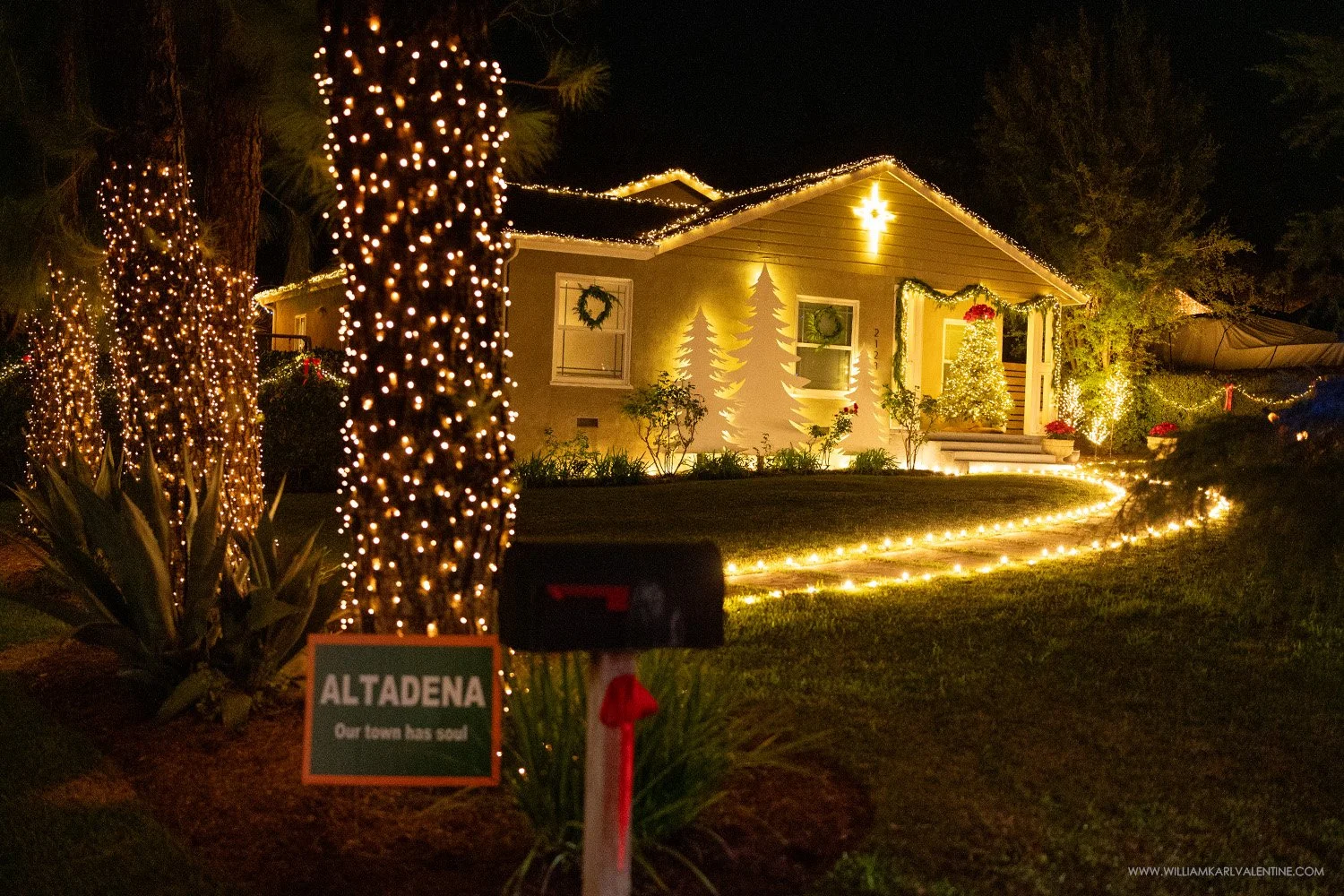
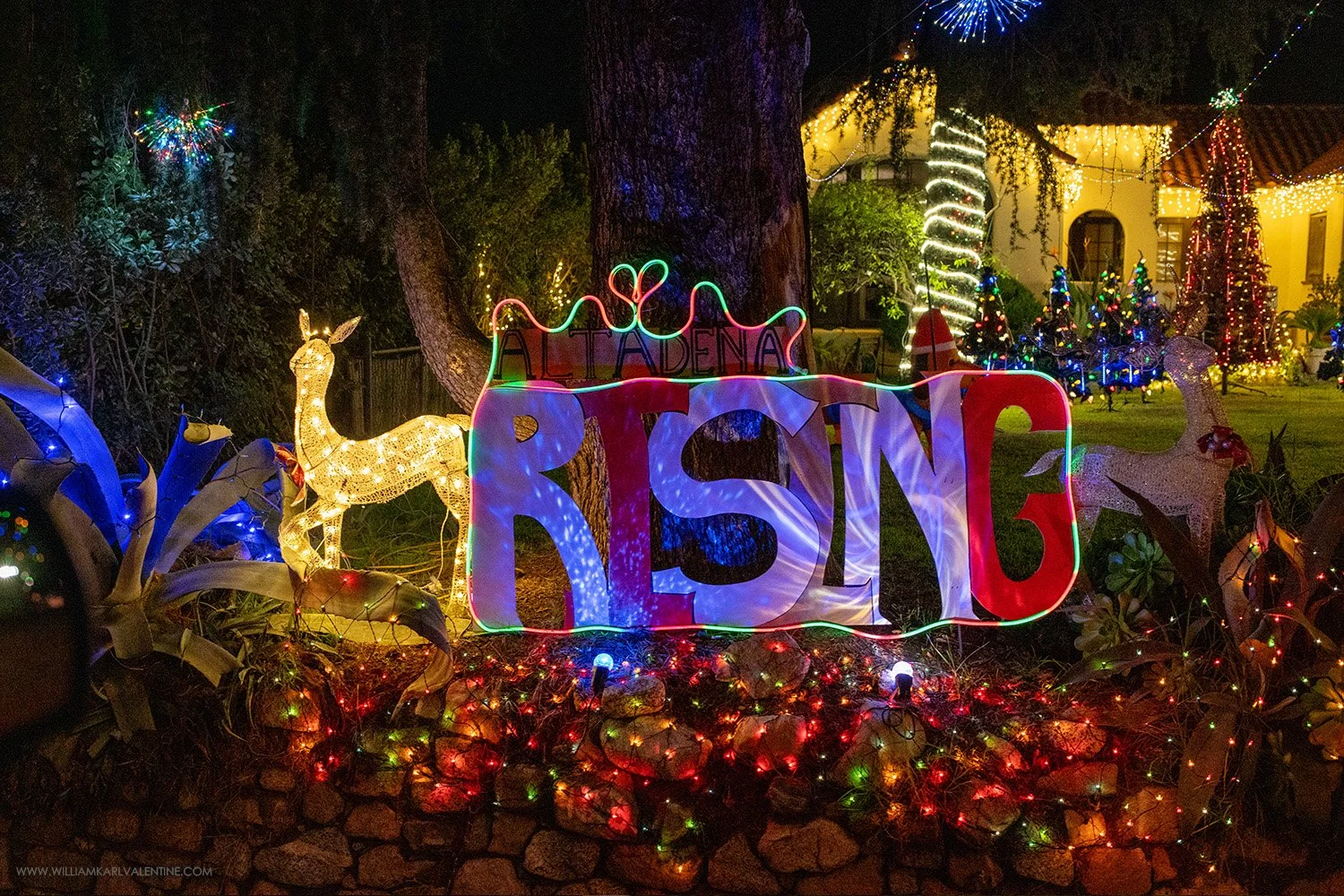
When I began photographing the aftermath of the Eaton Fire last January 2025, I came across numerous homes that still had Christmas decorations up when they were destroyed. Wreaths were still hung on fences, burnt strands of lights, and melted decorations. Every time I saw that it magnified the fact that each mound of rubble had been a family's home. Everything I saw obviously was a reminder but with Christmas you think of joy and hope, children, and home. When I saw homes in April and May that hadn’t burned but still had Christmas decorations up, I knew those people were still displaced waiting to get their homes cleaned. I reminded me that the impact went beyond just the homes that were lost.
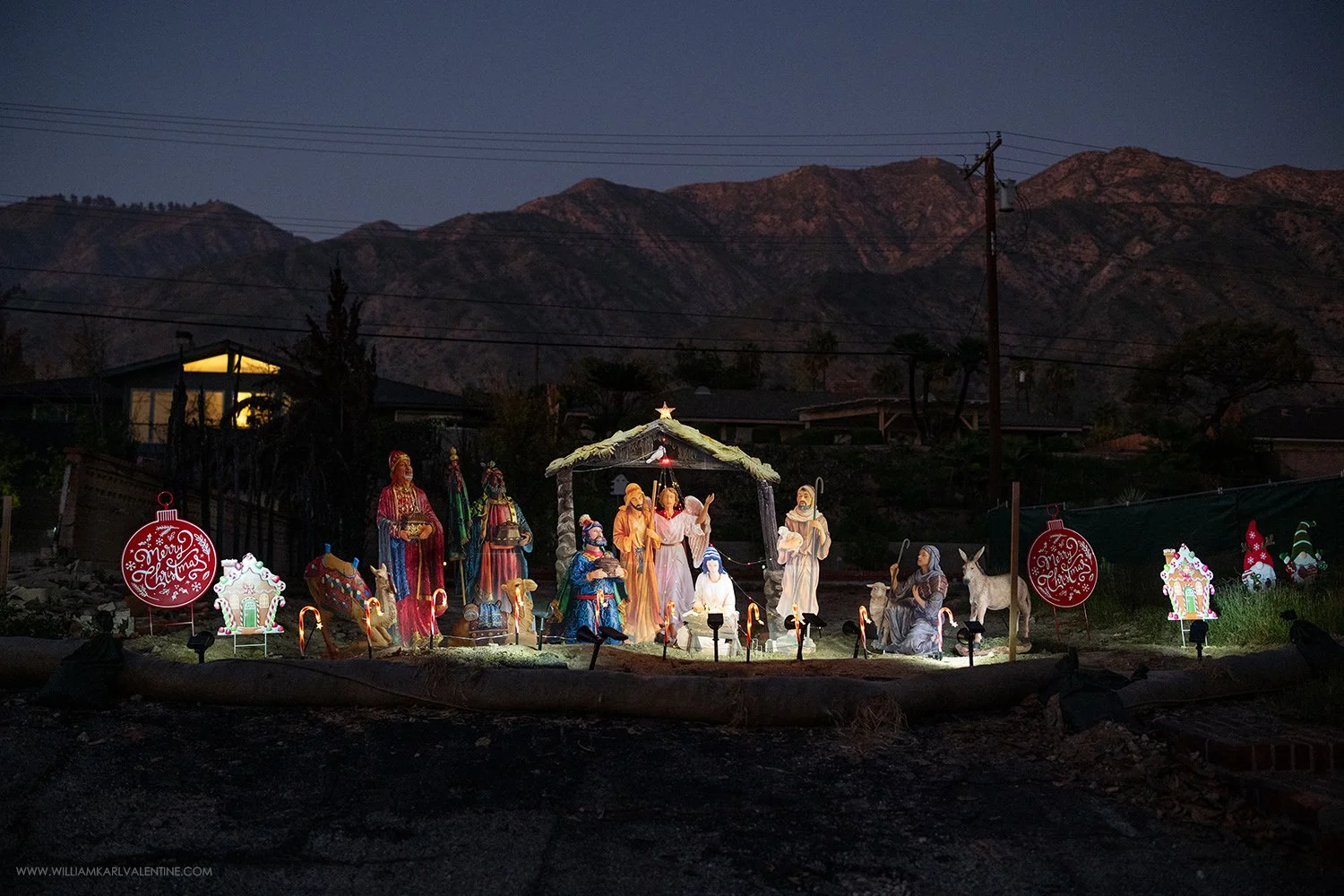
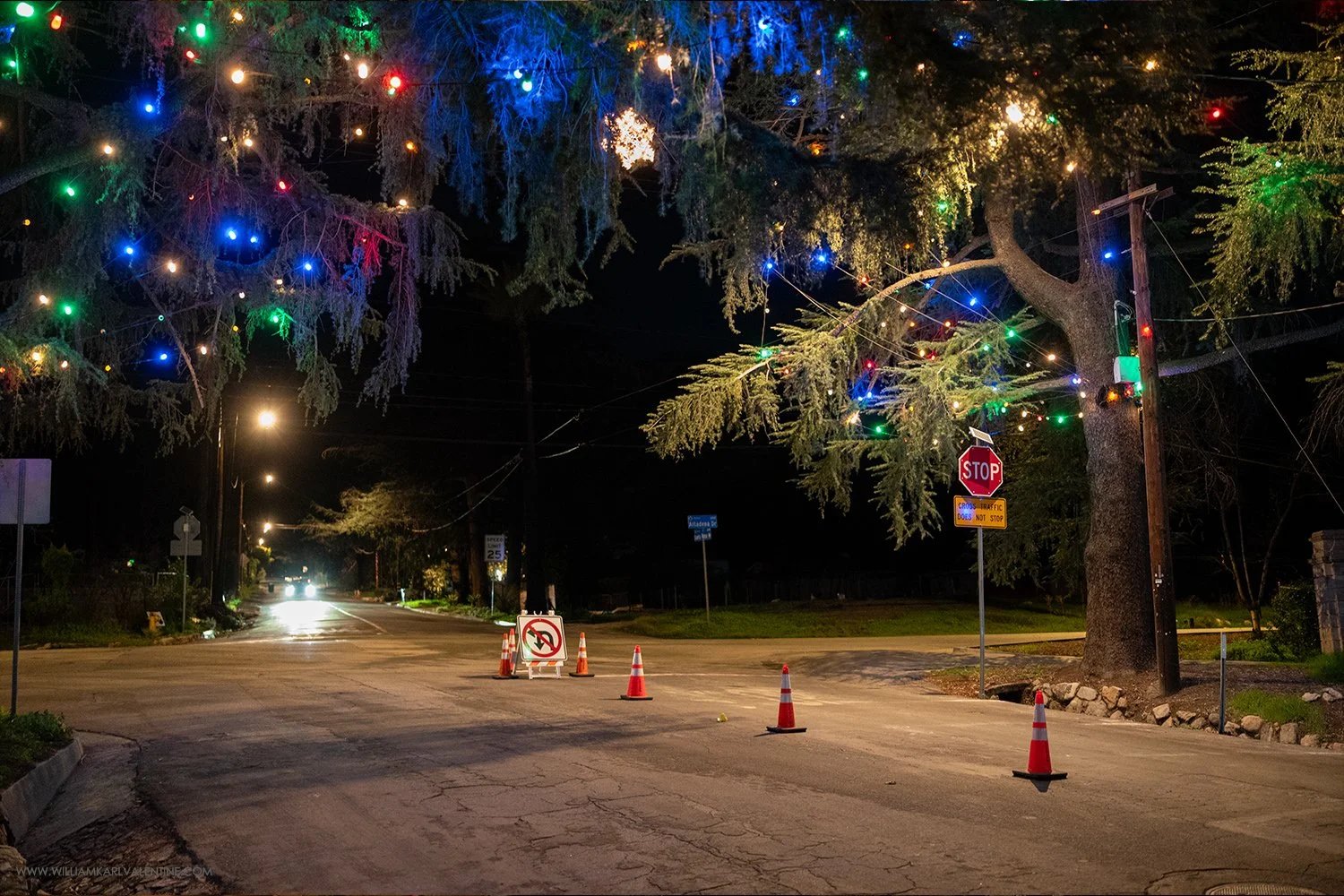
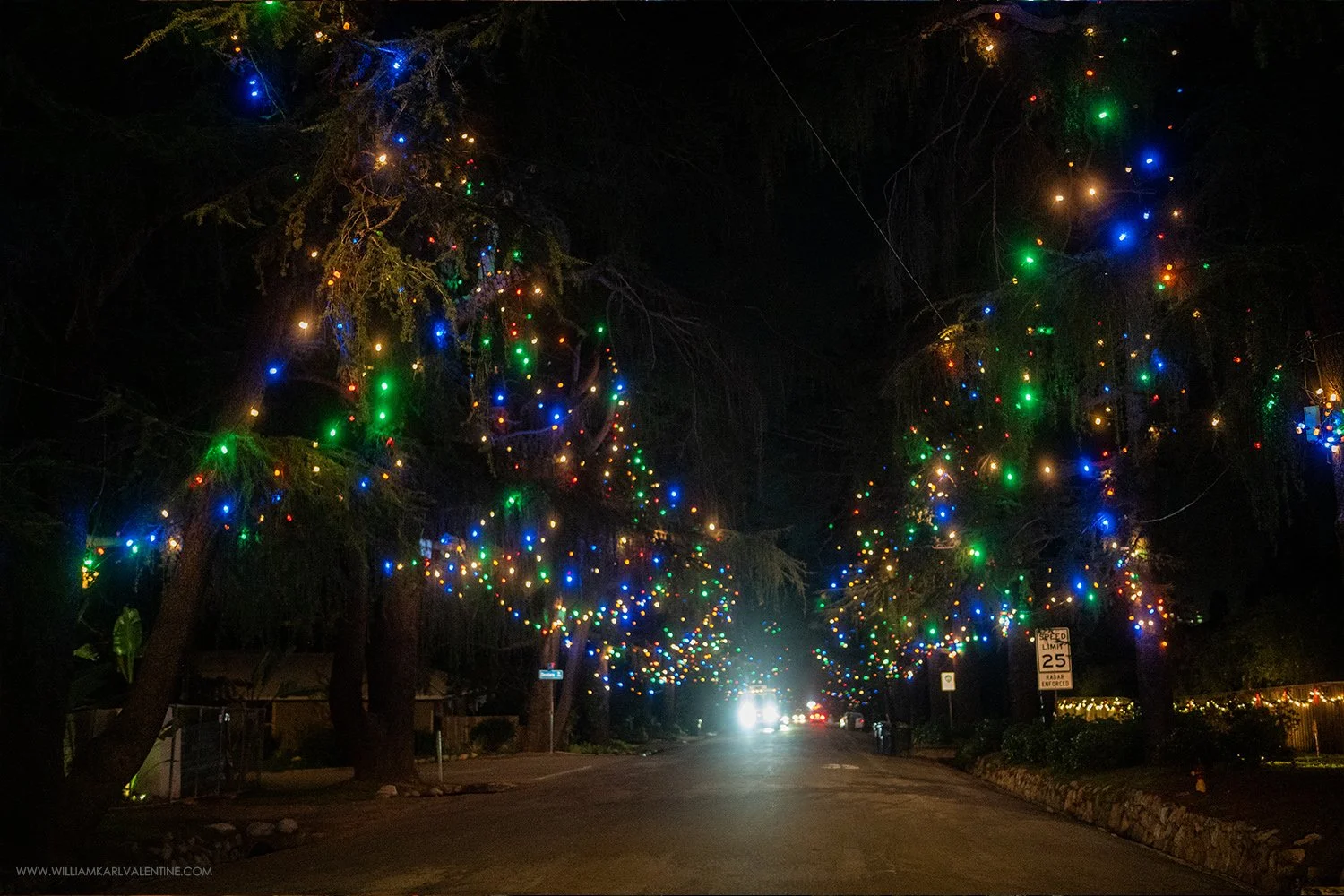
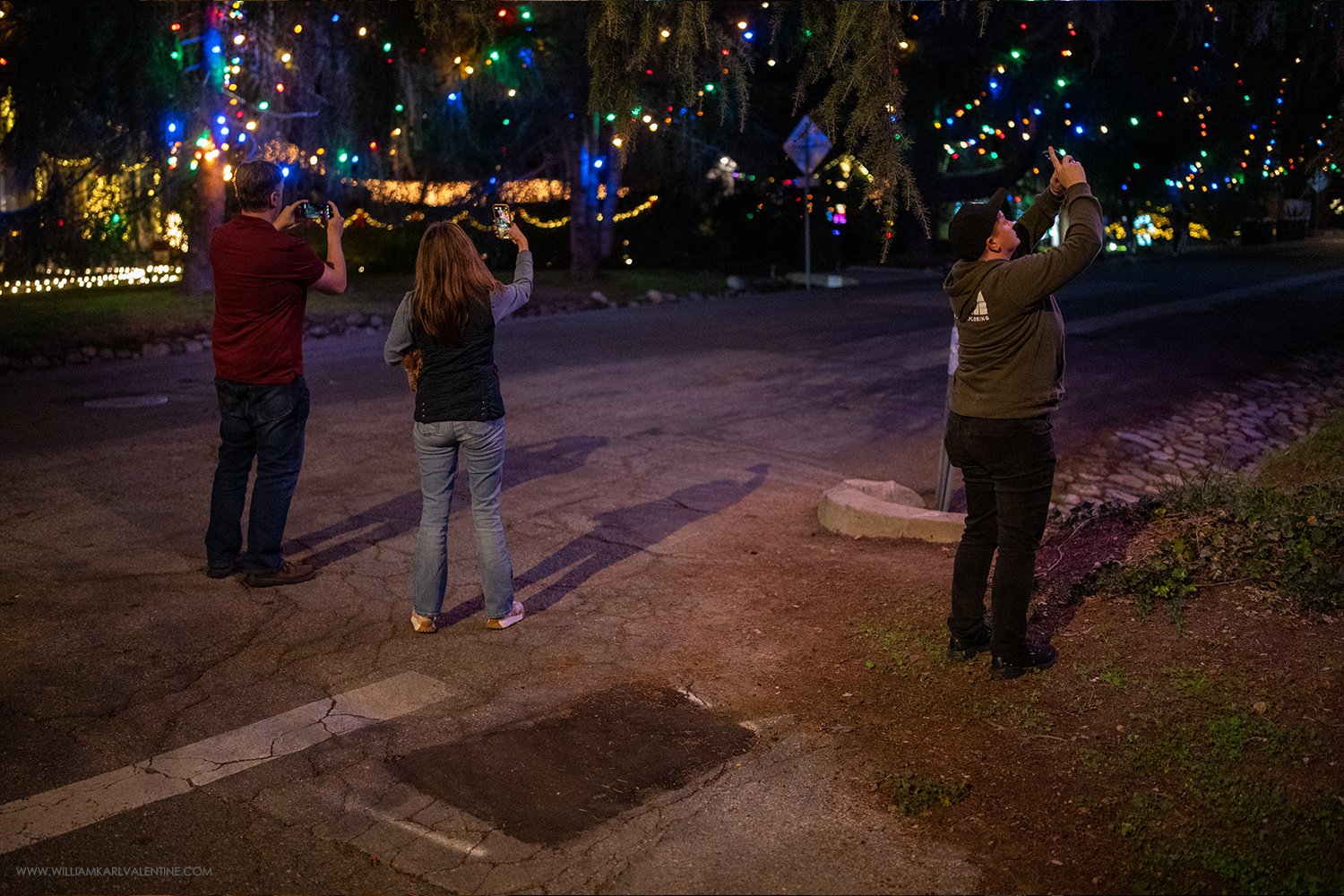
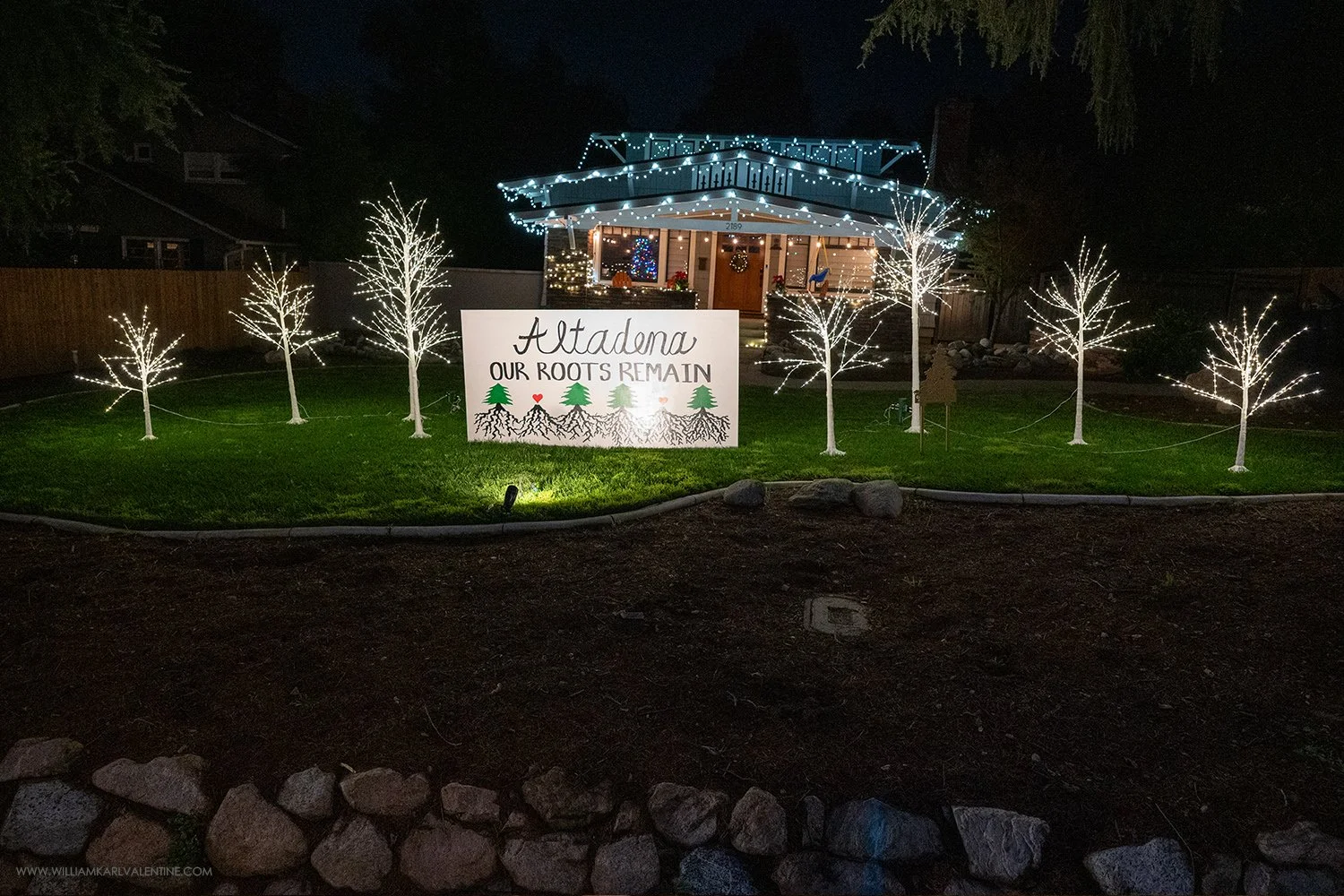
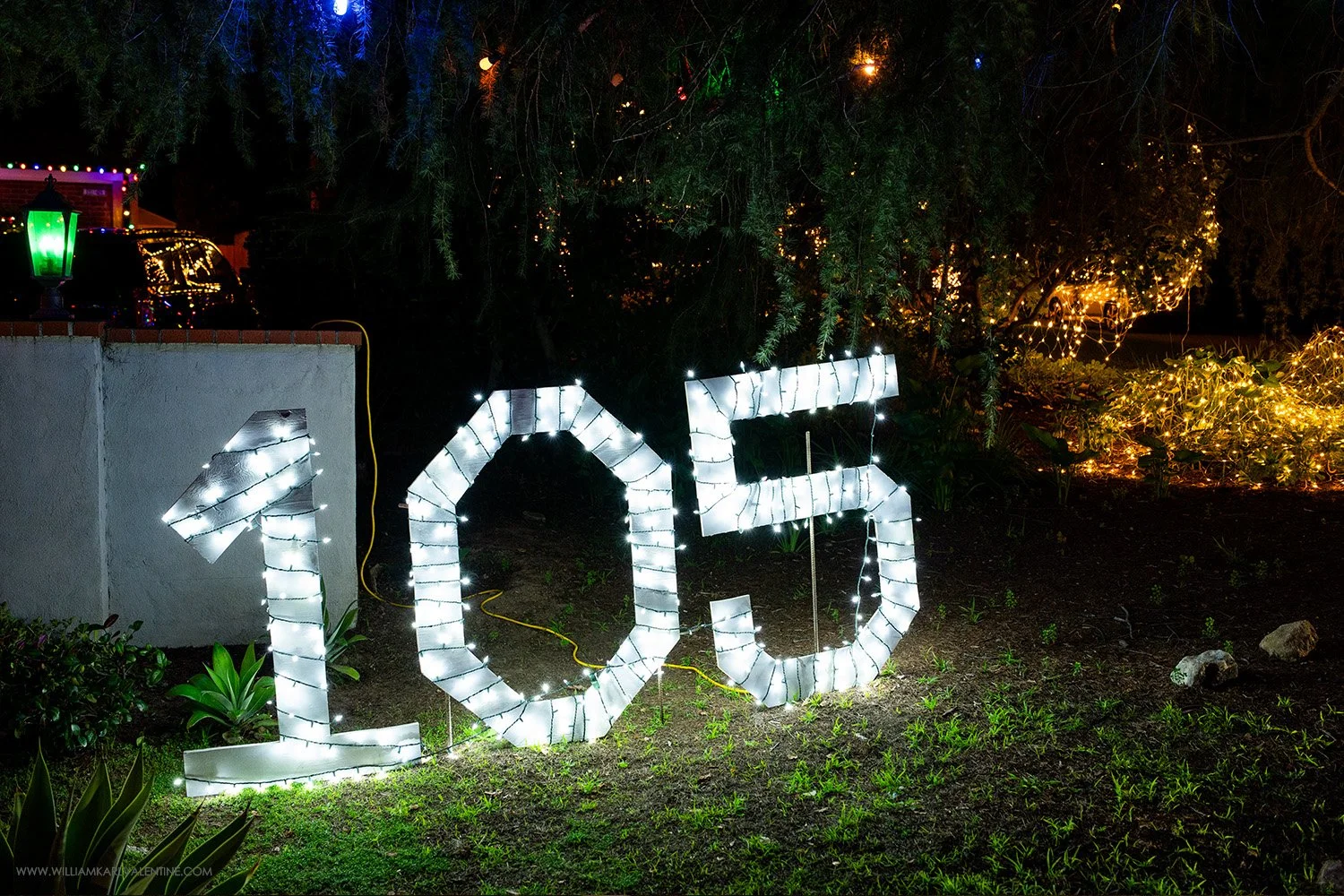
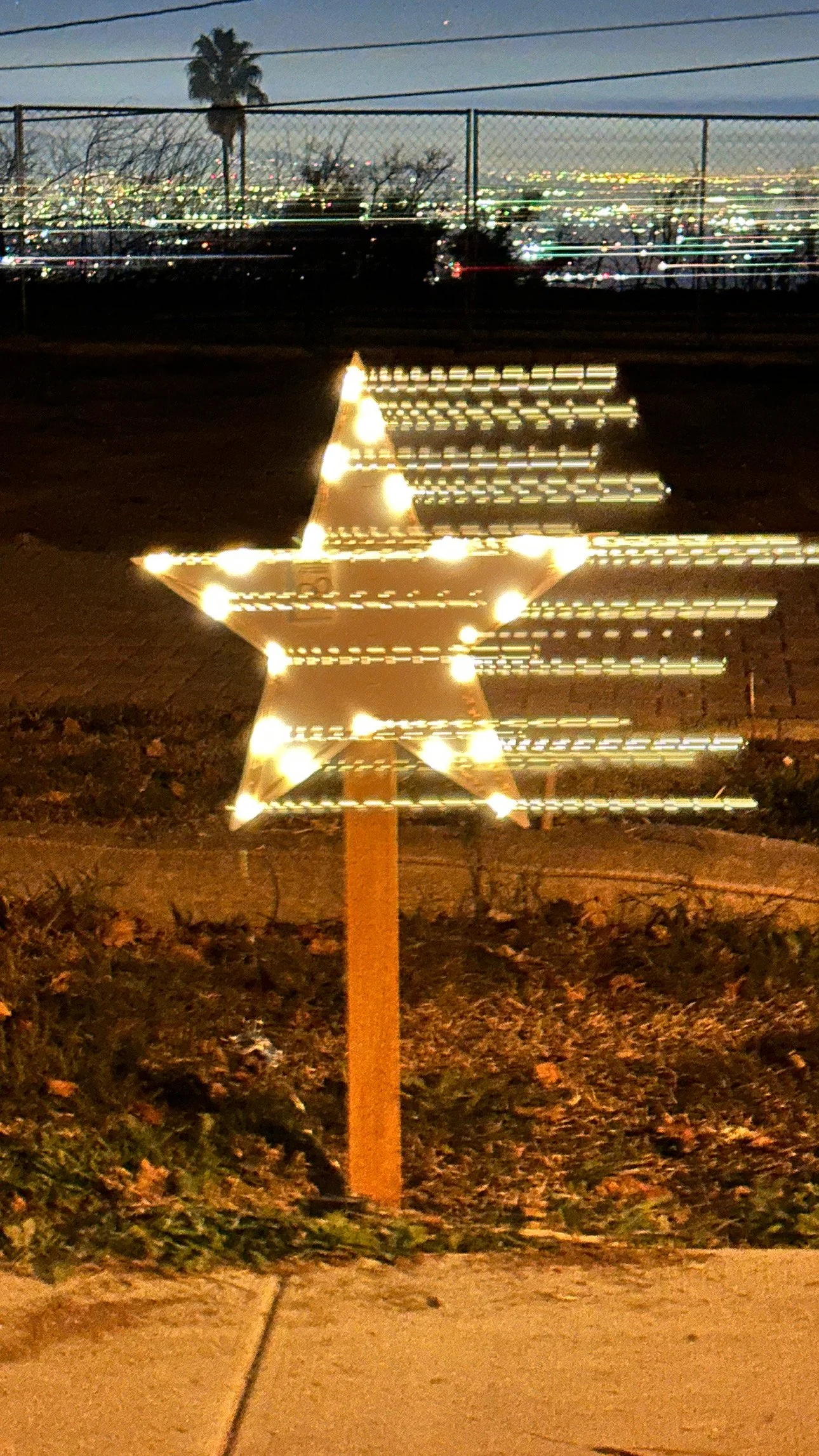
This year I have returned to some areas multiple times to photograph. There is one lot that the homeowner decorated for every holiday. The Werewolf of Altadena also changed attire for holidays, and this past month I saw lots of people making a point to recognize the hope of Christmas by still decorating in some way. In Upper Hastings Ranch the community there has a long tradition of decorating each street as a different theme. I remember going there as a child and my parents driving me around to see the lights. Dozens of homes were lost in Upper Hastings Ranch and the association there has placed a lighted star in front of each house that was lost. One owner set up a Nativity Scene where their home once stood. I have seen lots of signs of hope and resilience throughout the burn zone. This past month I have met people effected by the fire and with each conversation I have been impressed with their resolve.
As we approach the 1st anniversary of the fire on January 7th, I wanted to showcase my recent images from Altadena and Pasadena to show how far people have come and how much further the area has to go to recover.
Christmas Tree Lane - Altadena
Deodar Pine trees line Santa Rosa Avenue in Altadena and for 105 years the residents have hung Christmas lights on the trees. Miraculously none of the trees were lost in the Eaton Fire (the trees have properties that protect them from fires) but unfortunately several homes on the street were lost. At least one of the homes has already started reconstruction. It is a tradition I remember from my Childhood and I am so grateful that it wasn’t lost in the fire.
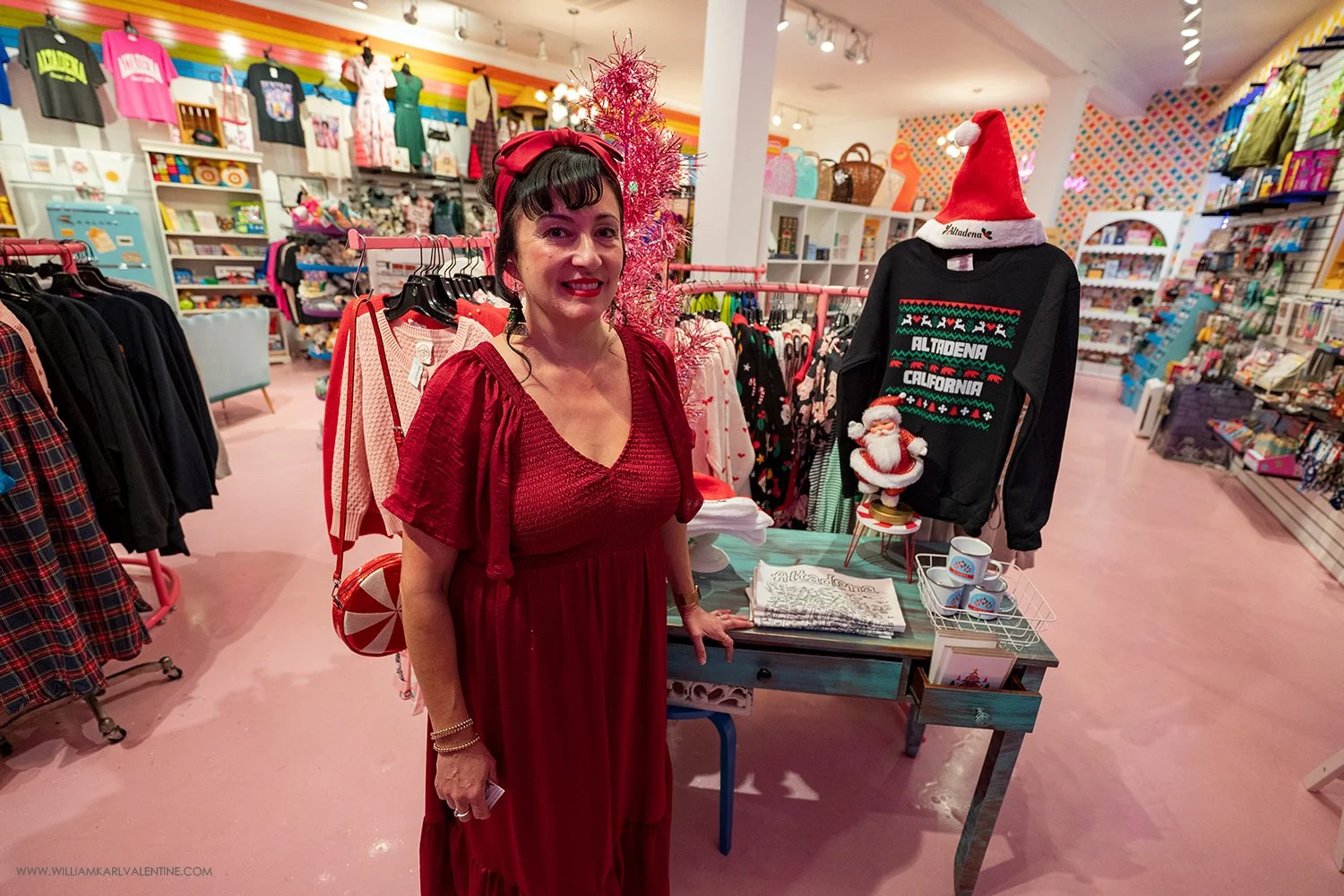
Adrian Molina - Owner of Sidecca
CA DSC 5920 11-30-25 Adrian Molina
Sidecca is a boutique shop in Altadena on Lake Avenue which survived the fire with just smoke damage. They have long carried Altadena themed products and really represents the community well. I was able to get Adriana to pose for a photo shortly after she reopened in November. She had to shut down again a couple weeks ago when heavy rains caused massive leaks in her shop. She is amazingly resilient, and I am sure she will be back because I know her customers will continue to rally around her. www.sidecca.com
A Couple Images from my Phone:
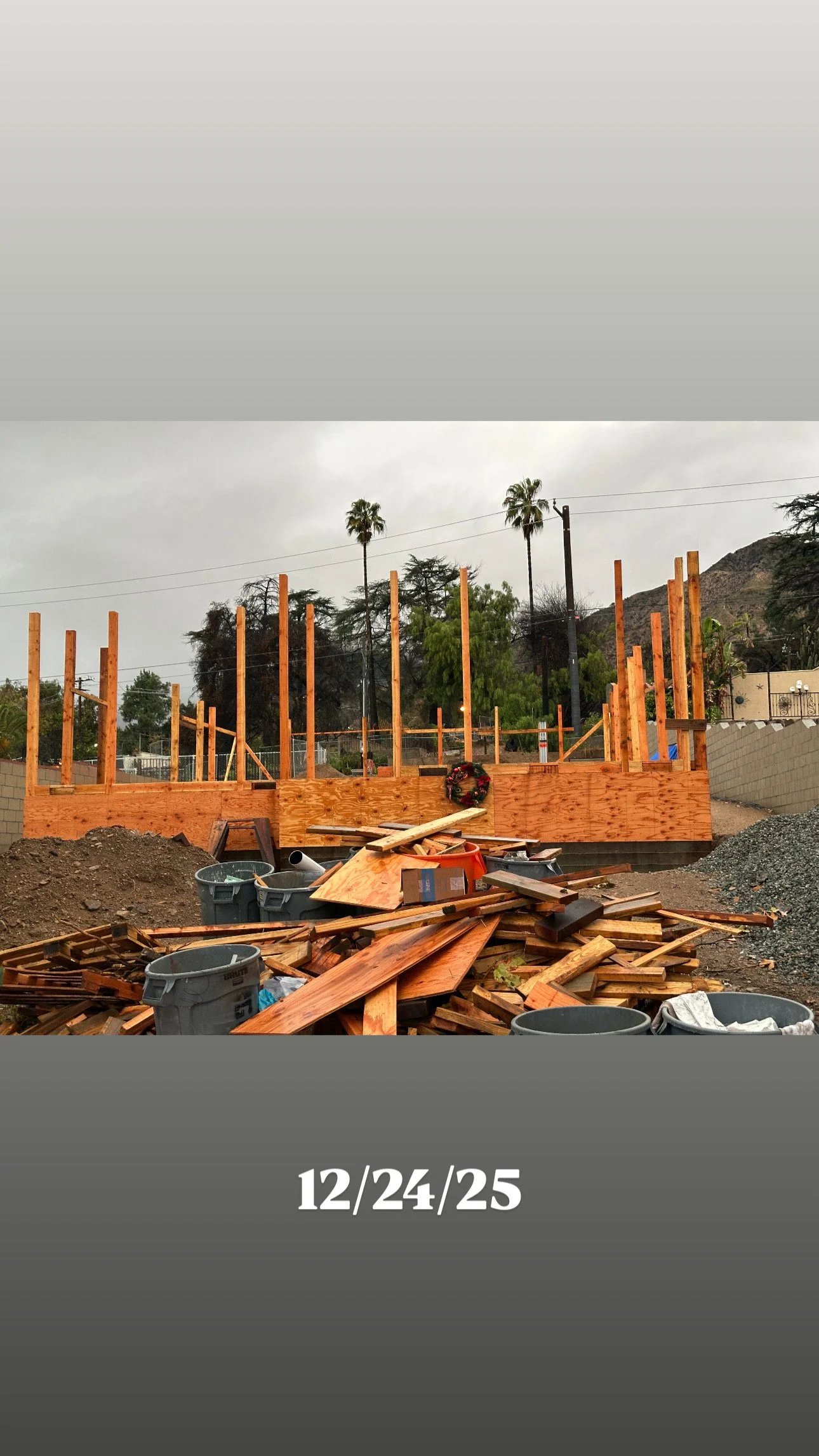
Finally, two images from my phone. One from Christmas Eve when I found a house that is in the process of being framed where the owner had hung a wreath on the plywood. The other is something my phone created when I apparently moved during a long exposure in Hastings Ranch. Happy New Year and may the recovery from the Eaton Fire pick up speed in 2026. Lots of people still hurting up there.
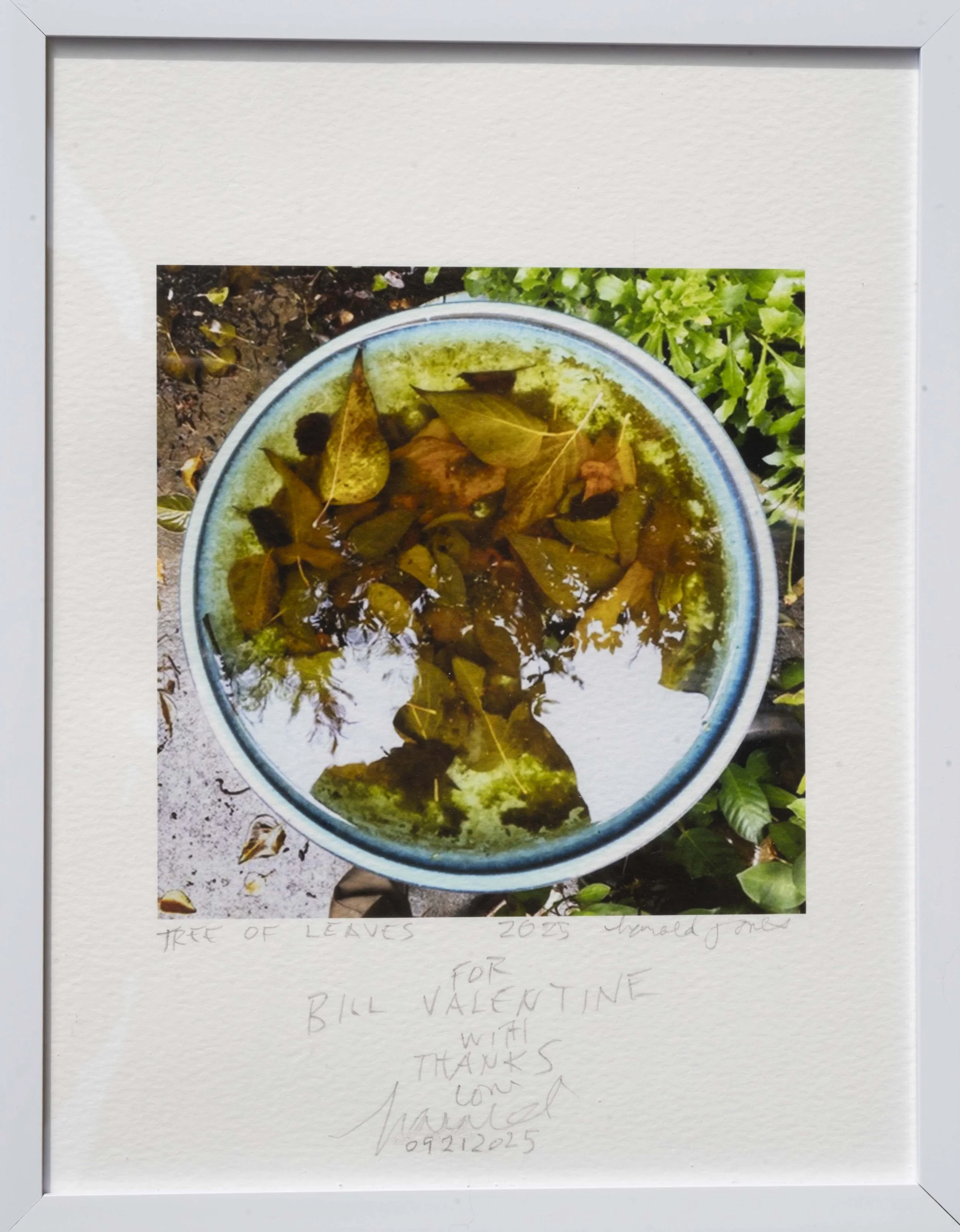
Harold Jones’s print that he sent me this past Fall.
In 2020 I went to the Legacy of LIGHT symposium at the Center for Creative Photography at the University of Arizona, in Tucson. It was held in January and commemorated the 50th Anniversary of the LIGHT gallery in New York City. LIGHT was the first gallery dedicated solely to exhibiting and marketing Photographs. The Gallery had a huge impact on the establishment of the medium as an artform and its impact on the medium was incredible.
Harold Jones was the first Director of the LIGHT gallery. In 1975 Harold was recruited to be the first Director of the Center of Creative Photography. He taught at the University of Arizona while leading CCP for 30 years and has maintained his ties to CCP and the U of A since he retired. Harold is an icon in the history of the medium of Photography as an artist, educator, curator, and director.
I was fortunate to have one of my prints included in the exhibition that was held in conjunction with the symposium. I went out for the exhibition opening as well as for the symposium. The opening was good, and the symposium was incredible. As soon as I saw the exhibition, which was amazing, I knew how important the exhibition and symposium were going to be. I photographed the opening, and when I returned for the symposium, I had already decided to photograph as much as I could to document that event. I authored a number of blog posts about LIGHT, and I also mailed out prints to people who I met or saw at the symposium. I sent a group of prints for people at CCP in a single package but unfortunately it shipped in March 2020 just as the Covid lockdown was starting. The package was misplaced and not found until this past summer. The folks at CCP then distributed the photos to everyone including forwarding the photos for Harold, who moved to Oregon when he retired. I didn’t know all this until I got an email from Harold in September thanking me for the prints and asking for my mailing address.
I sent a reply with my address, and we had a couple emails back and forth. Harold’s emails are fun; he attached a vintage photo of a Canon Camera production line on one then a very appropriate cartoon for me personally on another. Our exchanges were validating, and I especially loved when he thanked me for being a photographer before the age of the cell phone. He absolutely sees the dangers of the cell phone photography culture for the medium of photography.
A couple weeks after our exchanges I received the above print from Harold. I am so honored that a person of Harold’s stature would take the time to thank me in such a way. Without a doubt this is the coolest gift I received this year. As a photographer I get this on every level, especially the process. It is an incredible thank you gift. It is also a great example of what photographers are. You can’t shut off seeing images. This also isn’t an image you can appreciate in an Instagram post. You can’t appreciate the layers of meaning in a 2 second view and swipe.
I know it was a private gift, but I felt the need to showcase it because Harold is an amazing person and was so influential for the medium of Photography on so many levels/
(ASU-103 #29 - 11-13-86) My first solo exhibition, Northlight Gallery - Arizona State University
I responded to a call this year for Alumni to share their stories on Arizona State University’s website. Below is a link to the page they published on me.
CA DSC_7379 11-22-2025 - Jun Li Lujan, First to rebuild and move back into a home lost in the Eaton Fire. Pasadena
The Eaton Fire this year really reminded me to be thankful. First that my mom, who lives in Pasadena, was fine and our family came through it pretty well. But then every day I photographed in burn zone and saw the incredible loss it reminded me to always be grateful for what I have.
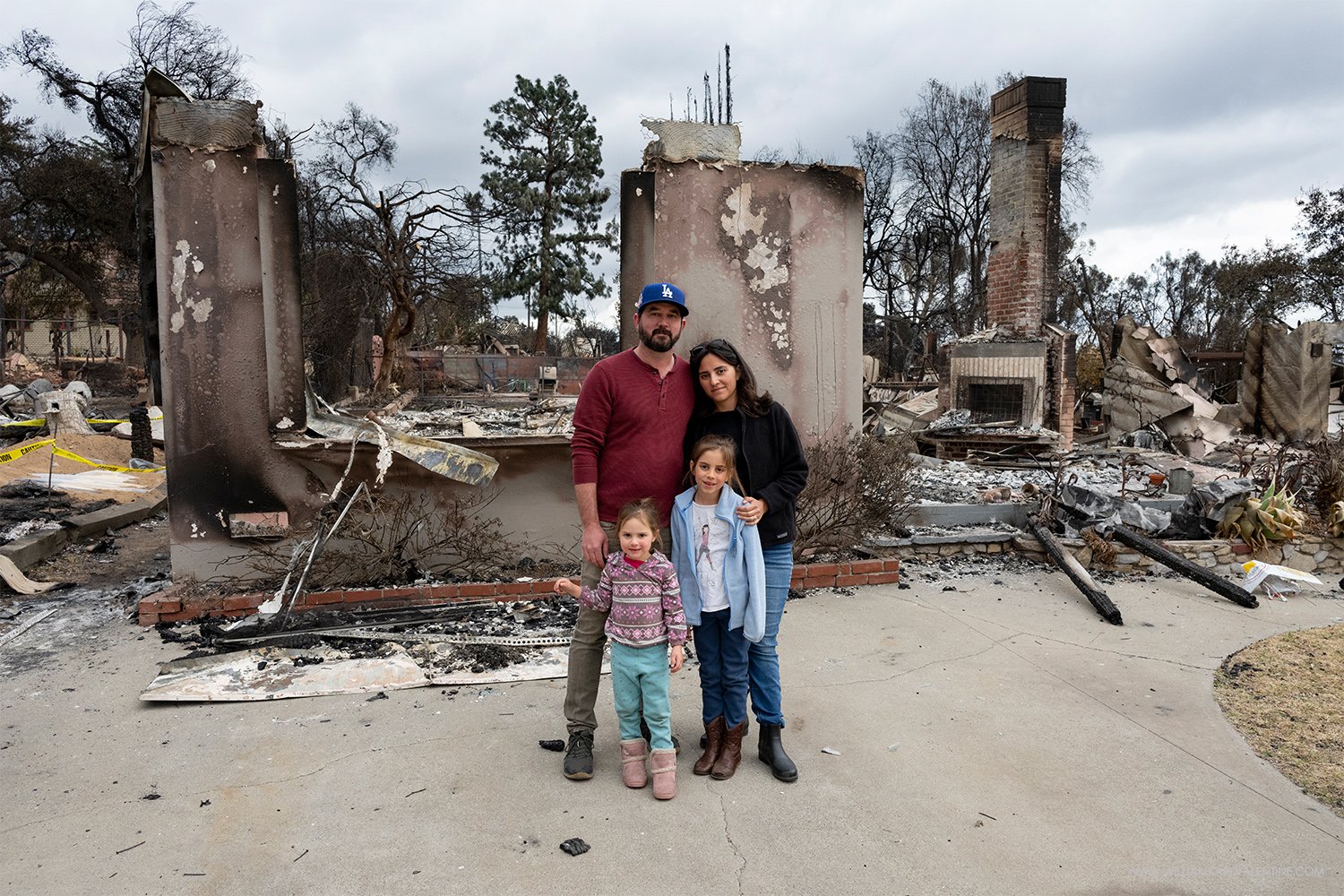
Most the time when I photograph in Altadena it is in solitude since so few homes have been rebuilt. I have been lucky though to have had some incredible conversations with people this year. A lot of people just wanted to tell me how they felt, or what they witnessed, or what special item they lost. A lot of these conversations have been really powerful, especially when they talk about their resolve to rebuild. It is also so random how I have come in contact with some people, like I was guided to that spot.
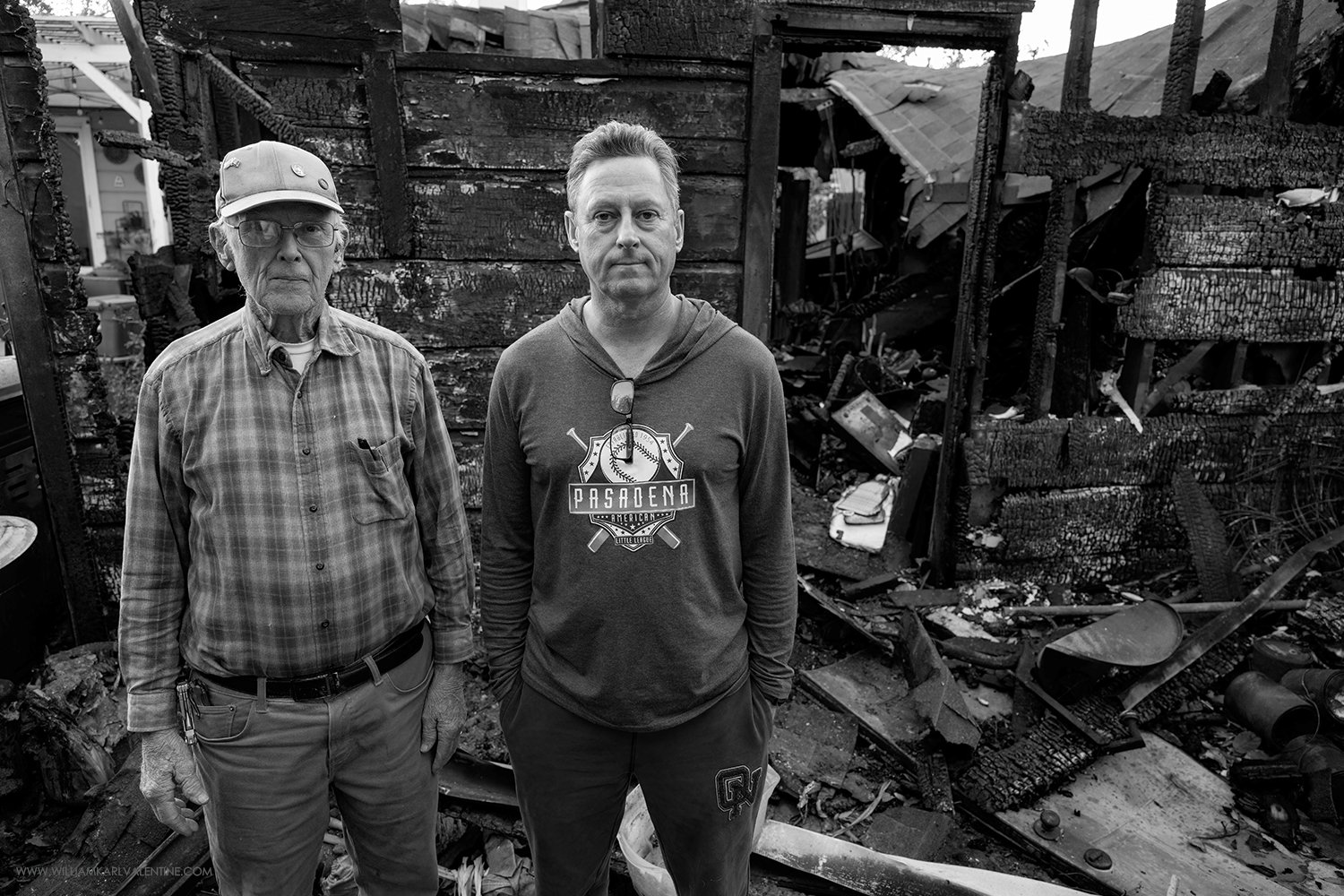
I saw Jun Li Lujan being interviewed on TV last week about being the first resident to be back living in a home that was rebuilt. I figured out what street she lived on and went over to photograph the house. As luck would have, I caught her at home and was able to photograph her. Her house is in Hastings Ranch, in Pasadena. Jun is a dynamic human, and she took the loss like it was a challenge to rebuild. She is a contractor and home designer, and she had built the home that was lost. Her positive outlook was admirable. In May I talked with Rob Moreland for half an hour about his Eaton Fire experiences. I learned a lot about the progression of the fire and timeline from him. He was another person with a positive outlook as was John who I met in September. There were a lot of great neighborhoods with good people who were impacted in the Eaton Fire. A lot of people up there are still hurting.
I believe my Eaton Fire Portfolio was assigned to me. Too many times, I have been at the right place at the right time to get amazing images or meet people. Although this process has been hard on me, I am grateful the task was given to me, and I will continue to do my best to complete the mission.
One final thing, I am also still thankful for the photographic talent I was born with and for everyone who has helped developed me as a photographer since then.
CA DSC 9701 1-14-25 - Del Reay Avenue, Pasadena, California - probably less than ½ a mile from my mom’s home.
CA DSC 7092 10-31-25
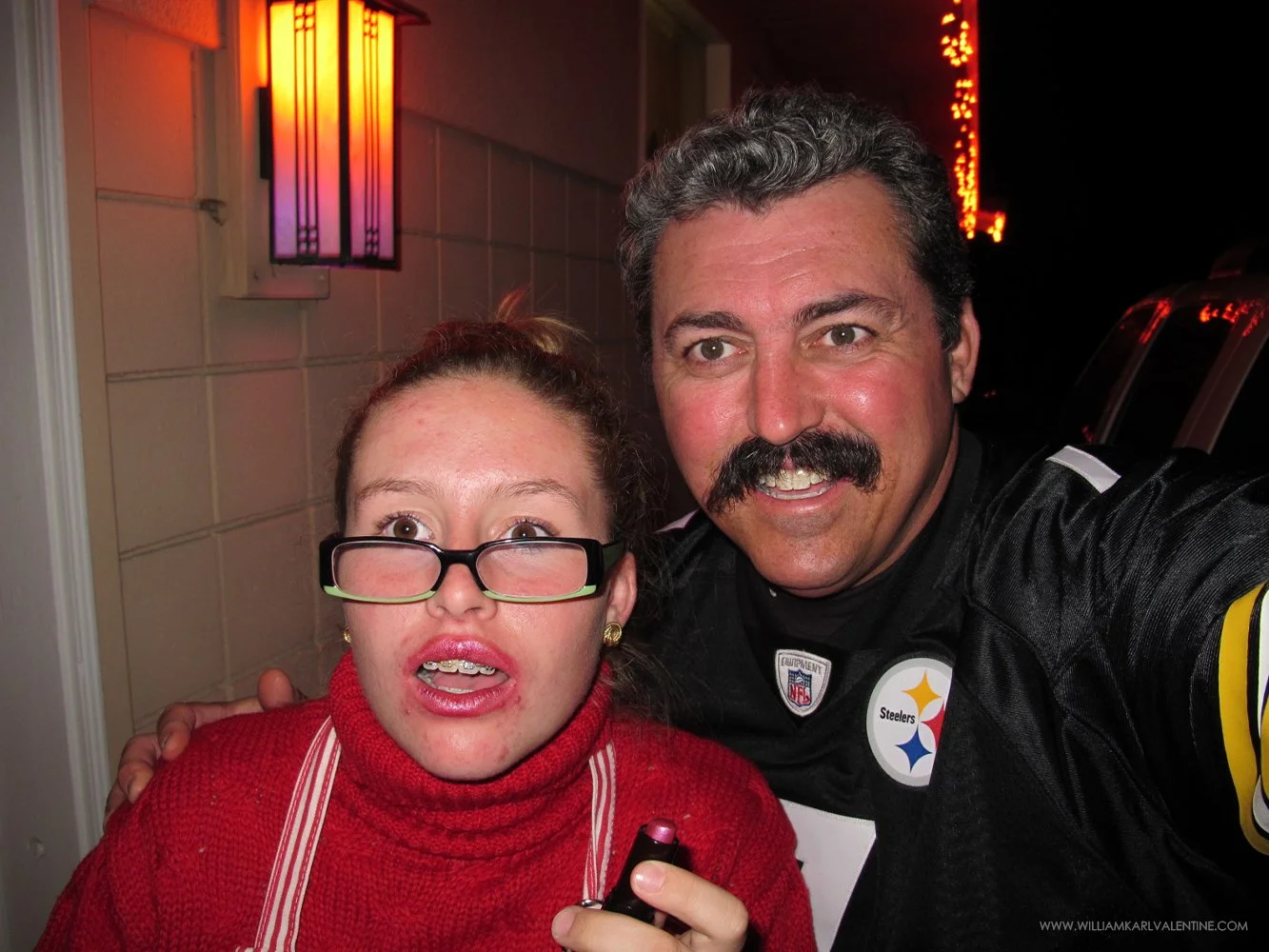
Grandma Bernice - Balboa Island - Halloween 2010
I saw a post on Facebook today by a friend who lost her forty-year-old son a couple months ago after a lifelong debilitating illness. She shared a series of Halloween photographs when her son was still a very mobile child dressed up and obviously having so much fun. She posted more photos through the years and wrote how much they loved Halloween and how hard this first Halloween without him is. She was showing to her friends how thankful she was for all the years with him and also showing her grief in those images. Her son was wheelchair bound for over half his life, but it didn’t stop the adventures they had together. He had a Make-A-Wish trip to visit the President at the White House, and he got out to Kings game here in LA. Everywhere they went my friend photographed the adventure. I assume knowing her son would have a short time on earth she wanted to capture and preserve every moment so she could cherish them forever. She also documented the simple moments too like dogs curled up with him on the bed. Obviously, you can see the grief with the loss, she openly owns it, but in every image, I can see how much she loves her son and that she cherished every moment with him.
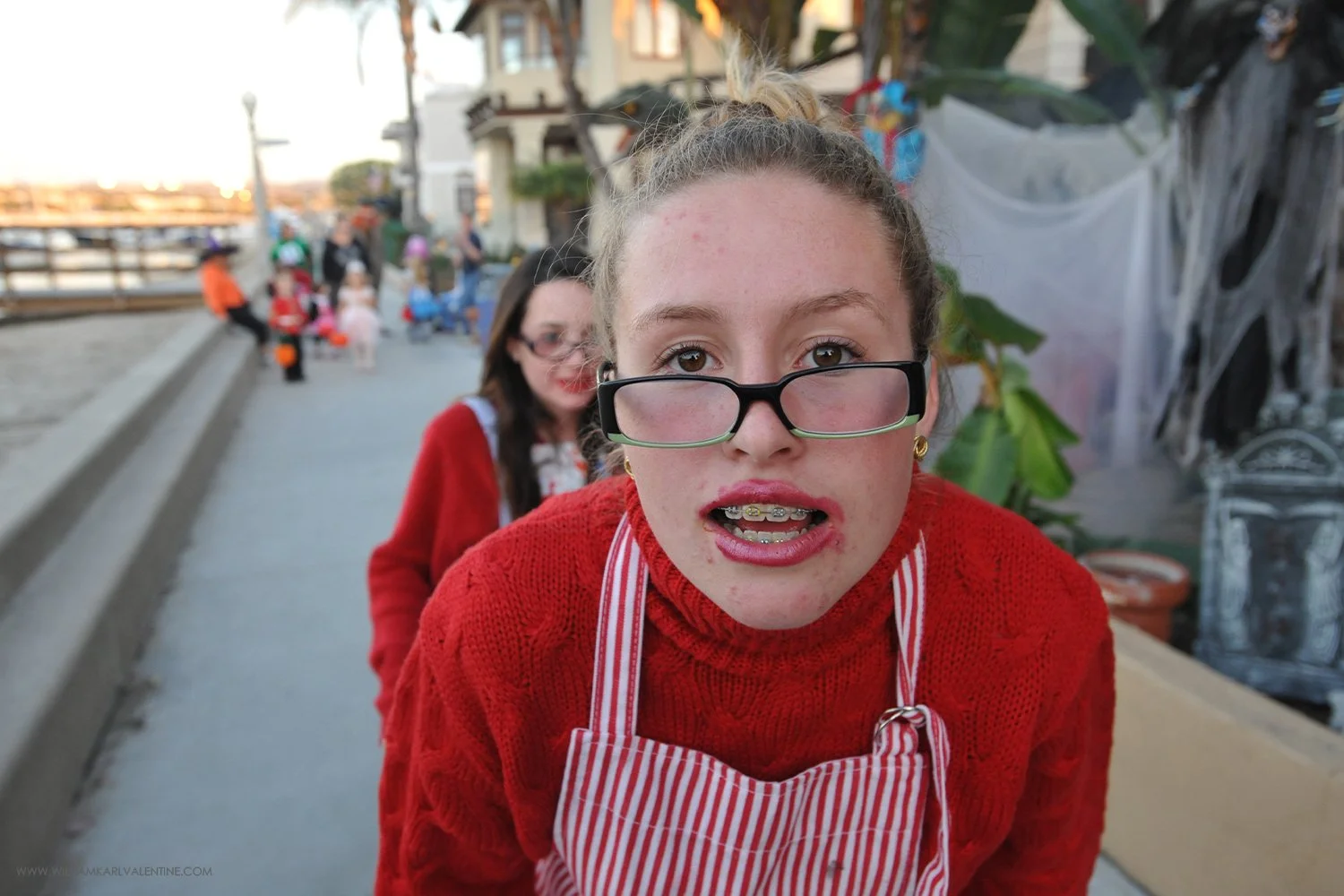
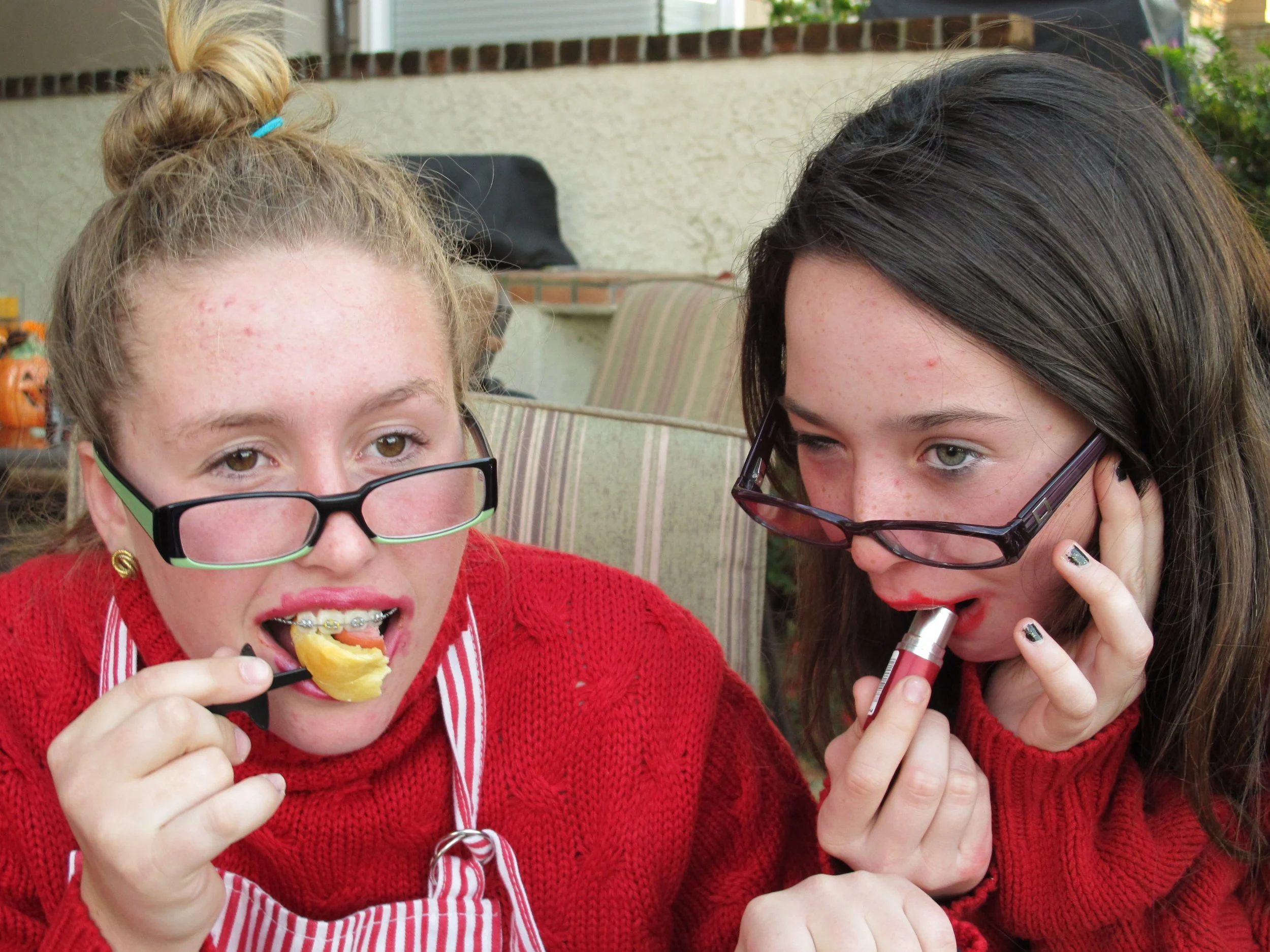
Her post today hit home for me. Her snapshots captured so much about life it motivated me to reflect and eventually write this post. I have always loved Halloween especially when my kids were in the innocent years of Trick or Treating. Probably the pinnacle year was the one where my daughter and her friend couldn’t decide on a costume. Late in the afternoon we came up with the idea they would dress up as old ladies. They grabbed a bunch of her grandmother’s clothing, reading glasses, walkers, and way too much lipstick and my daughter created the character Grandma Bernice. We took them down to Balboa Island, one of the prime candy spots in Newport Beach. It is always packed and fun. As my daughter and her friend went from house to house they stayed in character and as I followed behind them at a distance, I could hear other people talking how great their costumes were. I had a camera of course and I am so happy I documented that night because it was amazing. As a parent you know you only get so many nights like that with your kids before they grow up.
I know I started this post with a sad subject, but I trust everyone sees the message is to cherish life, to live it, and that it is awesome we have the ability to document the images so easily now. BUT still make prints, have a camera other than your phone, and back up everything off site (I have talked to a few people who lost all their photographs in Altadena, and they were not backup someplace). Happy Halloween 2025
CHI DSC 03324 7-18-25 - ©2025 WILLIAM KARL VALENTINE
I have spent the majority of 2025 focused on my Eaton Fire Portfolio. I have said it in other posts how documenting the devastation in Altadena is unlike anything else I have experienced. The process is so different from what I am used to and it’s so methodical. Because everything was static after the fire you might think it was easier but since I am revisiting the area so often, I have a better understanding of the loss and the weight of the grief up there. It might seem static up there, but it is equally intense. So, it was very good to get to Chicago again in July and get back to photographing the street which is such a different process.
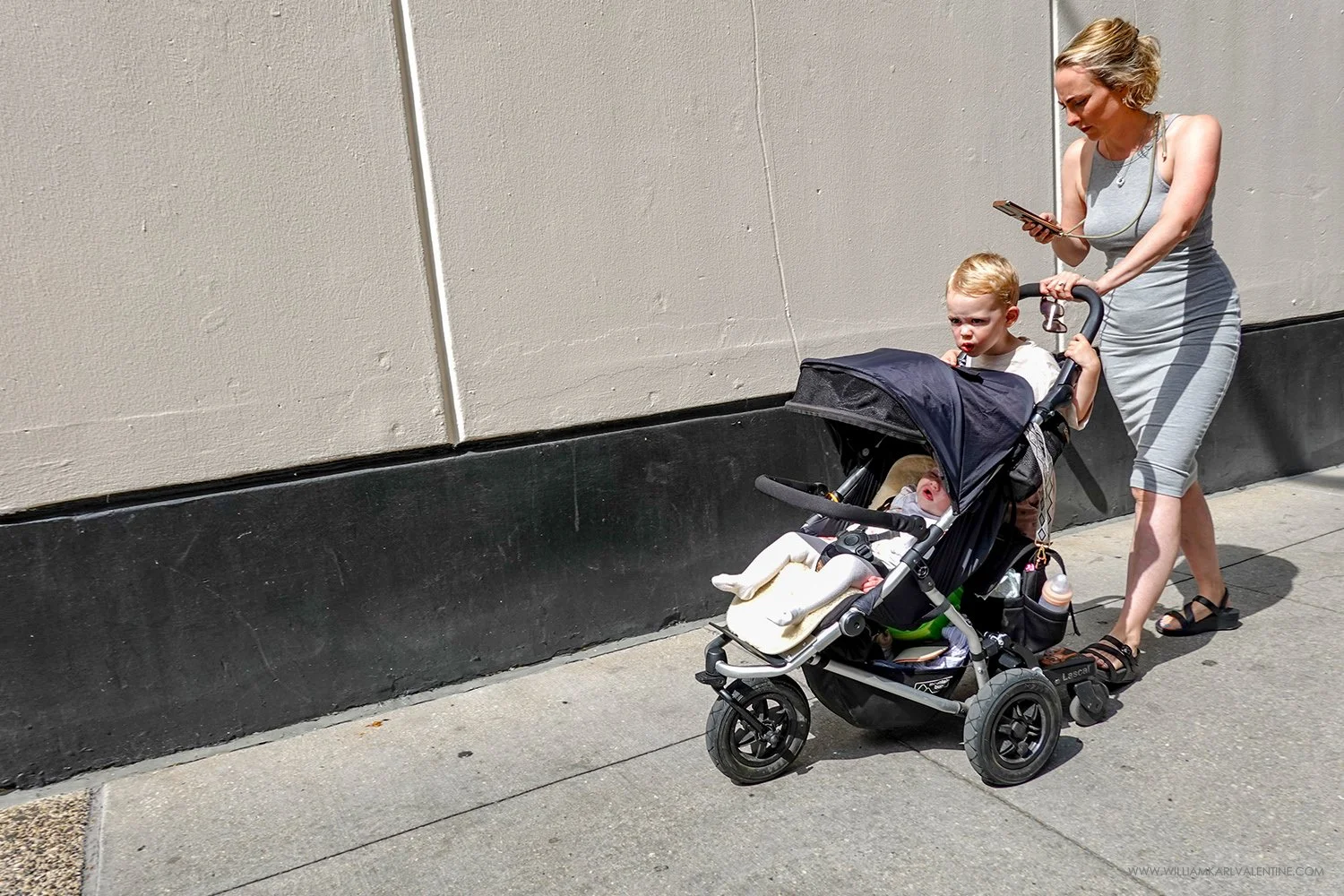
We stayed at The Gwen hotel and the first day I was in Chicago I saw the image above when we left the hotel and were walking across the street to eat at Joe’s. I had not walked more than 50 yards even when I saw this mom with the stroller and the cellphone. What was unique is I saw this image coming for a long way and had plenty of time to think about my framing. Usually, I see an image and react to it on the street, but I had so much time with this image I was actually thankful for it before I made the exposure. It felt like a sign of confirmation I was doing what I was supposed to be doing.
I have photographed in Chicago a lot since my first visit in 1987. The city is fantastic, and I think it has some of the best light in the world to photograph usually. The next four image are examples of that light. Since the city is somewhat spacious not only does light come in more but also allows you to move easier to frame images. I also have an interest in seeing people photograph with cellphones and that is here too.
Every visit I have spent some time on Michigan Avenue photographing. The images seem to document our society well and they are different that New York or San Francisco. There have always been a few people on Michigan Avenue panhandling, some I would see in the same spot year after year. I noticed the influx of South American migrants in March of 2024 near the civic center but not on Michigan Avenue, this year they were also up on Michigan Avenue.
It was awesome to get back to Wrigley Field. My last time there was opening day in 2017, before the Ivy had come back, so it was extra nice to see the Ivy. I took my first nighttime architecture cruise which was perfect in July since the sun was just setting. The architecture in Chicago is the best North America. My daughter went to grad school at Northwestern and stayed in Chicago after she graduated. She now lives in the West Loop so that is helping me explore even more areas of the city.
I have photographed in museums for years, and I actually have a solid portfolio of images which I intend to publish as a book one day. The Art Institute is an amazing space, I always get something there, it is rich with images of people photographing masterpiece paintings with cellphone cameras. The wedding photographer was something unique I had not seen before, but the highlight image was the one of my kids looking at a blank wall like it was an art piece. I don’t know if it was Alyssa or Brent’s idea because I just turned and saw them and knew exactly what they were doing. I am so thankful I got that image, says a lot about their relationship. What made it even better is a few people migrated over there to check out the artwork they were admiring. Art needs to be fun sometimes, so does life.
My daughter’s friend works at Salesforce and this year she took us up to their building’s observation decks and employee lounge. The building is at the “T” of the Chicago River so it allowed me a different view of the city, it was hazier than I would have liked but still a great experience.
A lot of people complain about O’Hare Airport, and I get it, I ended up in the “Penalty Box” for a half hour going in on this trip (stuck on the plane parked waiting for a gate to open) and have done that before, but I still like the airport for some reason. Probably because I have so many great memories of Chicago. I still think the walkway between the terminals is cool and I have my food spots. The open glass design of the terminals also makes photographing in there easier (Homage to Garry Winogrand).
CHI DSC 3588 7-21-25 ©2025 WILLIAM KARL VALENTINE
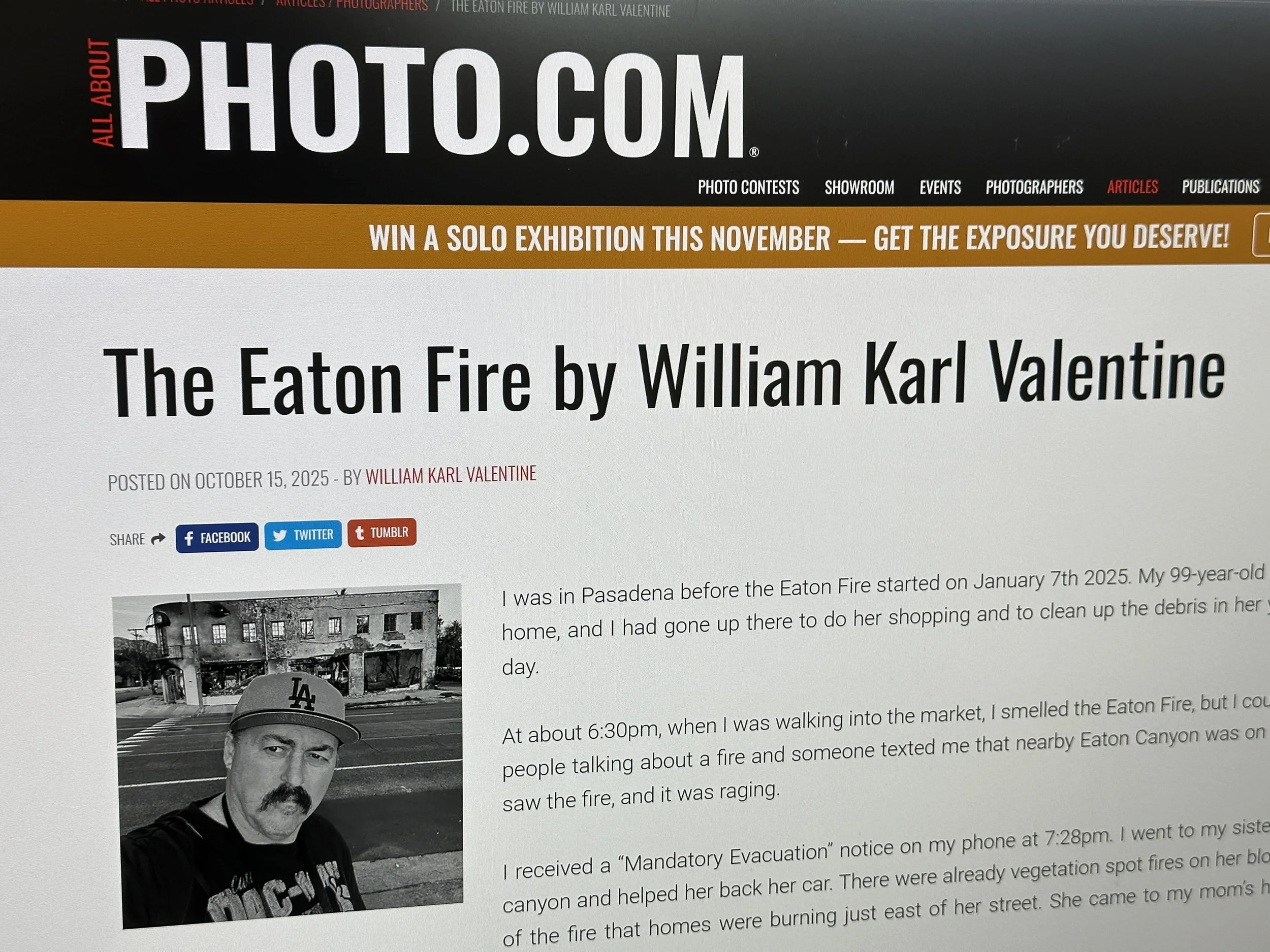
This is just a quick blog post to let everyone know that All About Photo.com just featured me and my Eaton Fire Portfolio on the website. Sandrine Hermand-Grisel was fantastic to work with, and I am really happy with how the article looks.
I know I have said this a lot, but I know I was at the right place at the right time for a reason, so I am committed to telling the story of the Eaton Fire and the impact it had on so many people. I am always thankful when I can exhibit work in a gallery or get my images showcased online, especially on an outstanding photography site like All About Photo.com.
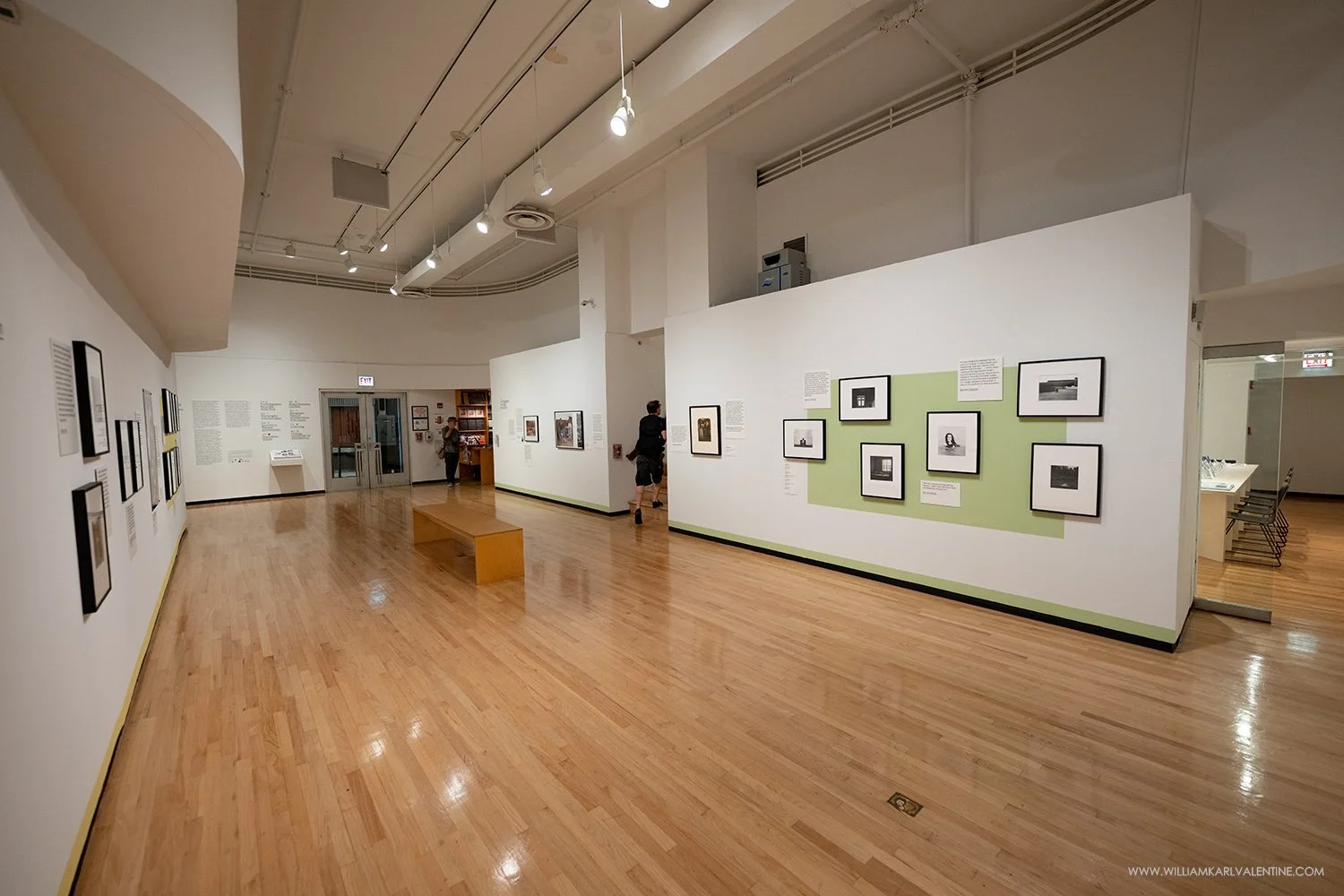
Museum of Photographic Art - Chicago - July 21, 2025
The Museum of Contemporary Photography in Chicago is an amazing space. Architecturally its beautiful and the way you wind through the space to see an exhibition is cool. It allows curators to be creative with the layout and content they exhibit. I have seen a few exhibitions there and I have never been disappointed. I wrote a blogpost about MoCP last year and you can compare how versatile the by checking out that blog post from 2024.
MoCP describes themselves as this on their website:
Museum of Contemporary Photography at Columbia College Chicago (MoCP) is a premier college art museum dedicated to photography. As an accredited art museum with the American Alliance of Museums, MoCP is a renowned photography specific institution whose mission is to generate ideas and provoke dialogue through groundbreaking exhibitions, innovative programs, and experiential events to cultivate a deeper understanding of the artistic, cultural, and political roles of photography in our world today.
Founded in 1976 by Columbia College Chicago as the successor to the Chicago Center for Contemporary Photography, the Museum of Contemporary Photography began collecting in 1979 and has since grown its collection to include nearly 18,000 artworks by 2,000 artists.
I was only in Chicago for a long weekend this year and had planned on finally getting out to Filter Photo to see that space and of course to get back to the Art Institute like I always do (I keep a membership there even though I live in Southern California). I wanted to see if there was any other current exhibition I should get to, so I reached out Greg Harris if there were any must see exhibitions in Chicago at that time. Greg is the Curator of Photography at the High Museum in Atlanta, but he studied and worked in Chicago before taking a position at the High. Greg didn’t hesitate with his reply and said the current exhibition at MoCP was very good, and he was absolutely correct.
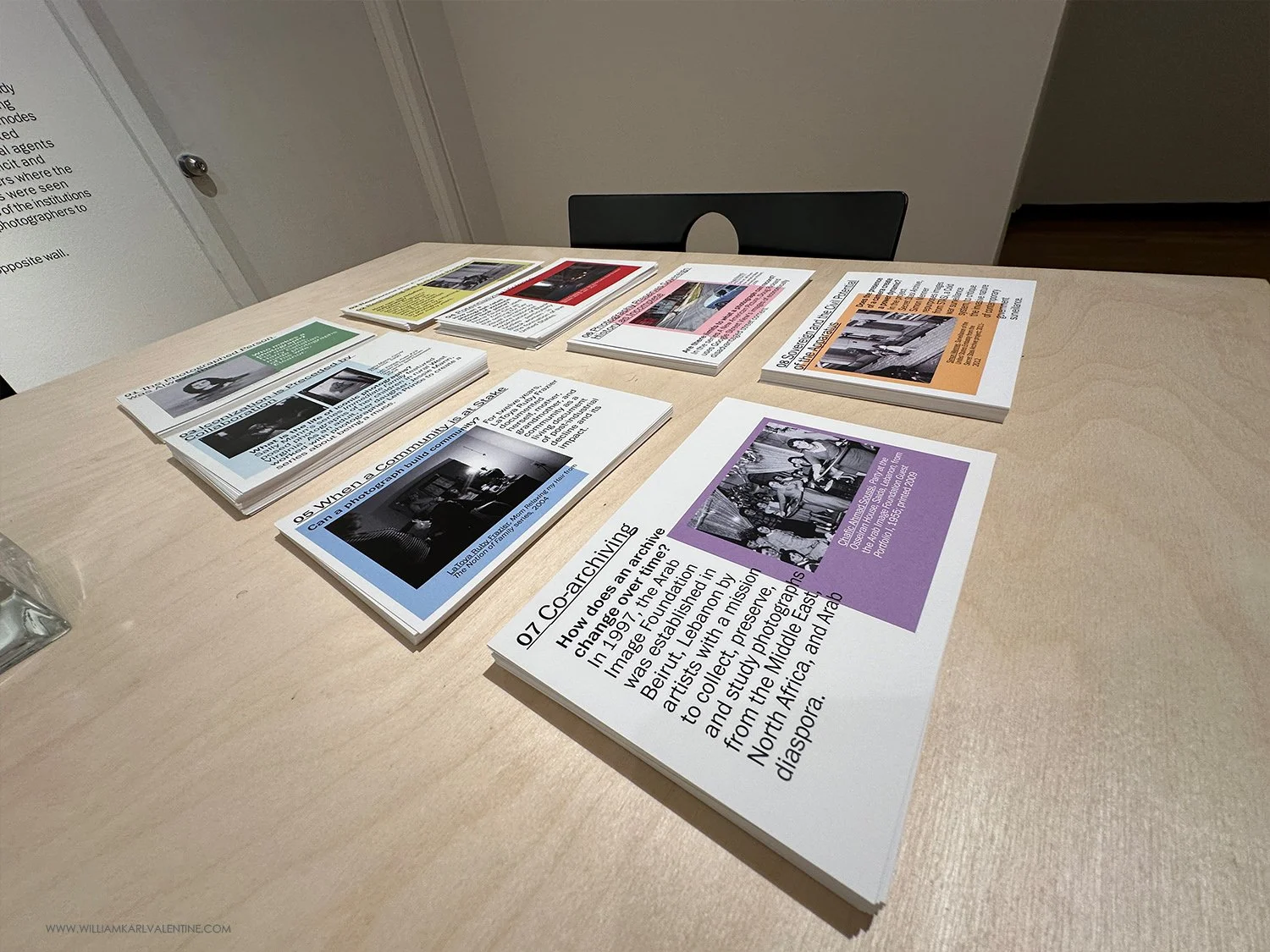
The exhibition was Collaboration: A Potential History of Photography in Dialogue with the MoCP Collection. It ran from May 30th through August 16th, 2025. The exhibition was guest curated by Wendy Ewald, Susan Meiselas, and Laura Wexler, along with Kristin Taylor, MoCP Curator of Academic Programs and Collections. A catalogue also accompanied the exhibition.
The exhibition really did encompass a lot of the medium’s history, and I loved how they designed the exhibition by utilizing color on the walls to highlight the grouping of images. I have never seen this approach before, nor have I ever thought about it, but it worked so well. It was especially nice when you got the interactive part of the exhibition, and it really helped tie the viewer into the exhibition. Any history project needs words to put items in context and good that they did that on the walls. There was a lot of text on the walls, but I don’t know how they could have cut that back and still told the story. Usually, the catalogue has most the information, but they also found a way to get those words on the walls. The curation was thoughtful and inclusive, and it speaks well to MoCP’s amazing collection.
I am not going to attempt to talk about everything in the exhibition because there was so much content. I encourage you to look at MoCP’s Instagram account for more details on the exhibition as well as my gallery below that documented my visit. Whenever you visit Chicago, I would suggest checking to see what MoCP has up in their gallery, it is usually worth the time to get to down there.
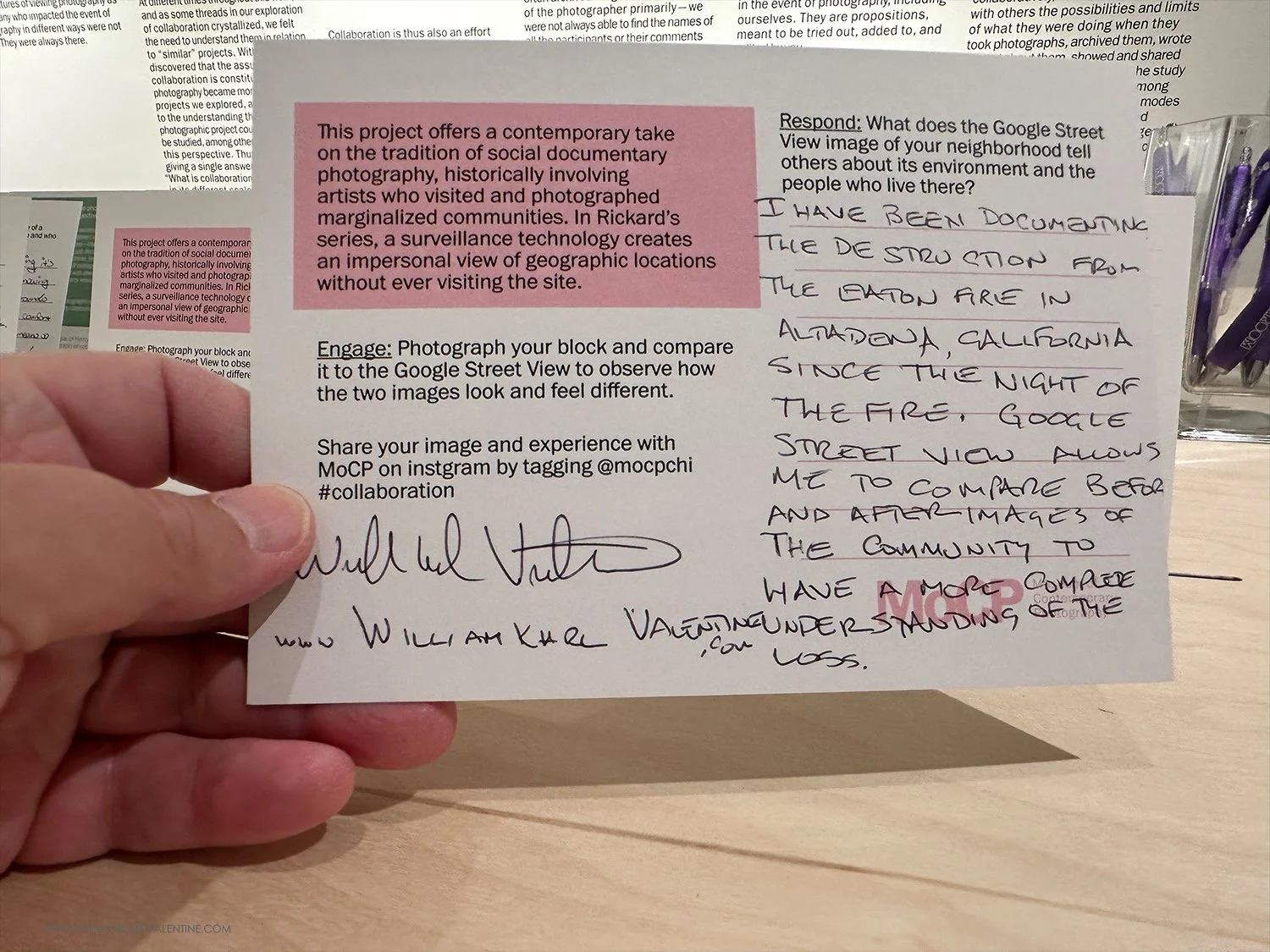
I love interactive exhibitions, and this part was perfect for what I have been photographing this year. Outstanding Idea!
CA DSC1442 05-06-2025 - Eaton Fire Burn Zone - Altadena, CA
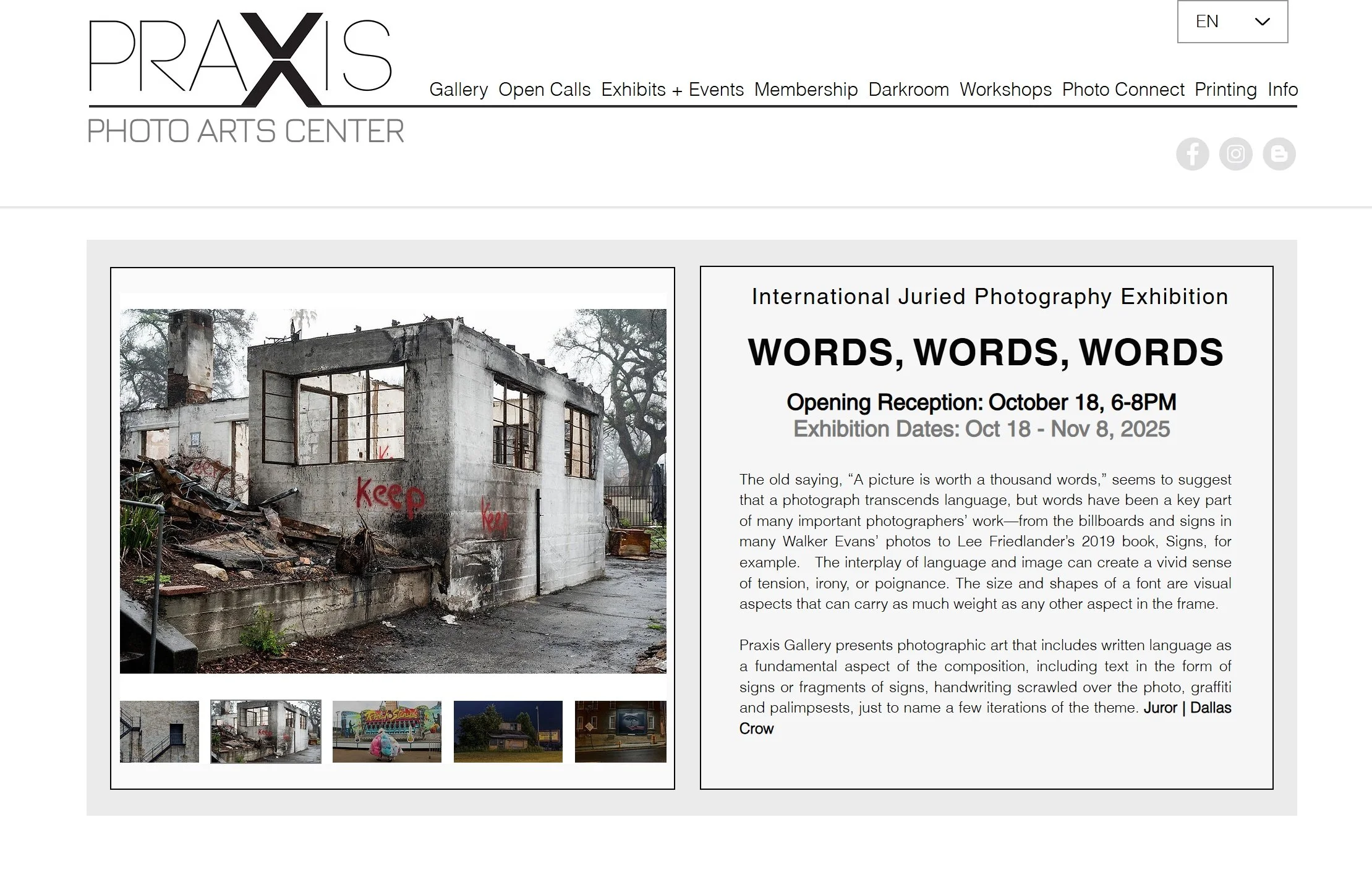
I am pleased to announce that another one of my Eaton Fire portfolio images was selected for Praxis Gallery’s International Photography Exhibition “Words, Words, Words” which opens on October 18th in Minneapolis, Minnesota and runs through November 8th, 2025. This is the time I have exhibited work in Minnesota and the sixth time an image from my Eaton Fire portfolio has been featured in an exhibition.
The old saying, “A picture is worth a thousand words,” seems to suggest that a photograph transcends language, but words have been a key part of many important photographers’ work—from the billboards and signs in many Walker Evans’ photos to Lee Friedlander’s 2019 book, Signs, for example. The interplay of language and image can create a vivid sense of tension, irony, or poignance. The size and shapes of a font are visual aspects that can carry as much weight as any other aspect in the frame.
Praxis Gallery presents photographic art that includes written language as a fundamental aspect of the composition, including text in the form of signs or fragments of signs, handwriting scrawled over the photo, graffiti and palimpsests, just to name a few iterations of the theme. Juror | Dallas Crow
PRAXIS GALLERY | PHOTO ARTS CENTER
Praxis Gallery and Photographic Arts Center (PPAC) is a community based, non-profit, artist-led organization in Minneapolis that aims to support the development of new and emerging artists through exhibition and education. Our mission is to bring diverse perspectives into focus through lens-based art, creating photographic exhibitions that engage, challenge, inspire, and surprise the public.
As the only non-profit dedicated photographic arts center in Minnesota, PPAC has produced group exhibitions featuring local, regional and international artists. PPAC has presented four local solo exhibitions yearly, and many local multi-artist pop-up exhibits since 2017 - bridging artists and audiences by creating platforms for discovery and discourse through visual art.
Ross Anderson | Program Director
Jonathan Pavlica | Gallery Director
Dan Fenner | Analog Director
Elizabeth Flinsch | Consulting Director of Development
Main Entrance: The main entrance is located in the parking lot at 2601 27TH Ave. S.
Praxis is located at the corner of 26TH S. E & 27TH Ave S, Minneapolis, MN 55406, USA
Please click the Google maps link below for directions to Praxis from your location.
Directions to Praxis: Google Maps
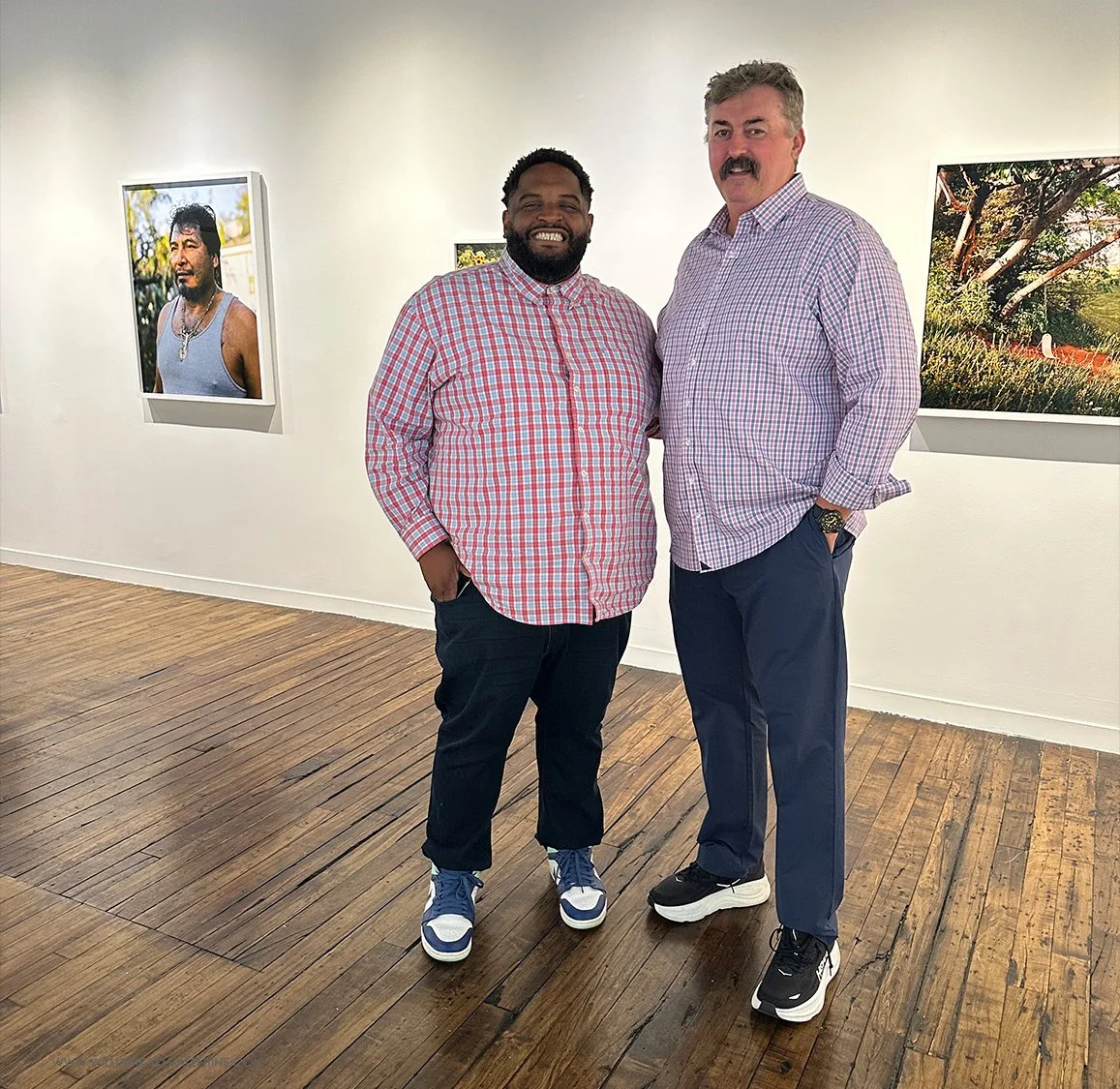
Kenn Cook Jr. - Filter Photo Fellow & William Karl Valentine
On July 18th of this year, I was finally able to visit the Filter Photo gallery space in Chicago. I have submitted work to a call there before, but this was the first time I was in Chicago and able to get out there.
This gallery space opened in 2015 and is really nice. It is a hip building with other art spaces, the only downside is that it is West Town which is a little way from downtown.
When I got there, I met Kenn Cook Jr who is a Fellow at Filter and who was holding down the reception desk. Kenn was a great host showing me around the space and explaining their mission. We also talked some about our own work and cool making a Chicago photographer friend. I love the fact that Kenn is focused on documenting his community, that is so important.
Was the solo exhibition up when I visited. José Ibarra Rizo (American, born Mexico) is a lens-based artist living and working in Atlanta, GA. His work examines cultural memory, identity, and the migrant experience in the American South. José’s work is part of the permanent collections of the High Museum of Art, the Virginia Museum of Fine Art, and the Michael C. Carlos Museum. Rizo’s prints are wonderful and what he is documenting is so important, especially at this time. I also like the framed work without matting, it fits the space and the portfolio. What I didn’t get was the design of the exhibition, it seemed sparse on the walls. I don’t know if that was by design or if Rizo only supplied a small number of prints. Obviously you don’t want to overcrowd a space, and it is good to let images stand out, I wanted to see more of Rizo’s photographs and almost felt cheated.
FILTER PHOTO - Information from their website:
Filter Photo supports, elevates, and connects photo-based artists through social and educational programming. Through year-round initiatives, Filter provides a platform for artists, curators, publishers, and other arts professionals to collaborate and connect with opportunities that support their artistic and professional growth.
Our mission is to foster meaningful dialogue around contemporary photography and to cultivate a vibrant, inclusive community dedicated to advancing the medium while positioning Chicago as a leading hub for contemporary photo-based practice and critical discourse.
Filter Photo was founded by artists to meet the needs of emerging and mid-career photo-based artists working in the Midwest, with a particular focus on Chicago as a hub of artistic practice. Filter Photo aims to be a thought-leader in the field of photography—demonstrating the ever-evolving importance of the medium in contemporary art practice and discourse. Our organization aspires to support sustainable career pathways into the art world, while presenting exhibitions and educational programming that represents a strong creative vision. We work towards these goals through two primary programmatic outputs: our gallery and project space, Filter Space; and our annual Filter Photo Festival.
Since 2009, Filter Photo has been the driving force behind the annual Filter Photo Festival. The Festival hosts portfolio reviews, exhibitions, workshops, lectures, and other career-building initiatives to support photo-based artists nationwide. The portfolio review program has been instrumental in connecting artists with curators, galleries, editors, and arts professionals who can provide artistic feedback, professional guidance, and career opportunities.
In 2015, Filter Photo opened Filter Space, a gallery and project space located in Chicago’s West Town neighborhood. Through this space, Filter hosts a year-round program of exhibitions, critique groups, workshops, and an emerging arts administration fellowship, all aimed at fostering support for photo-based artists in Chicago and beyond.
Filter Photo Festival is a celebration of photography that takes place every September in Chicago. The 2025 Festival will be held at the Columbia College Chicago Student Center, centrally located downtown in proximity to museums, galleries, and other cultural institutions. Renowned photographer Dawoud Bey is speaking on the opening night and many top photographers, curators, and educators will be taking part in the weekend lectures and portfolio reviews. I have not attended this festival yet, but I have heard it is an outstanding experience.
Programming includes portfolio reviews, workshops, lectures, and artist talks. Additionally, exhibitions will be hosted at Filter Space gallery
LOCATION
Filter Space is located in Chicago’s West Town neighborhood, at 1821 West Hubbard Street, Suite 207.
I am extremely happy to announce that a portfolio of my Eaton Fire photographs has been selected as a Top 200 Finalist in Photolucida’s Critical Mass 2025 competition. This is the fourth time I have been a Top 200 Finalist (previous years: 2023, 2016, & 2014).
Three of the ten images I submitted have already been exhibited this year in the following cities: New York City, Atlanta, Houston, and Middlebury, Vermont. I am thankful that so many people have recognized the value of this portfolio and have showcased my images. I also want to thank Polly Gaillard, Photolucida’s program director, who oversees Critical Mass for all the work she puts in making this competition happen every year.
My Submitted images are below.
How Photolucidia describes Critical Mass:
Critical Mass is an annual online program designed to foster meaningful connections within the photography world. Open to photographers at all levels and from anywhere across the globe, participants submit a portfolio of 10 images. After an initial pre-screening process, 200 finalists are selected to have their work reviewed and voted on by more than 150 distinguished international photography professionals. From this group, the TOP 50 are chosen, and a range of prestigious awards is presented.
Critical Mass offers an unparalleled opportunity to get your work in front of influential museum curators, gallerists, publishers, editors, educators, artists, and media producers.
Exhibited Vermont May 2025
Exhibited Atlanta August 2025
Exhibited Houston June 2025
Exhibited New York City July 2025
On September 29th the Final Photolucida Final 50 was announced. I did not make it but I am happy to see that Aline Smithson’s work was selected, it is solid.
Me, Gizmo, and Ave - Santa Monica
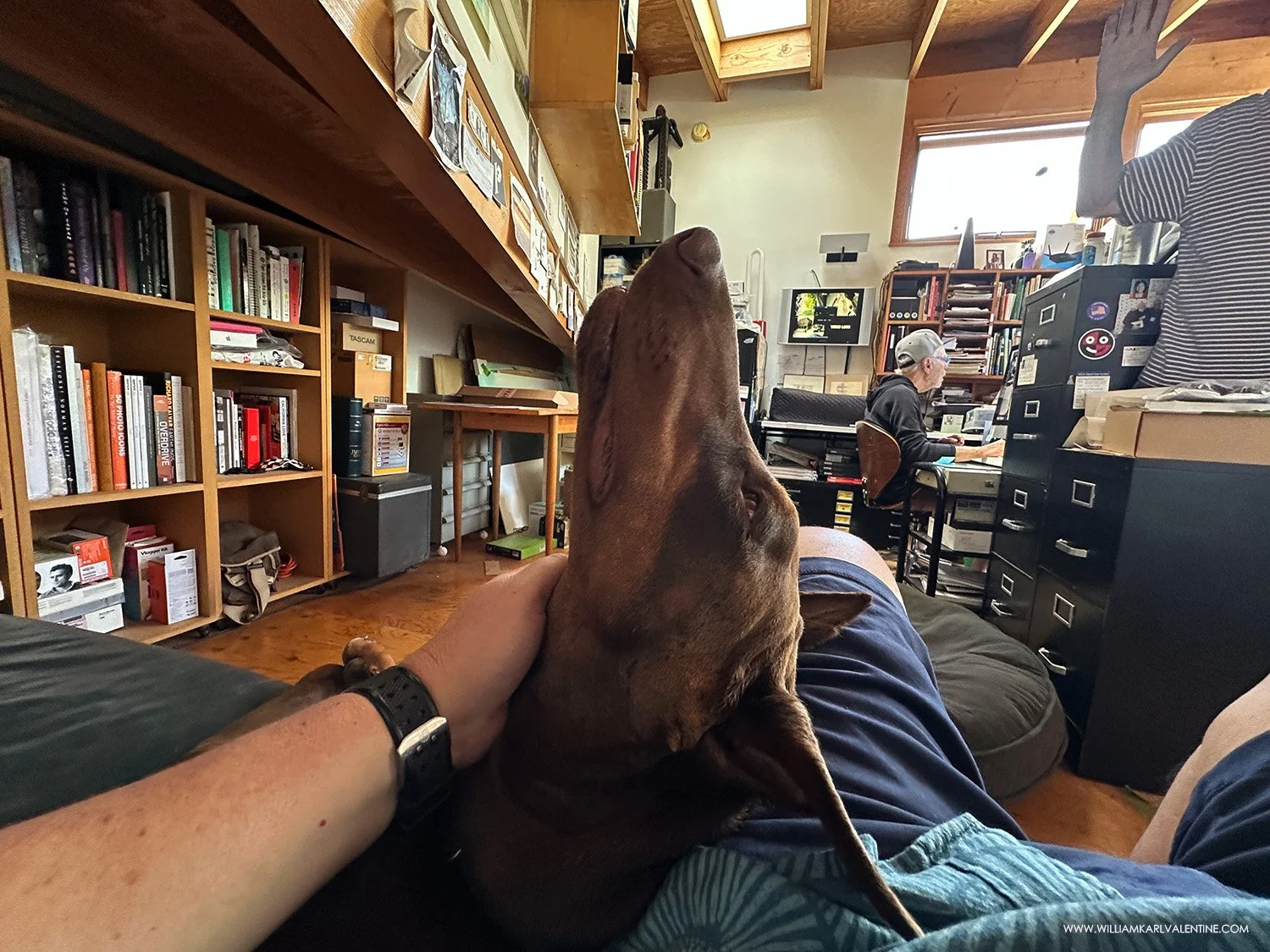
On August 16th I drove up to Santa Monica to meet up with Alex Turner who was giving a talk at Marshall Gallery about his current exhibition there. I had called one of my favorite LA photographer friends, Ave Pildas , on the way up to see if he wanted to join me. Ave, who lives in Santa Monica, couldn’t make the lecture, but said he would be home later if I could stop by after, which I did.
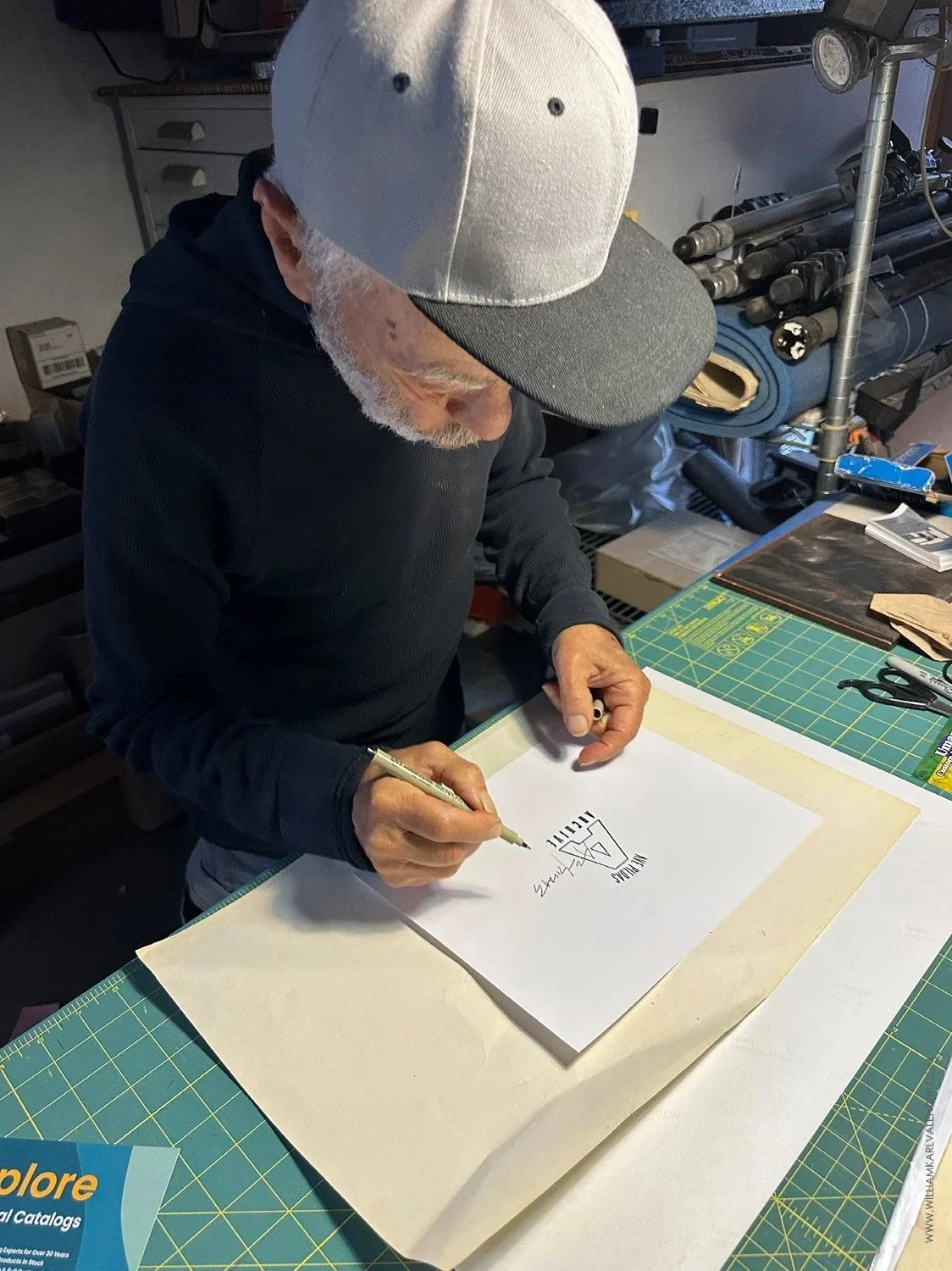
We were catching up in his studio space and during the conversation I told Ave that I really wanted to add one of his prints to my collection and I specifically asked about his photograph of three Long Beach PD color guard officers. He was happy that I wanted a print and agreed to make this print below for me.
I first learned about Ave’s work seven years during a visit to Arcana Books. I saw his self-published book Street / People on a feature rack, and I immediately related to his photographs. I especially liked the image above of the color guard officers. I bought the books and finally met Ave when Arcana held a book signing for his book Star Struck which was published by Deadbeat Club. Since then, we have become good friends, so it became a priority for me to get at least one of his prints.
While Ave was getting ready to make my print, I got to go through his working prints for his Liemert Park Portfolio. It was exciting getting to see so many different images from this portfolio because I remember him telling be in October of 2023 he was thinking about starting to photograph there. At the time we were together photographing in the Eagle Rock area, and we were talking about other areas of Los Angeles that would be good to document. He checked it out the following week and he has been photographing there regularly since and has really come to know that community. The work is solid and important because it documents an important neighborhood in Los Angeles’s history. I hope the right people discover this portfolio and find it several good homes; it has value.
Ave Pildas’s Leimert Park Portfolio
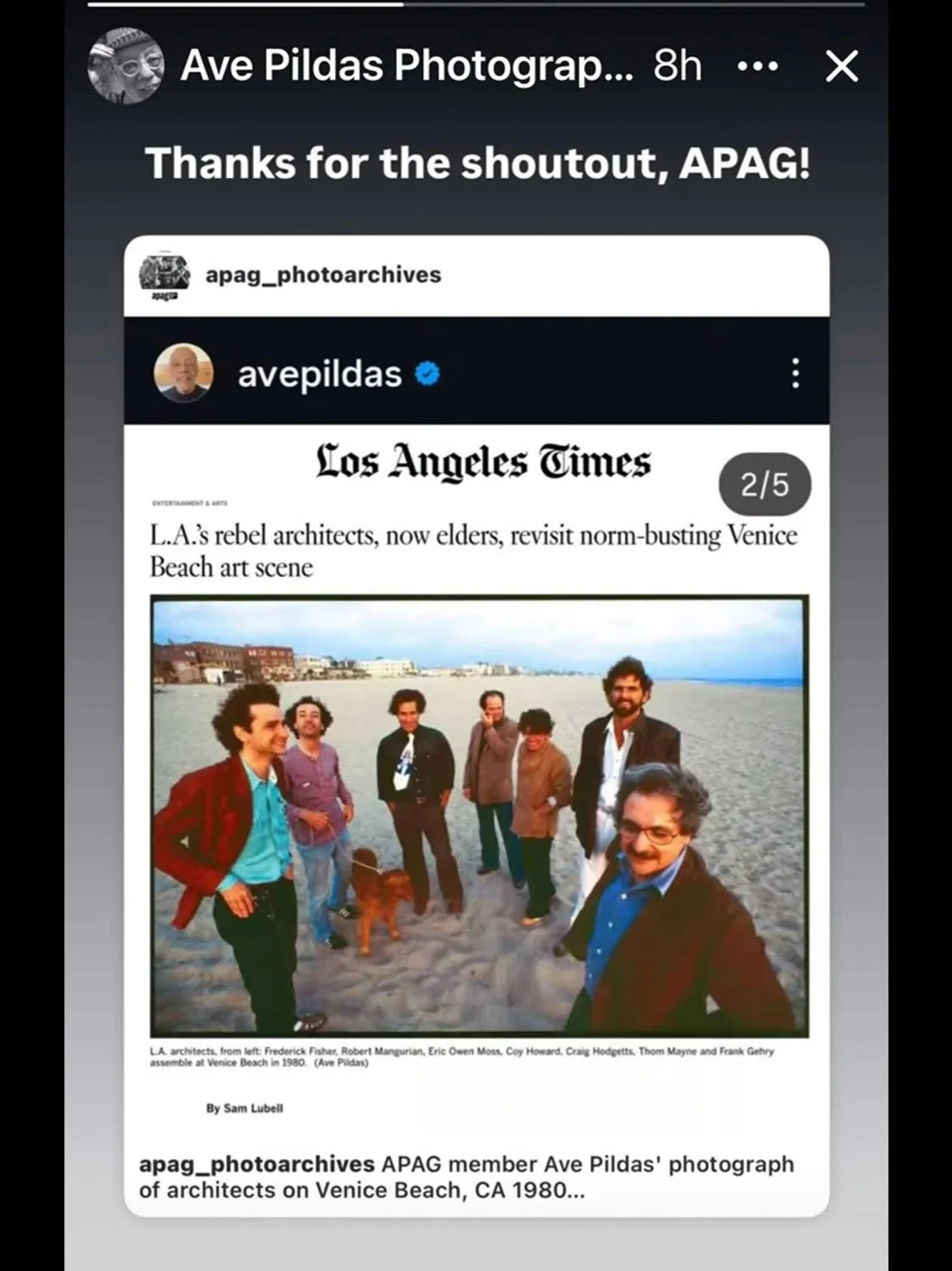
Ave has been documenting Los Angeles for a long time, so it was of little surprise when he proudly told me that the Los Angeles Times was publishing a feature Sunday article the next day built on his 1980 Venice Beach photoshoot of seven of LA’s prominent young architects (Frederick Fisher, Robert Mangurian, Eric Owen Moss, Coy Howard, Craig Hodgetts, Thom Mayne, and Frank Gehry).
Here is a link to the article and photographs of it are below. I am so jealous of how much energy Ave has; he is really focused now on preserving his archive as well as still getting out there to keep photographing.
Finally just a few more photos from Gizmo’s photoshoot that we got in while Ave was printing my photograph.
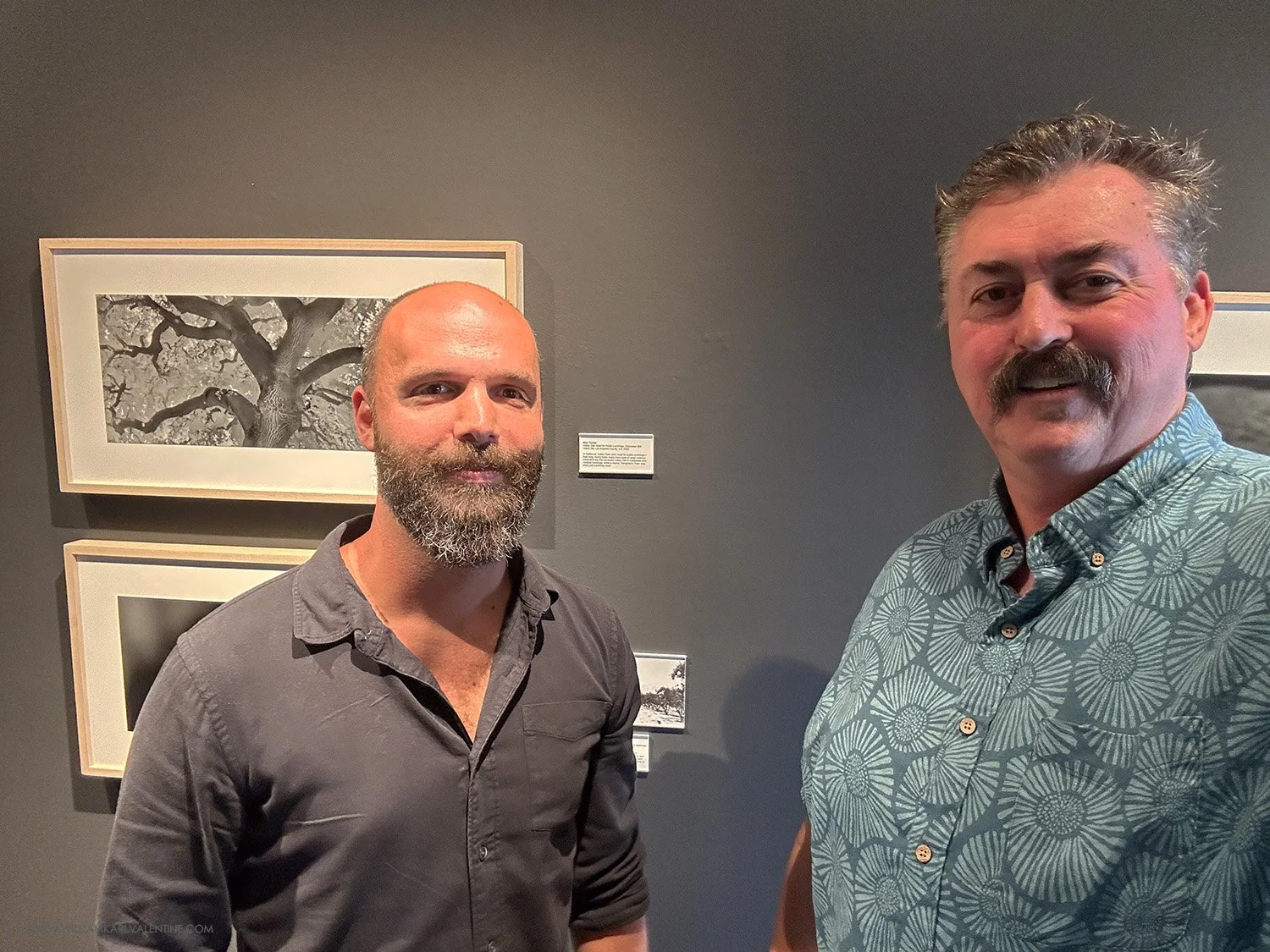
Alex Turner and me at Marshall Gallery.
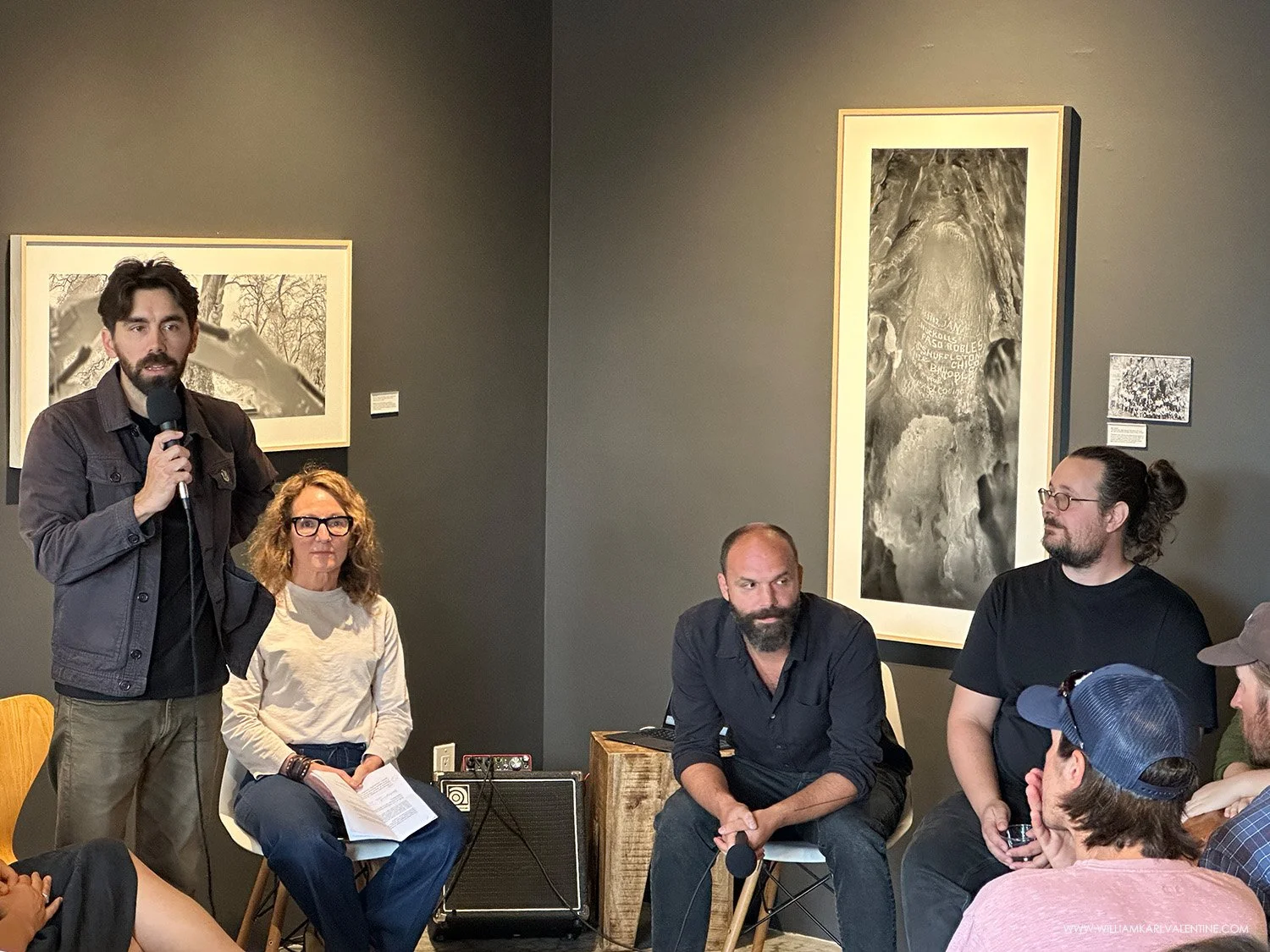
On August 16th I was able to get up to the Marshall Gallery at Bergamont Station, in Santa Monica, to hear Alex Turner talk about his current exhibition Blind Forest which closes today. Heidi Volpe (Director of Photography, Patagonia) hosted the discussion whoch also included Kaya & Blank, video artists who also have a video installation up at Marshall. This is Alex’s second solo exhibition at Marshall, having previously exhibited his Blind River portfolio there in 2023.
Alex Turner (born 1984 in Chicago) is currently a Los Angeles based photographer who received his MFA from the University of Arizona in 2020. I met him in January of 2020 at the Center for Creative Photography’s Legacy of LIGHT Symposium and have followed his career since then.
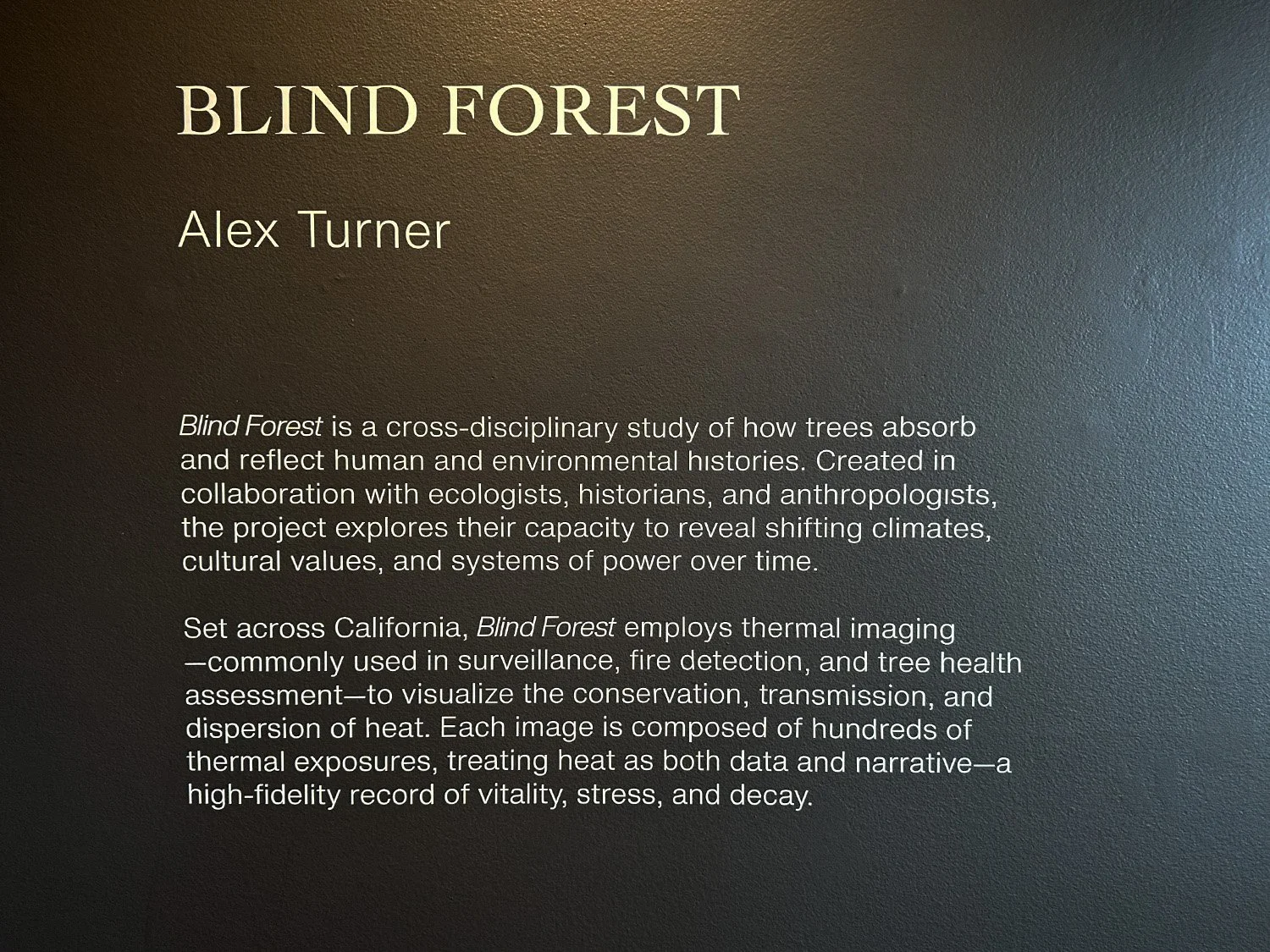
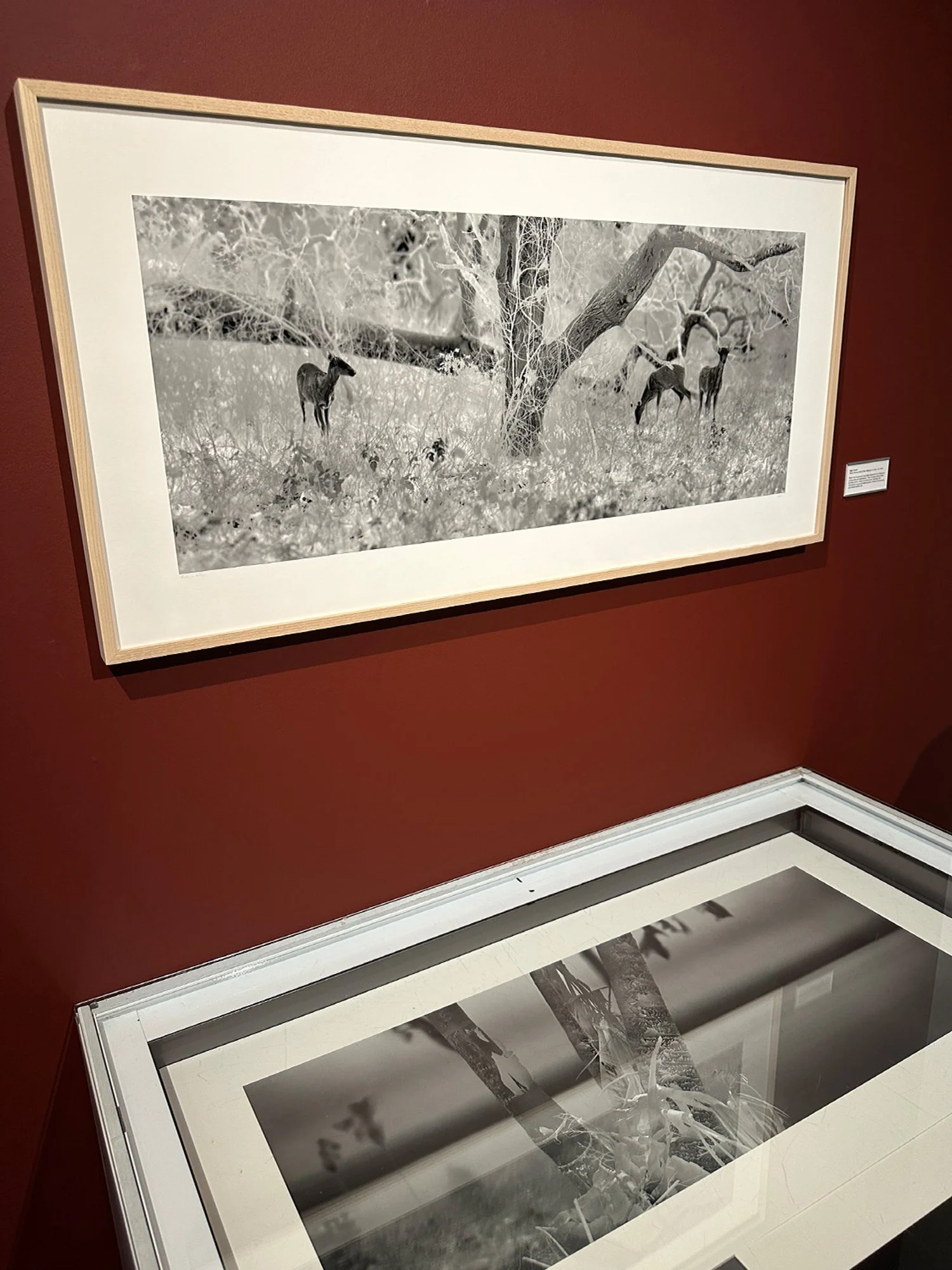
With Blind Forest, Alex used a hunting scope with a built in infrared camera to capture thermal images of the forest around him. Most every photograph in this was a montage of 150 small image files stitched together digitally to create one larger image file. Those image files are sent to his printer who uses a special digital enlarger that projects a negative image of the file on to Silver Gelatin paper that is then processed in a traditional manner. When he explained the process I had to admit to him that I had never heard of it before. Alex explained how he had been dissatisfied with his early prints on digital paper so he found this other alternative. The prints are beautiful, his decision was correct. With a Google search I found several different companies who provide this service including this one that stood out to me. The Blind Forest images are impressive, and I especially like how the thermal imaging captured artifacts in the trees that Alex could not see with his naked eye; like the carvings in a tree which had apparently healed but the scarred area gave off different heat signatures.
I loved some of Alex’s Bling River photographs when I discovered his work, but I also remember wondering where he would be able to go from there, he has definitely answered that question. I love our medium of photography and how inclusive it can be to so many different lens-based artists. I encourage you to also follow Alex Turner’s career. I have linked several outstanding articles below the gallery of images in this post.
Marshall Gallery is located in Bergamont Station at 2525 Michigan Avenure, #A6, Santa Monica, California and is open from 12pm to 7pm Tuesday - Saturday. It is a great space and Bergamont Station is my favorite gallery community in Southern California, I can always find an interesting exhibition there.
Alex Turner’s Exhibition Statement:
BLIND FOREST My work navigates the intersections of ecology, technology, and human experience, and Blind Forest embodies this approach through an extended study of trees as both ecological keystones and mirrors of human intent. Set across the diverse landscapes of California, the project uses thermal imaging—a tool of surveillance, fire detection, and tree health assessment—to reveal what lies beyond the visible: the conservation, transmission, and dispersion of heat through living systems. Created in collaboration with ecologists, natural historians, and cultural anthropologists, Blind Forest reflects a cross-disciplinary inquiry into how natural systems absorb, reflect, and archive cultural and natural histories. Using a thermal hunting scope mounted on a panoramic tripod head, I construct largescale images from hundreds of exposures, mapping thermodynamic activity in precise detail. In doing so, I treat heat not just as data, but as narrative—a record of vitality, decay, stress, and transition. Trees are long-living witnesses to environmental and human histories, and they carry evidence of shifting climates, displaced communities, and evolving systems of power in their bark, roots, and canopies,. From junipers and pinyon pines valued by Indigenous communities, to redwoods logged for empire and citrus groves that once symbolized prosperity, the species featured in Blind Forest trace overlapping tensions—extraction and preservation, survival and erasure, change and continuity. Blind Forest questions what it means to see—and what is made visible or concealed through the tools we use to understand the world. Thermal imaging extends human perception but also implicates us in systems of control. By turning this apparatus toward the forest, I aim to collapse the distance between scientific observation and poetic witnessing, rendering the unseen visible and inviting viewers to reconsider their relationship to place, memory, and environmental urgency. Ultimately, Blind Forest asks how we document and understand the slow, often invisible forces that shape our surroundings. It positions trees not as passive scenery, but as active participants—living archives that conserve, transmit, and disperse meaning across generations. In a moment of ecological precarity, Blind Forest prompts reflection on the fragile systems we inherit, inhabit, and either sustain or destroy.
Additional information about Alex Turner :
Musee Magazine 2025 article on Blind Forest - This is an outstanding interview!
CA DSC 4767 4-14-25 Eaton Fire devastation - Altadena, California
Houston Center for Photography
I was honored earlier this year when Dr. Rebecca Senf, the Chief Curator at the Center for Creative Photography at the University of Arizona, selected the above photograph for the Houston Center for Photography’s 42nd Center annual exhibition. The exhibition closed this week and just before it did Areli Navarro Magallón, the Houston Center for Photography’s exhibition coordinator, sent me these installation view photographs. I always appreciate seeing exhibition views. This space is amazing, and the design of this exhibition was outstanding. Interacting with Ariel was also easy; I was impressed with every aspect of this exhibition process. I wanted to do a quick blog post to make more people are aware of how special the Houston Center for Photography is.
Los Angeles - CA DSC 02947 6-28-85
Since January 7th of this year, I have been all in documenting the Eaton Fire devastation in Altadena and Pasadena. For the first time in years, I didn’t make it out to Arizona in March to photograph Cactus League which still has my yearly clock off. I did get up to Sacramento in June for a weekend and to Chicago for a long weekend in July. After dealing with so much Eaton Fire content it was good to get back on the street photographing. It is a completely different way of photographing, and I have missed that.
This week I started to unclutter my computer desktop, and I found a bunch of good images that I had not posted to my website, a bunch of photographs from 2011. So I have focused the last couple days on updating many of my portfolios with more images.
So, this blog post is pretty simple, I am announcing that I have posted more images to a number of my portfolios. I really tried to showcase more of my Los Angeles work and add more Chicago work. I also added more photographs to my New York and Cemetery Portfolios too. Hopefully you will enjoy the new images and please check back often for more content.
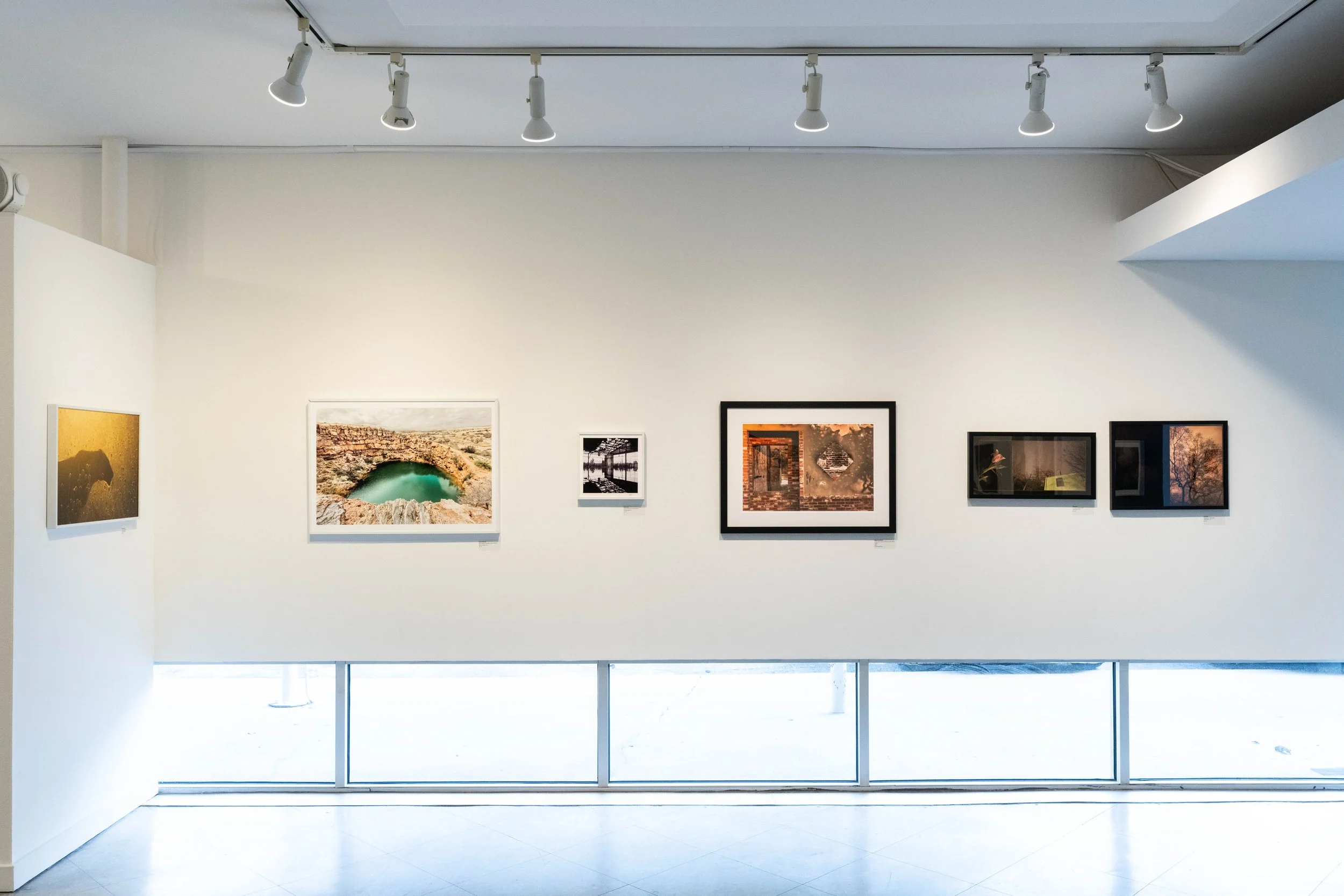
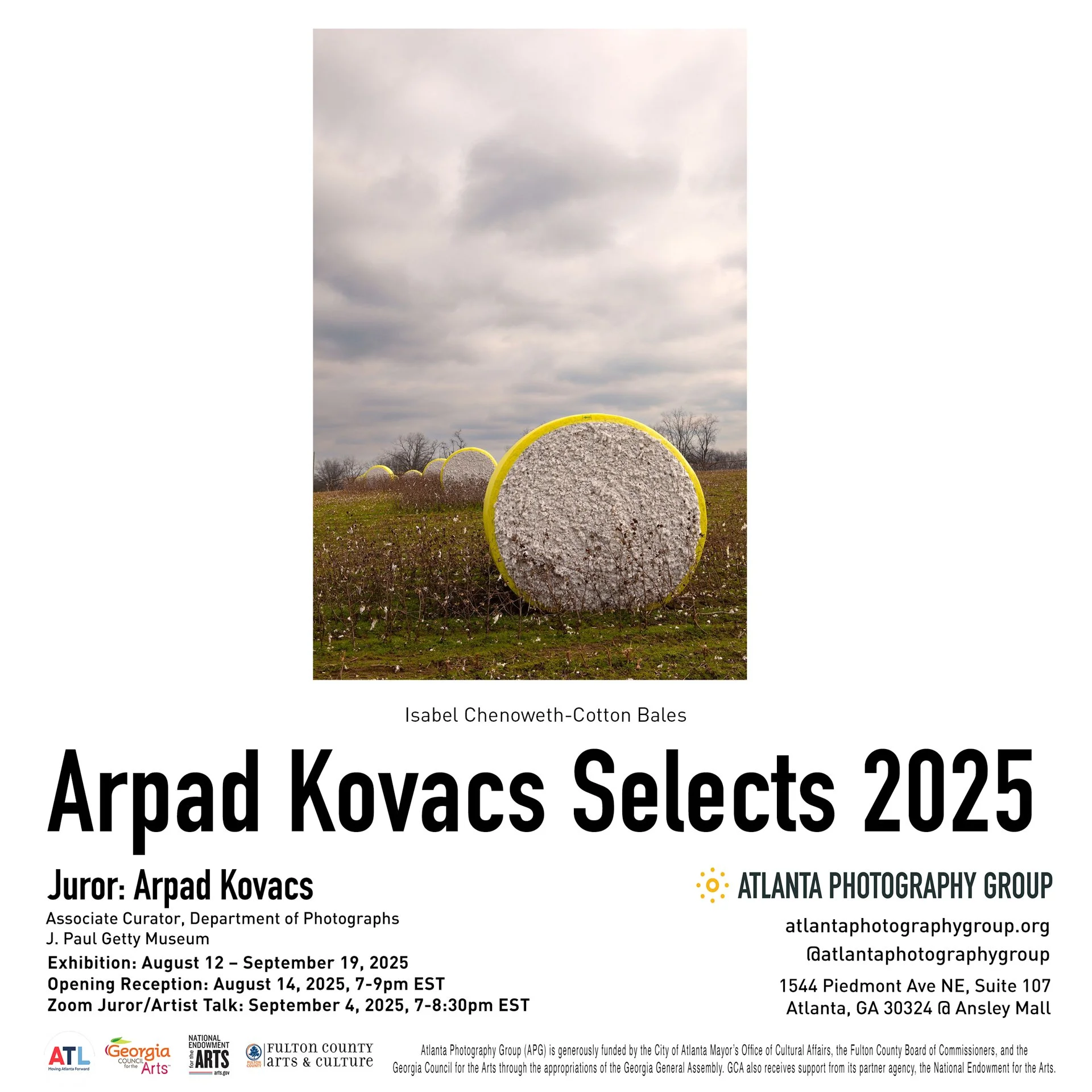
I am honored that the above print is included in the Selects 2025 exhibition which will open this month at the Atlanta Photography Group gallery.
The exhibition was curated by Arpad Kovacs who is associate curator in the Department of Photographs at the J. Paul Getty Museum. Kovacs selected 30 photographs for the Selects 2025 Exhibition.
All work in this exhibition will be considered for the APG/Museum of Fine Arts, Houston Purchase Award, a $3,000 prize which is made possible through a generous grant from Edwin Robinson and Julin Maloof, in honor of Gloria and Ted Maloof. Lisa Volpe, Curator of Photography at the Museum of Fine Arts, Houston will make the decision for the museum purchase award.
The Image
This image is from my Eaton Fire Portfolio which I began on January 7th this year. This is the second time I have exhibited this image in print form and the four time this year I have exhibited a photograph from my Eaton Fire Portfolio.
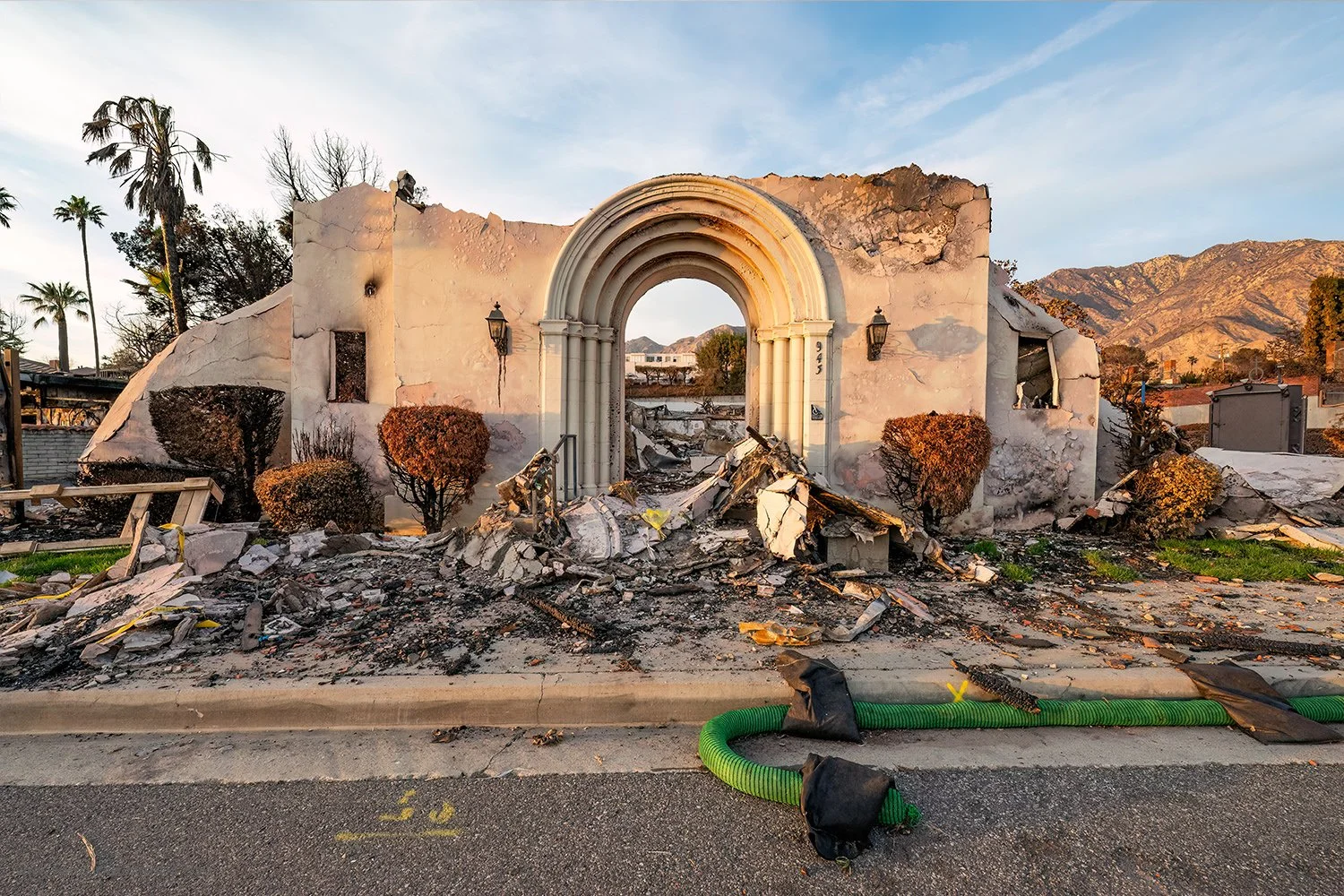
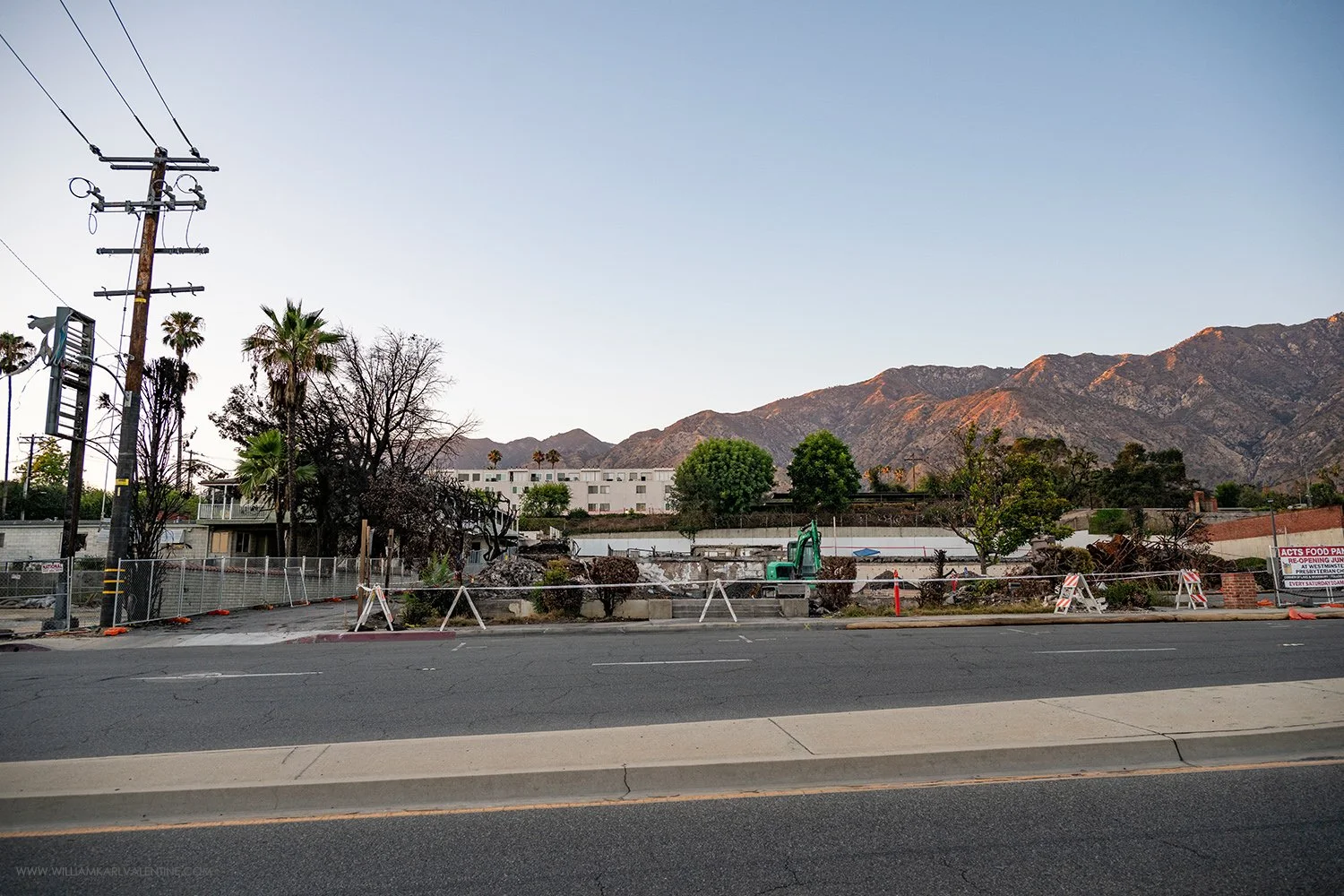
I was in Pasadena, where I grew up, the night the devastating Eaton Canyon Fire began. I smelled the smoke from the fire before I could see the flames and when I first saw the fire it was raging. I have written a lot about this portfolio on my website and in this blog, so I won’t repeat too much about it here. It was a devastating fire that killed at least 19 people and destroyed over 9,000 homes. I have continued photographing the area since the night of the fire to document the impact on the community and the massive scope of the damage.
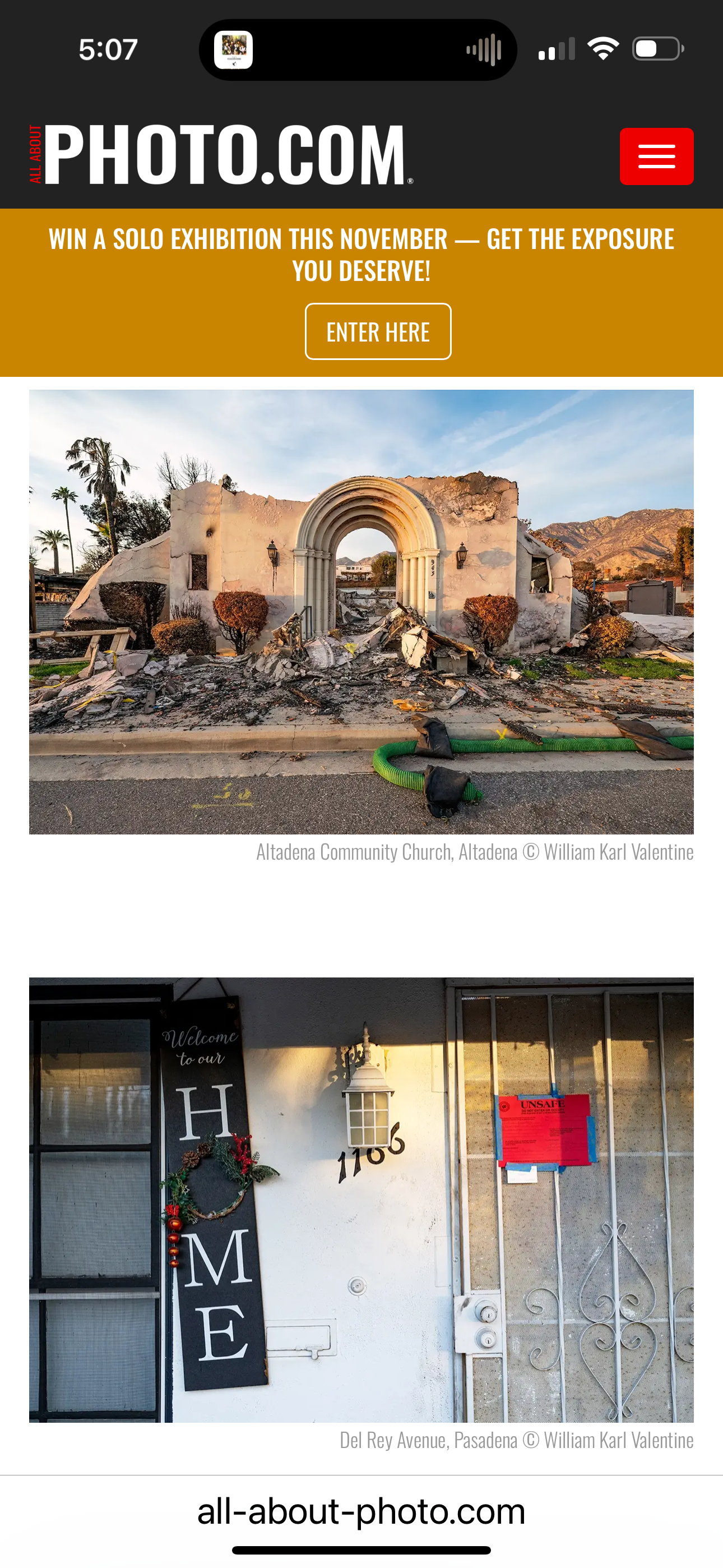
This photograph is of the Altadena Community Church which is near the intersection of Lake Avenue and Altadena Drive, arguably the center of the city. Many businesses near this intersection were lost but the entire Southwest corner was spared. For me there are lots of layers of information in this image. A destroyed church represents the impact to the community as a whole. I love the fact the archway stood strong and was such a powerful element in the image (it was just razed within the last week), and the mountain (where the fire started) are an important element. The image encompasses a lot about the fire. I photographed this church several times over the past six months, as have other photographers, but I have not seen any other photographs of the church as powerful as this image. The key is the lighting; I photographed this image on February 18th when the sun was further south and still shone on the face of the building. I also made the exposure around sunset when the colors came through. A month later the sun was further north in the sky and the light was not hitting the face of the building during sunset.
July 29, 2025 - The Altadena Community Church lot. The facade had been razed within the last week. (DSC 3666)
The Print:
The exhibition print has an image size of 24” x 16” which is the largest sized exhibition print I have produced so far in an edition (I have produced some larger prints for commercial clients). This print is on a sheet of 26” x 18” Hahnemȕhle Photo Rag Ultrasmooth paper, framed with a window matt to an external size of approximately 31” x 27”. The print has an edition of 9 for this image size.
The print was made, and framed by, by Digital Arts Studio in Atlanta who I have been using to produce all my large print editions. Owner Barry Glustoff is fantastic to work with and his lab is one of the top certified printers of Canson and Hahnemȕhle papers in the world.
I would also like to showcase four other photographs in the exhibition which stood out to me:
3516 N. Fair Oaks Avenue, Altadena, California after the Eaton Fire on January 7th. CA DSC 4767 04-14-2025
I am extremely honored to announce that Dr. Rebecca Senf from the Center of Creative Photography has selected the above photograph for exhibition in the Houston Center for Photography’s 42nd Annual Center Exhibition. It opens Thursday June 12, 2025, and closes on Sunday August 17th, 2025.
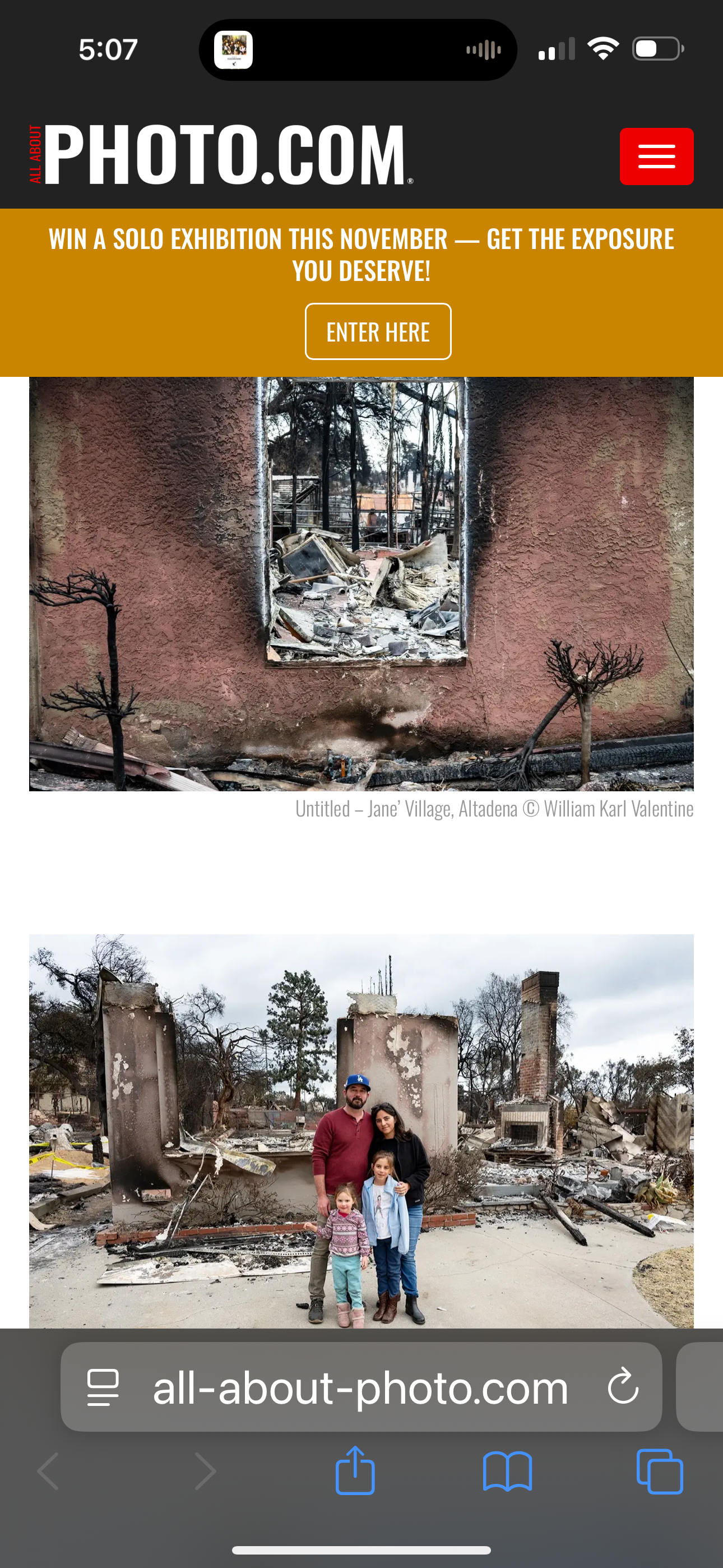
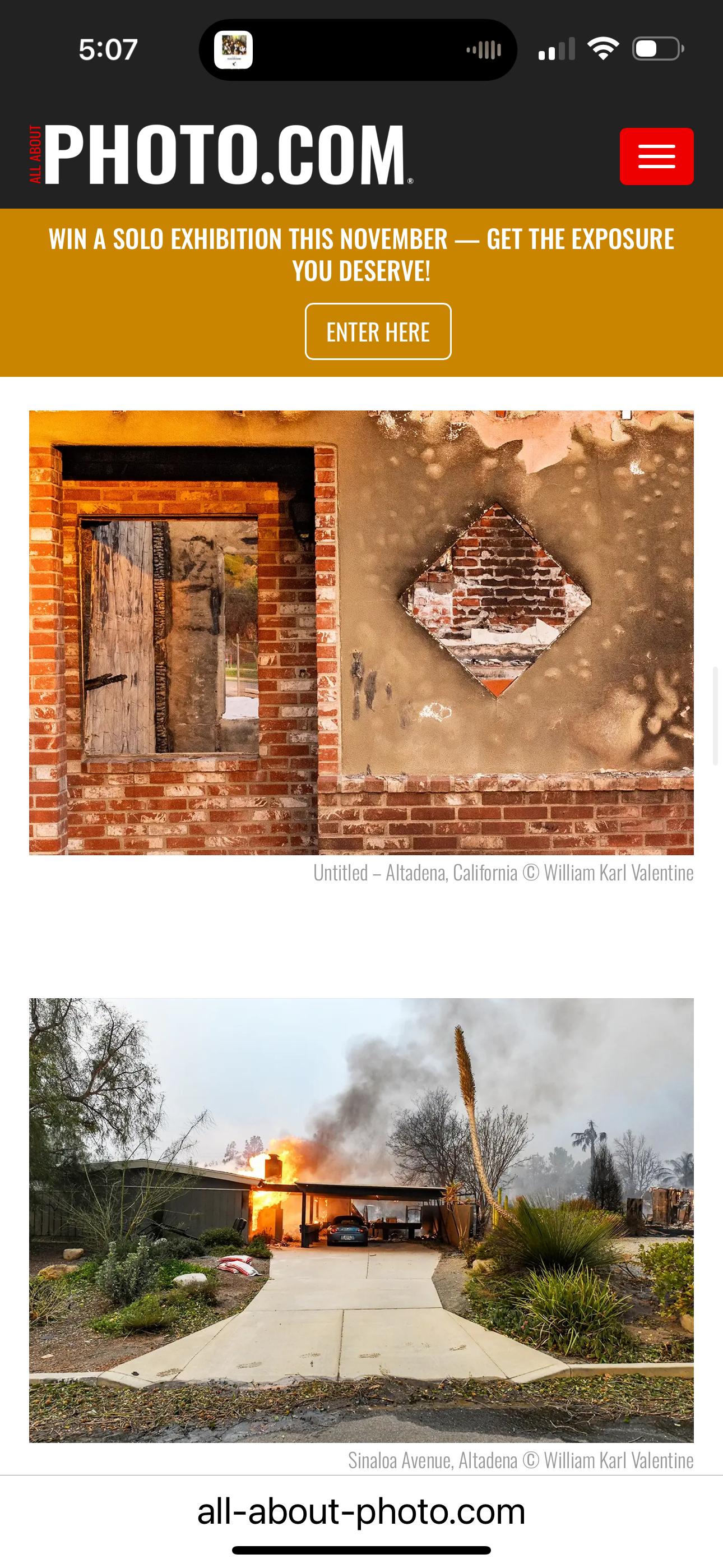
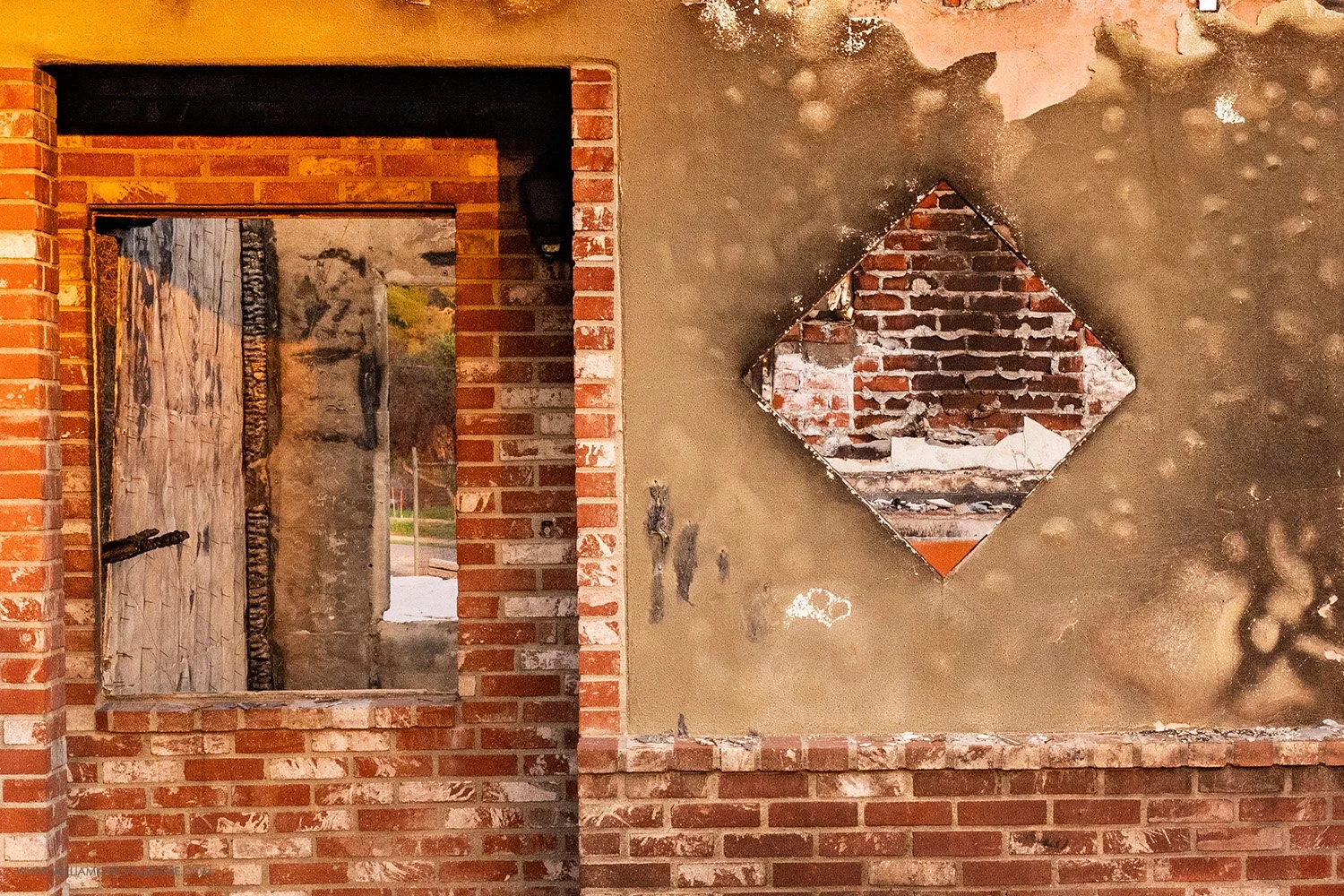
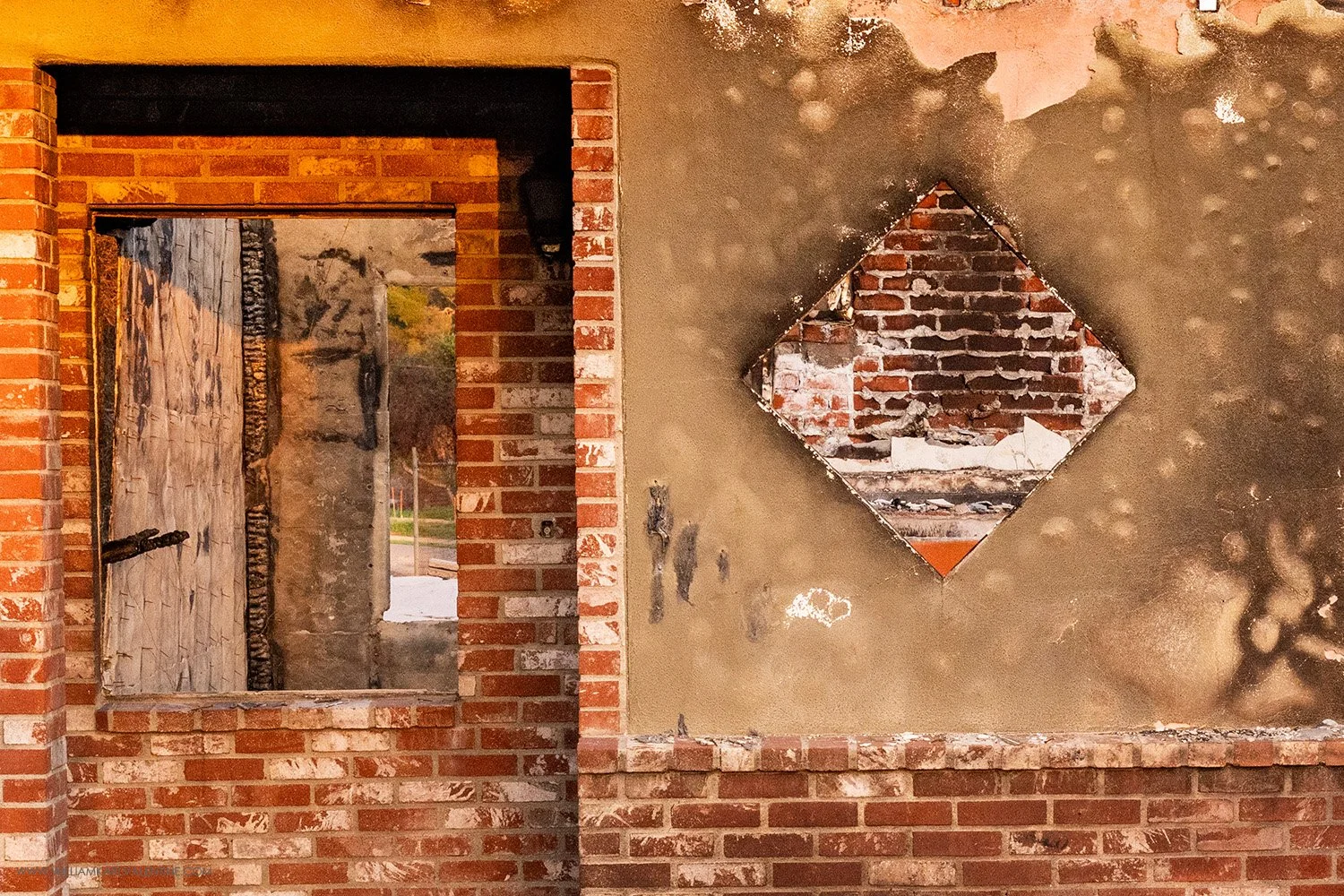
My Eaton Fire Portfolio began on January 7th, 2025, when a fire started in Eaton Canyon (above Pasadena and East of Altadena) and quickly spread because of unusually high winds. I have chronicled details in previous blog posts and my web page for the portfolio. I knew right away I was witnessing something historic, and I felt compelled to document it. I was initially focused on the fire and the destruction but as I have returned over 25 different days since the fire I find I am document more individual loss and how people are dealing with the aftermath. I also soon recognized the destructive nature of the fire left behind many forms and shapes that were beautiful and often powerful. In January I was already taking notice of the frames within a frame caused by the fire. The image above is from a home in the Jane’s Village neighborhood of Altadena. The diamond shape to the right was a window that burned away allowing the viewer to see the brick fireplace. The rectangles on the left side of the image are a covered porch, a front window and a rear window. The exposure was around sunset causing the hue cast. What remains of the home address numbers are the black or grey blobs to the lower left of the diamond window as you face it. Altadena is a wonderfully eclectic and diverse community covering 12 square miles North of the City of Pasadena. Altadena lost over 9,000 structures in the fires.
The Center Annual is Houston Center for Photography’s yearly group exhibition that seeks to highlight and provide insight into current themes, technologies, and practices in photography. This year’s exhibition features 47 diverse works from members of our global photography community and was selected by a Dr. Rebecca Senf who is Chief Curator at the Center for Creative Photography at the University of Arizona, in Tucson. Her B.A. in Art History is from the University of Arizona; her M.A. and Ph.D. were awarded by Boston University. In 2012, her book Reconstructing the View: The Grand Canyon Photographs of Mark Klett and Byron Wolfe was released by University of California Press; in 2017, her book To Be Thirteen, showcasing the work of Betsy Schneider, was published by Radius Press and Phoenix Art Museum. She has curated fifty exhibitions, including her recent Richard Avedon: Relationships which was shown in Milan and Palermo, Italy and Rotterdam, in The Netherlands, and has contributed chapters, interviews, and essays to over a dozen publications. Senf is an Ansel Adams scholar, and in 2020 released a book on Adams’s early years, called Making a Photographer, copublished by the CCP and Yale University Press, now in a second printing.
Dr. Senf & CCP’s recent Instagram post: “Picture Party: Celebrating the Collection at 50,” on view through December 20, 2025, at CCP’s Alice Chaiten Baker Interdisciplinary Gallery.
The Houston Center for Photography galleries are always free and open to the public.
VISIT
1441 West Alabama
Houston, Texas 77006
(713) 529-4755
GALLERY HOURS
Monday–Tuesday: Closed
Wednesday–Thursday: 11am–9pm
Friday: 11am–5pm
Saturday–Sunday: 11am–7pm
Jane’s Village - Altadena CA DSC_0281 01-25-2025 William Karl Valentine
When I started photographing the Eaton Fire on the night of January 6th I was just trying to document everything I could since I knew the event was going to be historic. I obviously had no idea that fire would eventually destroy 9,000 homes and kill 30 people in a twelve square mile are of Altadena and Pasadena.
January 25th was the first day I could really get up into the hardest hit areas because the area had been closed before then. It was obvious to document the scale of the devastation but as I was doing that I also was looking for forensic evidence of how the fire moved through the neighborhoods and the individual properties. I also found that I was photographing with an artistic eye.
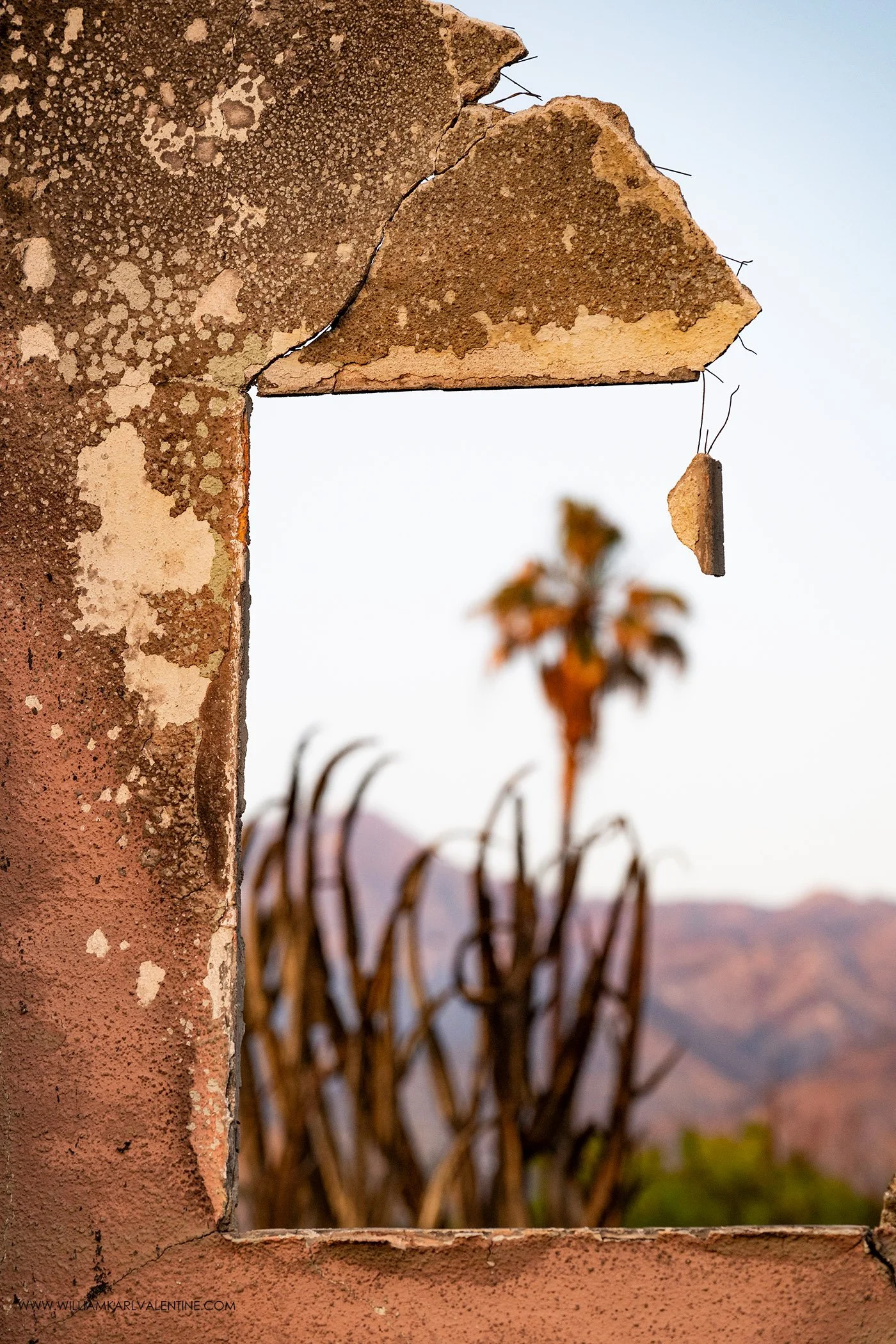
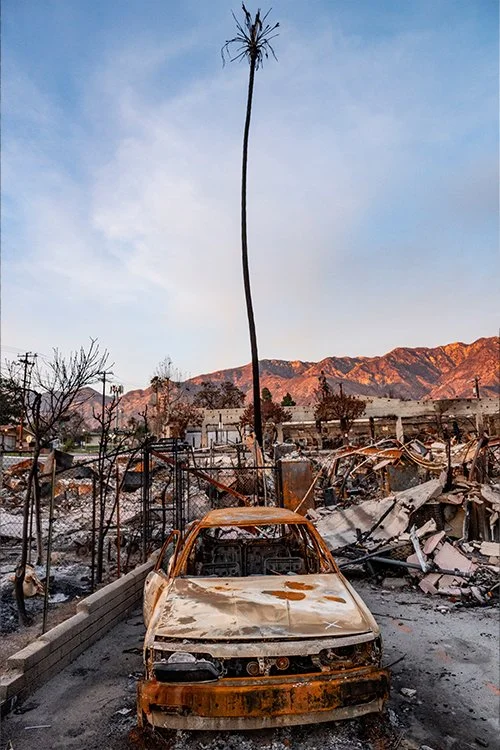
At times I have felt a little bad about looking for beautiful or artistic elements in the frame because I am documenting the worst event in so many people’s lives. But I know my intent isn’t to exploit their loss and I know it is good to look for beauty in the midst of something very ugly sometimes. As a photographer I think I do that a fair amount, I like to work in hard areas. The fire created a lot of dramatic images by how it destroyed things. With trees and bushes the fire removed the leaves to expose the shape of the trunk and blackened it to create contrast. With plaster walls the heat of the flames altered the hues on some walls and often created a split tone effect like what you can do with a silver gelatin print. Burned out windows created frames within a frame and unique images. Photographing after the rain came was also visually interesting because metal debris quickly rusted and turned bright orange which was another contrast.
A month or so ago I traded correspondence with a curator who I know, and she asked me about my editing process for the Eaton Fire Portfolio. It was an outstanding question, and I hit her with a super long reply because I also wanted to answer the question myself. I knew describing the process would have value at some point for others viewing the work or trying to better understand me as a photographer. It was also good exercise for me to complete while building the portfolio. To answer the editing question, I first had to think about the photography process. Below is some of what I wrote in my reply:
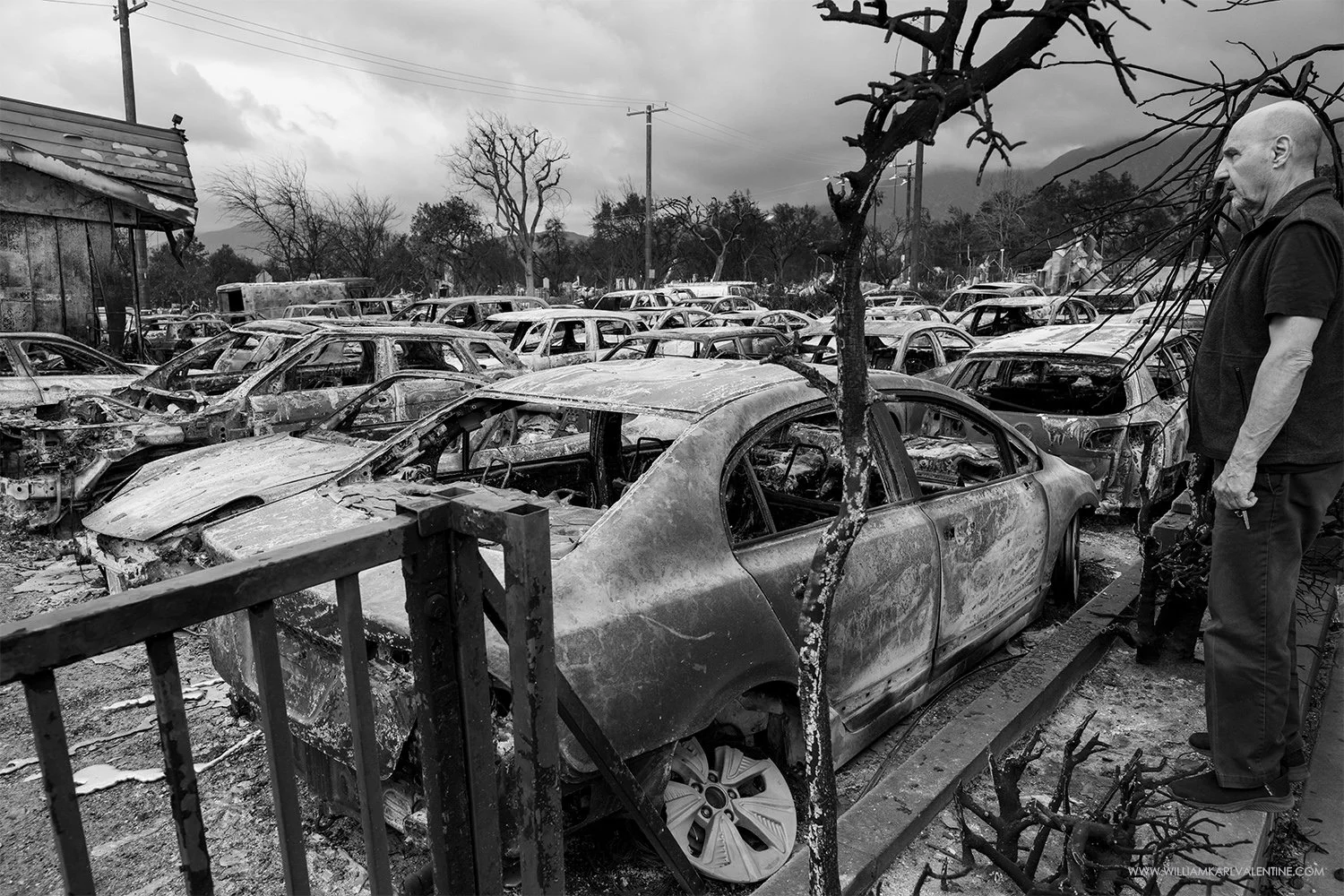
I’ve seen the world in 2:3 rectangle frames for a long time now so when I started documenting the devastation I was conscious of the elements within the frame. The big difference with this work is that most of the subject matter is static (My cemetery portfolio is very similar). So, I have been more methodical, I find something that interests me, tells the story, and I photograph it from multiple angles. I look for ways to bring out the important information and I try different focal length lenses. I also usually explore the general area for other images. January 25th was incredible because I drove up to see the condition of Mountain View Cemetery where most of my family is buried and nearby there were lots of burned businesses. I started photographing the businesses because the images were obvious. A wall with “Western Fence Co, Since 1967” and everything else gone, that image was obvious I just needed to frame it properly. Across the street the meeting hall which I later figured out was a Bible study, the burnt billboard, and the packed used car lot were all powerful subject. When I was photographing the car lot I noticed the streams of melted metals on the asphalt and then really homed in on detail as well. The shapes and forms of the metal were beautiful and so I worked with that. But the melted metal also documented the power and intensity of the firestorm.
The car lot was on the edge of the Jane’s Village neighborhood and almost all the homes on the block West of the car lot were gone. I walked into that area thinking the mass devastation would be the primary subject matter. It was but then I found the concrete flamingos that survived and partial walls with window openings that created frames within the frame. The burn patterns were interesting. The plaster on many houses changed color in the fire and it is incredible how it resembled a “Split Tone”, usually in the complimentary colors red and green, or better described as a light maroon and olive. The flames also left interesting designs on the plaster. It left different markings where it came out of vents, versus when it was burning a material against the house. The wood framing of some homes burned away but left black marks on the standing plaster wall that were very geometric. There are beautiful aesthetics within the devastation. The frame within a frame element from missing windows became interesting and I moved position to square my frame and also position elements within the background of the window frame. I then had to deal with depth of field and focus issues often making numerous exposures with different focal points.
Documentary photographers photograph in a similar ways as Press photographers and Photojournalists but there are differences. The Press photographer and Photojournalists are looking for impactful images that either complement or tell the story like documentary photographers do but they have more constraints. They have less time, and their image needs to stand out in a way to quickly grab the viewers’ attention and to focus their attention directly on the subject. As a documentary photographer I don’t have a deadline, I can revisit things again and again. I can craft images with layers of detailed information because the goal for me is to share my photographs in settings where people have time to explore the image for all the information in the image. Any type of photographer can and should be respectful when photographing subject matter like this. I have had lots of positive interactions with people while photographing in Altadena because I explain my connection to the community and I am respectful of other peoples’ property. I just felt it was important to author a post about this subject because I don’t want anyone to misjudge my intentions with this portfolio. Foremost my goal is to document the devastation, so society never forgets the impact this fire had on thousands of people.
Example Images below:
Frames within the Frame:
Branches:
Rust:
Eastbound Crary at Valencia - CA DSC 01168 1-07-25
Eastbound Crary at Valencia - CA DSC 9571 1-14-25
I have been photographing in Altadena and Pasadena so much since the Eaton Fire on January 7th that I have become behind in the blog posts I want to share related to that portfolio. I have been pretty good at reviewing images as I go and getting content into the portfolio on my website, but not as good with the blog and I have not worried about Instagram.
I attended Arizona State University a few years after Mark Klett completed his Rephotographic Survey Project, so I was very familiar with it and I loved the concept. I never studied under Mark there, but I got to know him, and I like him and absolutely respect his work. Since those days I have found most any project where a photographer chases another photographer’s tripod holes to be interesting, and I like to return to locations of my own photographs to document change.
Crary and Valencia is in unincorporated Pasadena about a block from my sister’s home which has been in the family for about 90 years. The one image is obviously from the night of the fire, and I made the exposure at a time I was really worried about where the fire was spreading to. Luckily at this point the winds were driving the fire in this area mostly South along Altadena Drive (as you look at the image that would be left to right).
When I made this exposure I could obviously see the mountains were burning and I thought the large orange glow at the end of the block was from Kinneloa Mesa burning, but the second image confirmed I was wrong since you can see the homes on Kinneloa Mesa survived. The glow was from a large townhome complex that had built along, more likely on, the Eaton Canyon Reservoir. To be honest I never realized they were there since they were tucked back in our of sight.
The car on the street burned but was removed before I got back to see it. These images are a week apart; I couldn’t get into that area at first because of LA County lockdown restrictions. I looked at the ground where the car was and I am assuming that leaves and other debris from the winds had piled up under the car and that an ember lit them on fire which burned the car. The palm tree trucks burned some but they survived, and the house appeared to be undamaged. I assume the fire engine which showed up for the car fire kept it from spreading to the homes.
The devastation I have photographed is so surreal, especially because I know the area so well. Comparing these two images I am still amazed how some areas came through the fire so well and other areas became rubble and ash.