William Karl Valentine: The Eaton Fire - LENSCRATCH
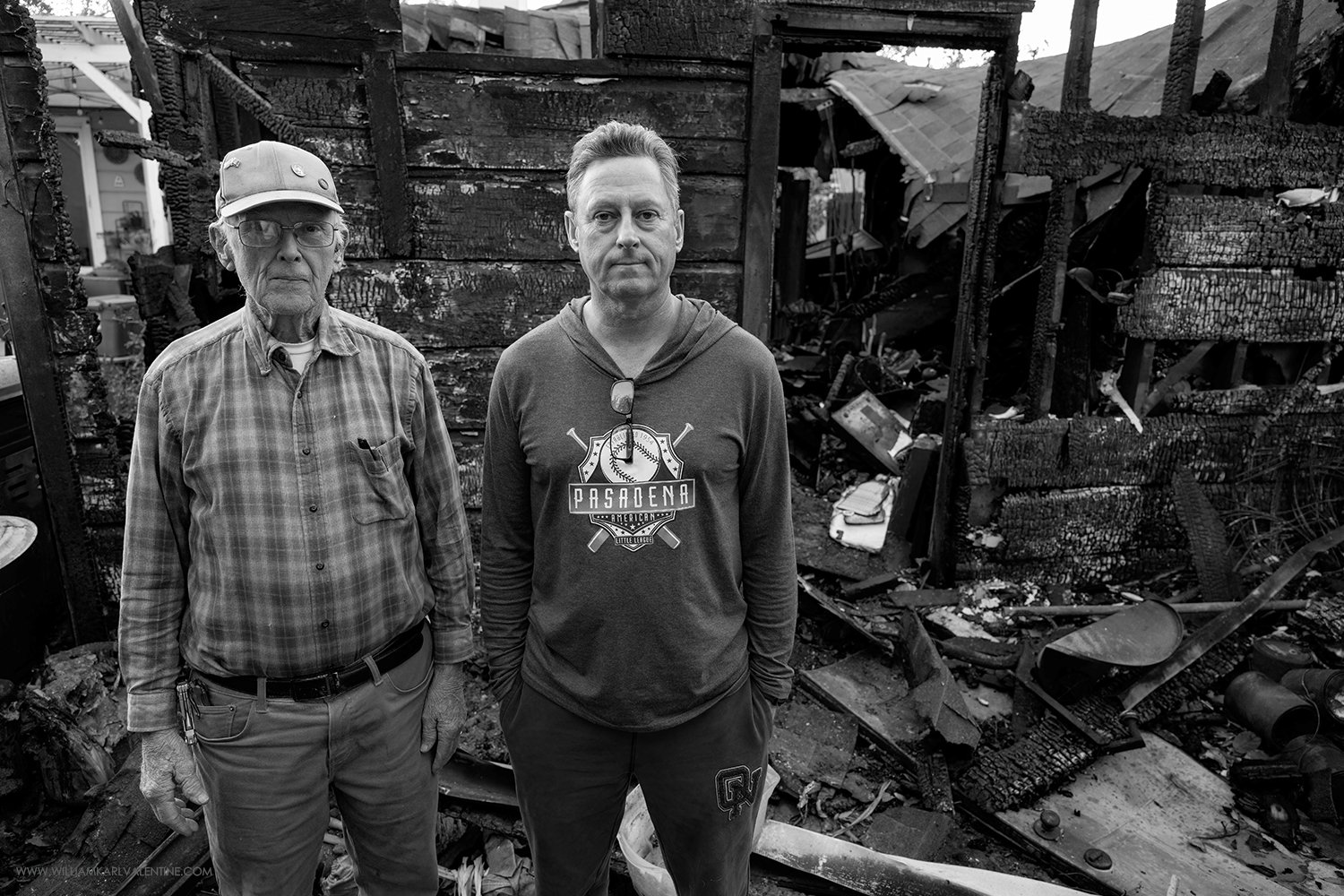
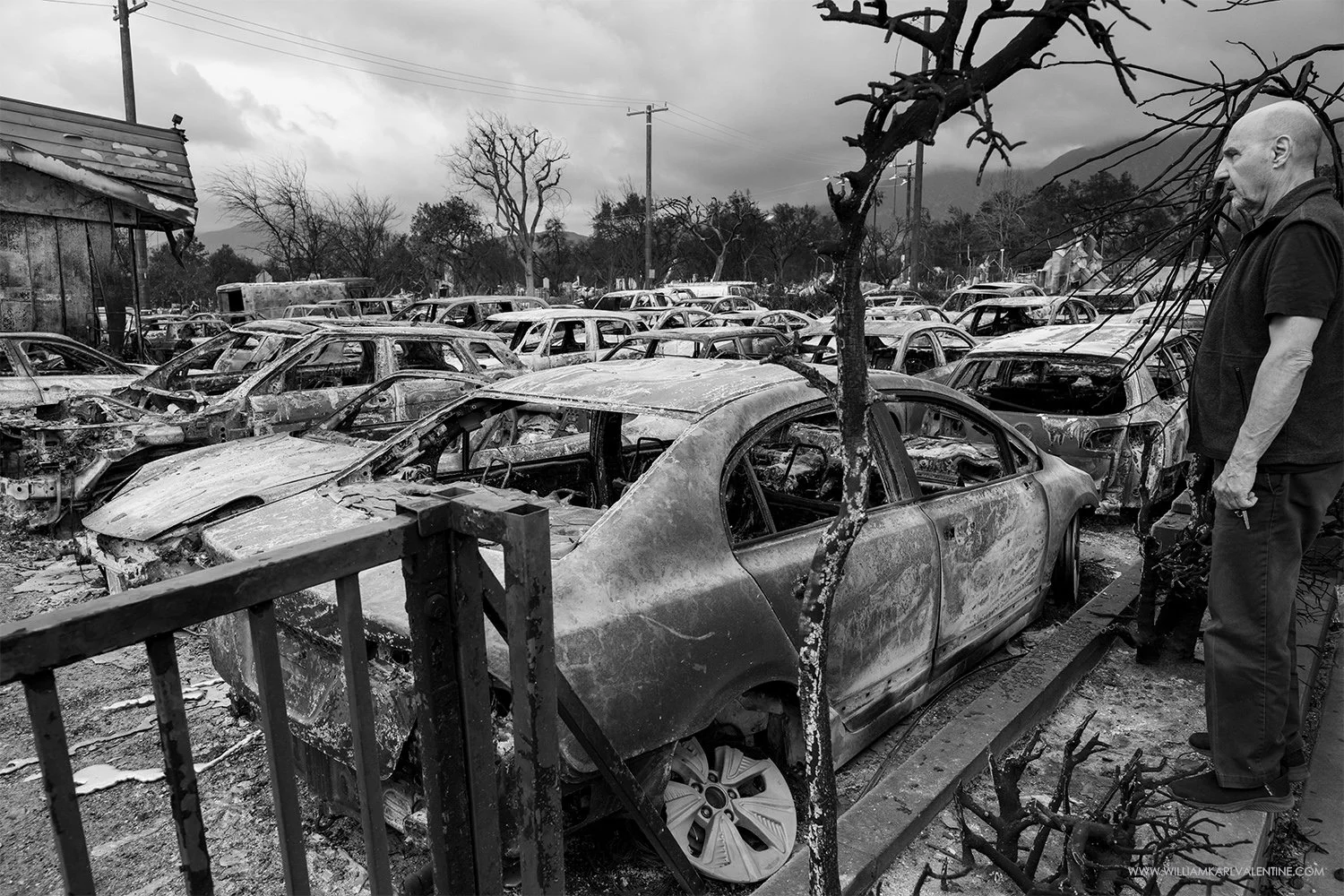
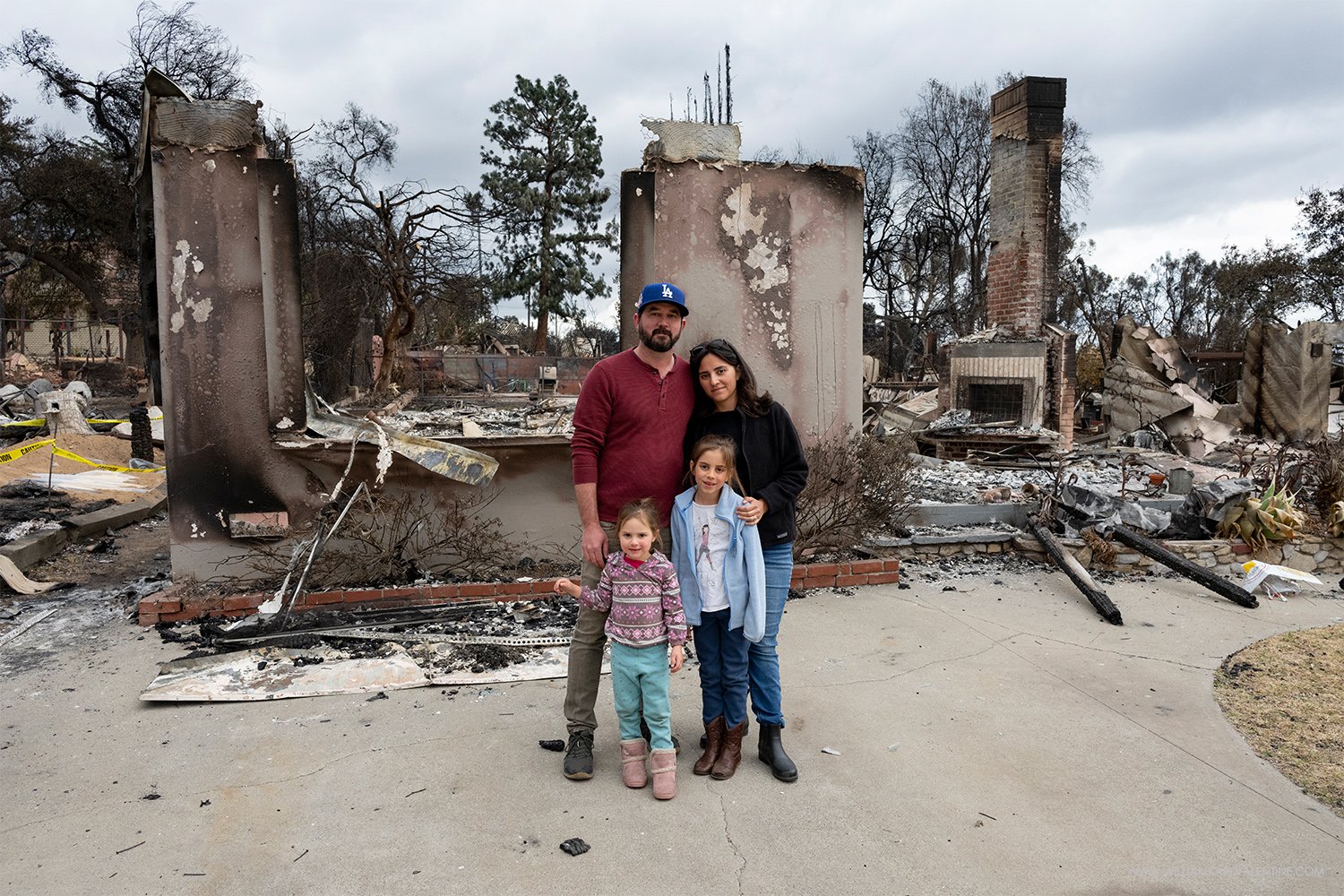
I am pleased to announce that Aline Smithson is showcasing my Eaton Fire Portfolio today, which is the one-year anniversary of the fire.

William Karl Valentine: The Eaton Fire - LENSCRATCH
I am pleased to announce that Aline Smithson is showcasing my Eaton Fire Portfolio today, which is the one-year anniversary of the fire.
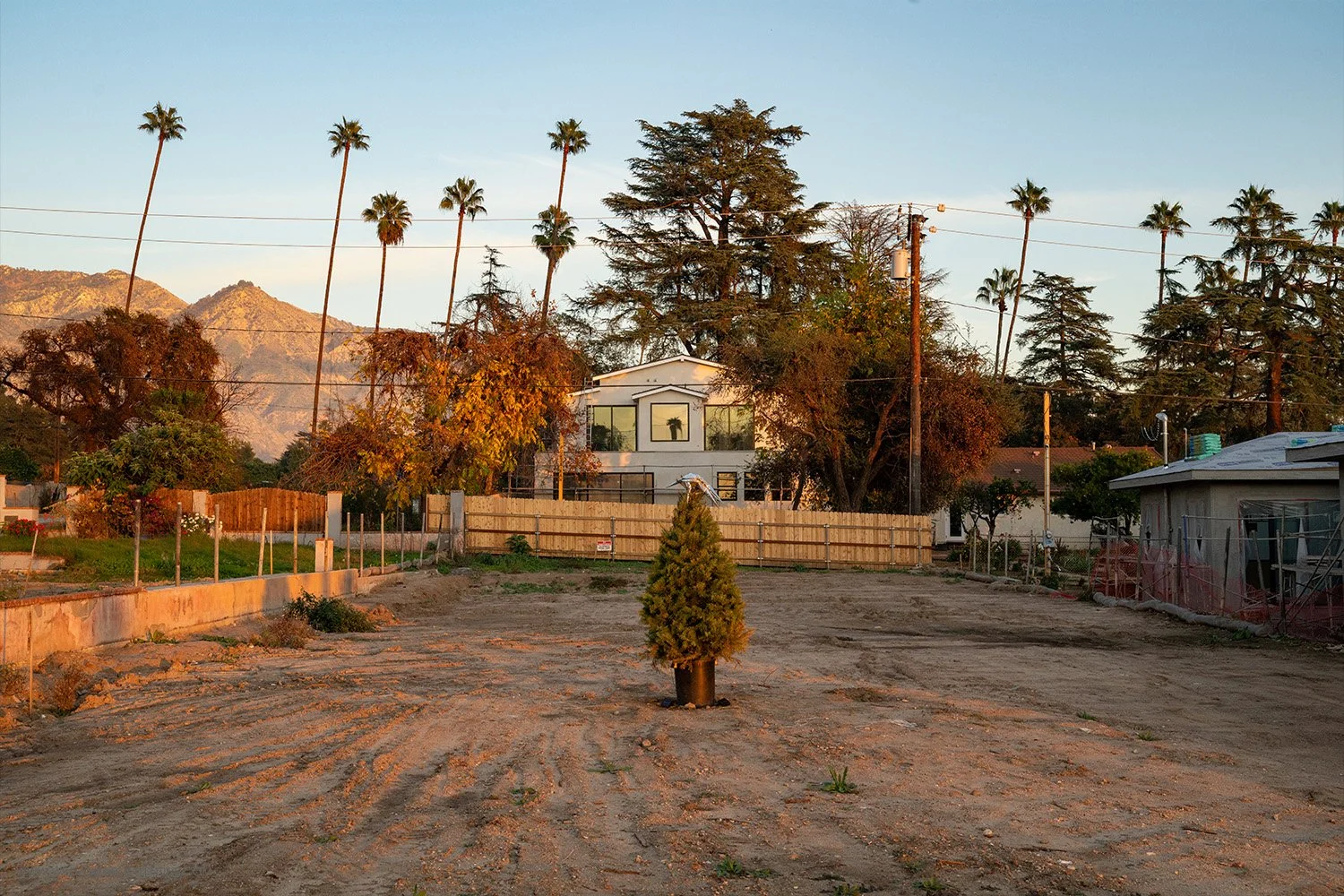
CA DSC 8334 12-16-25
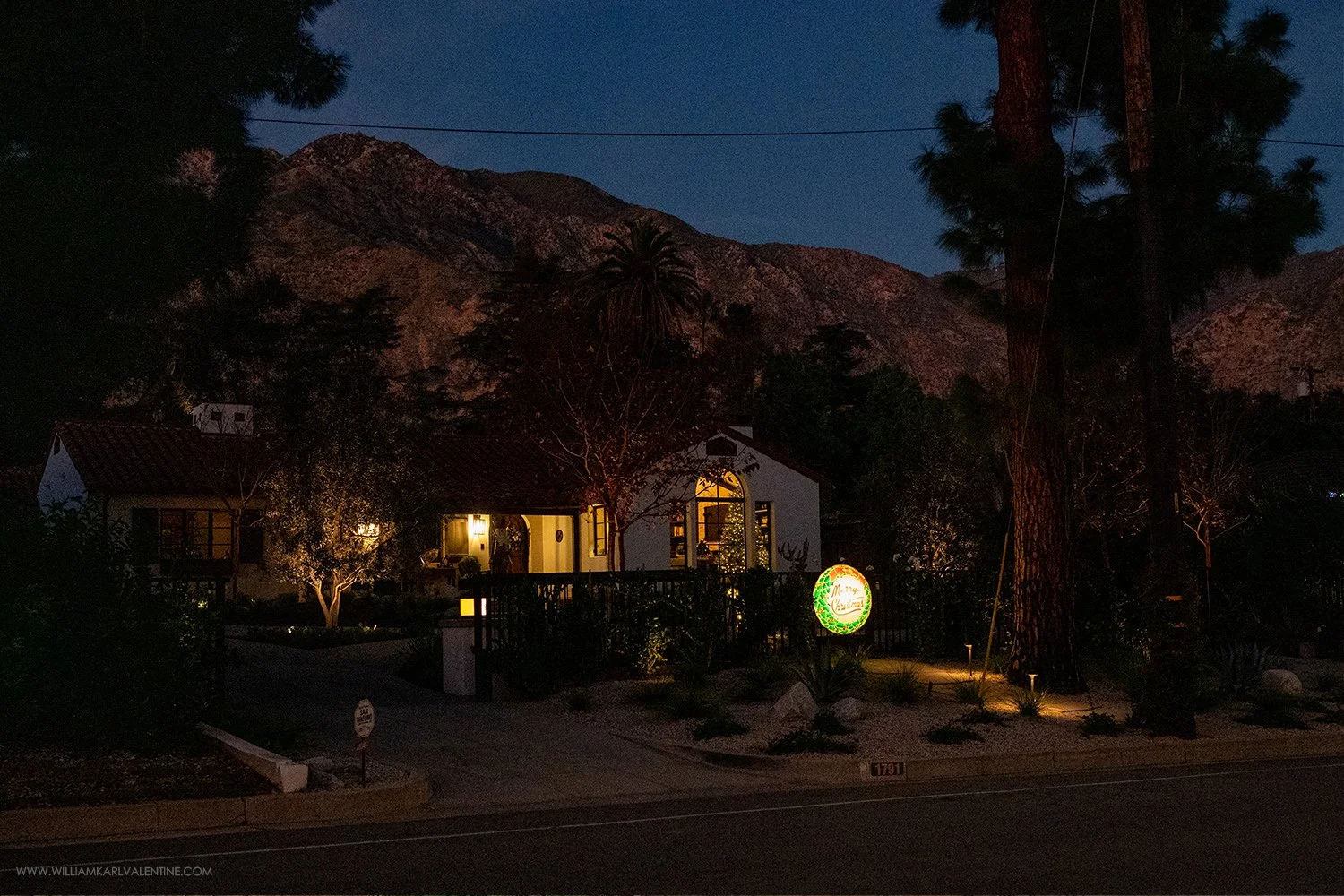
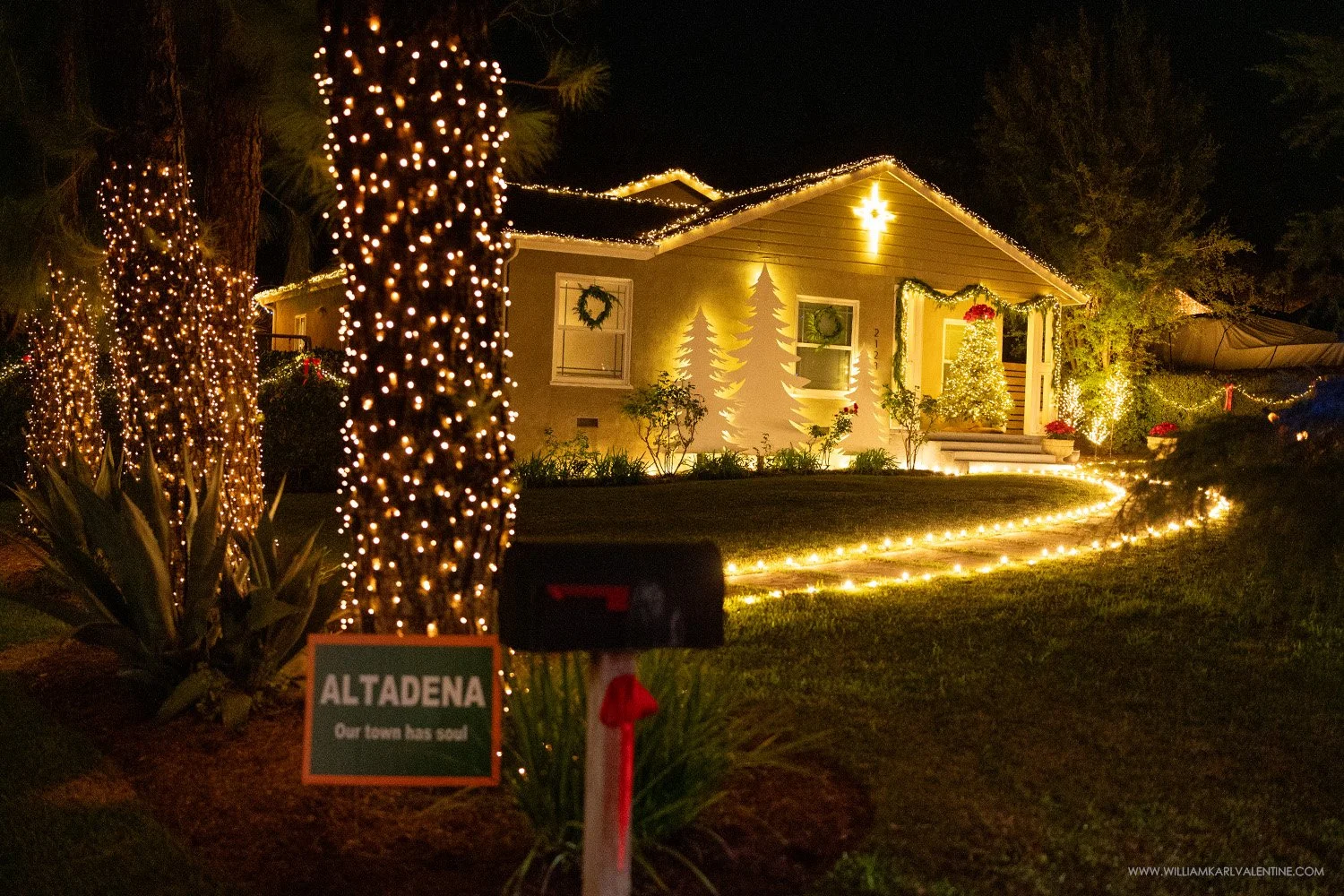
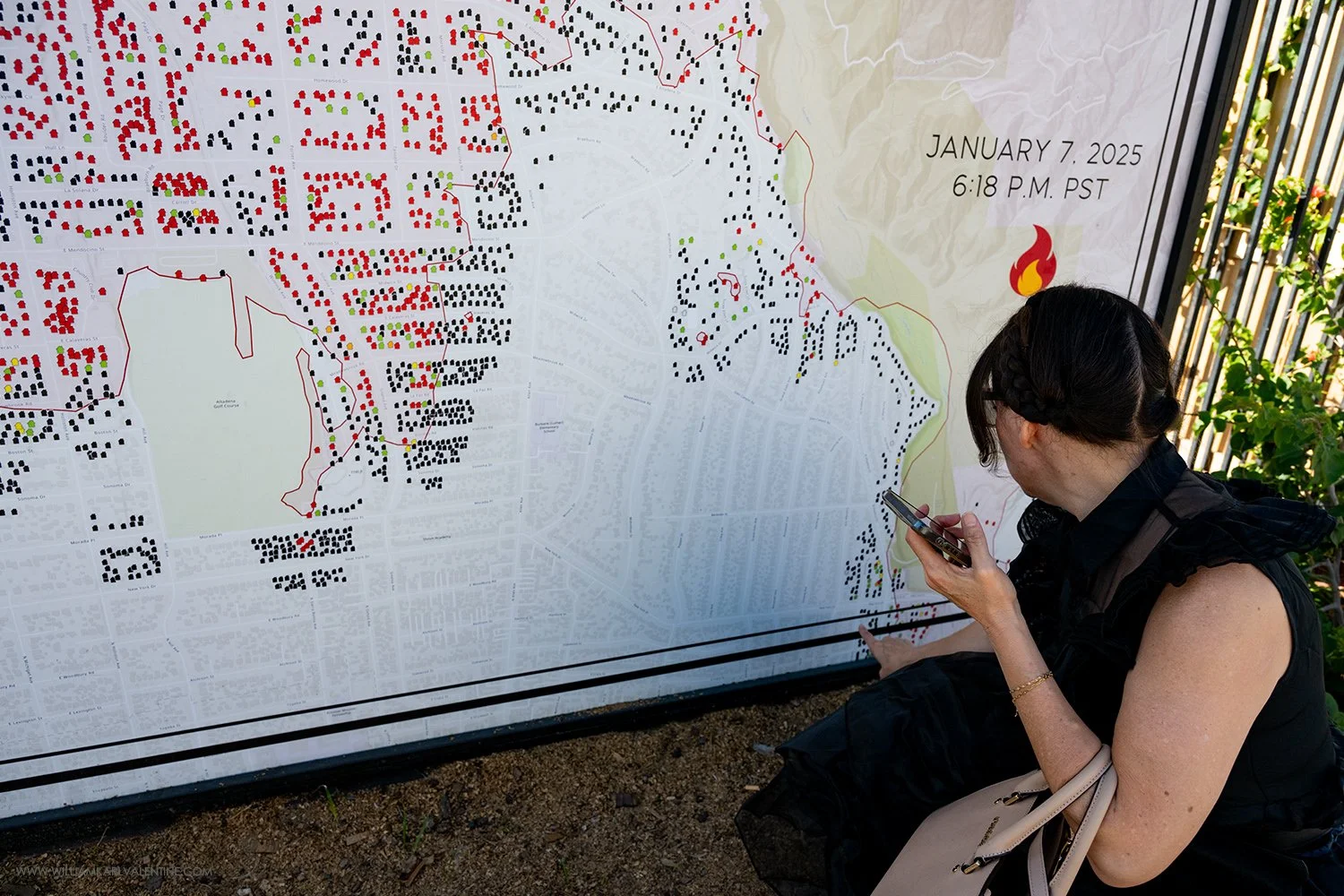
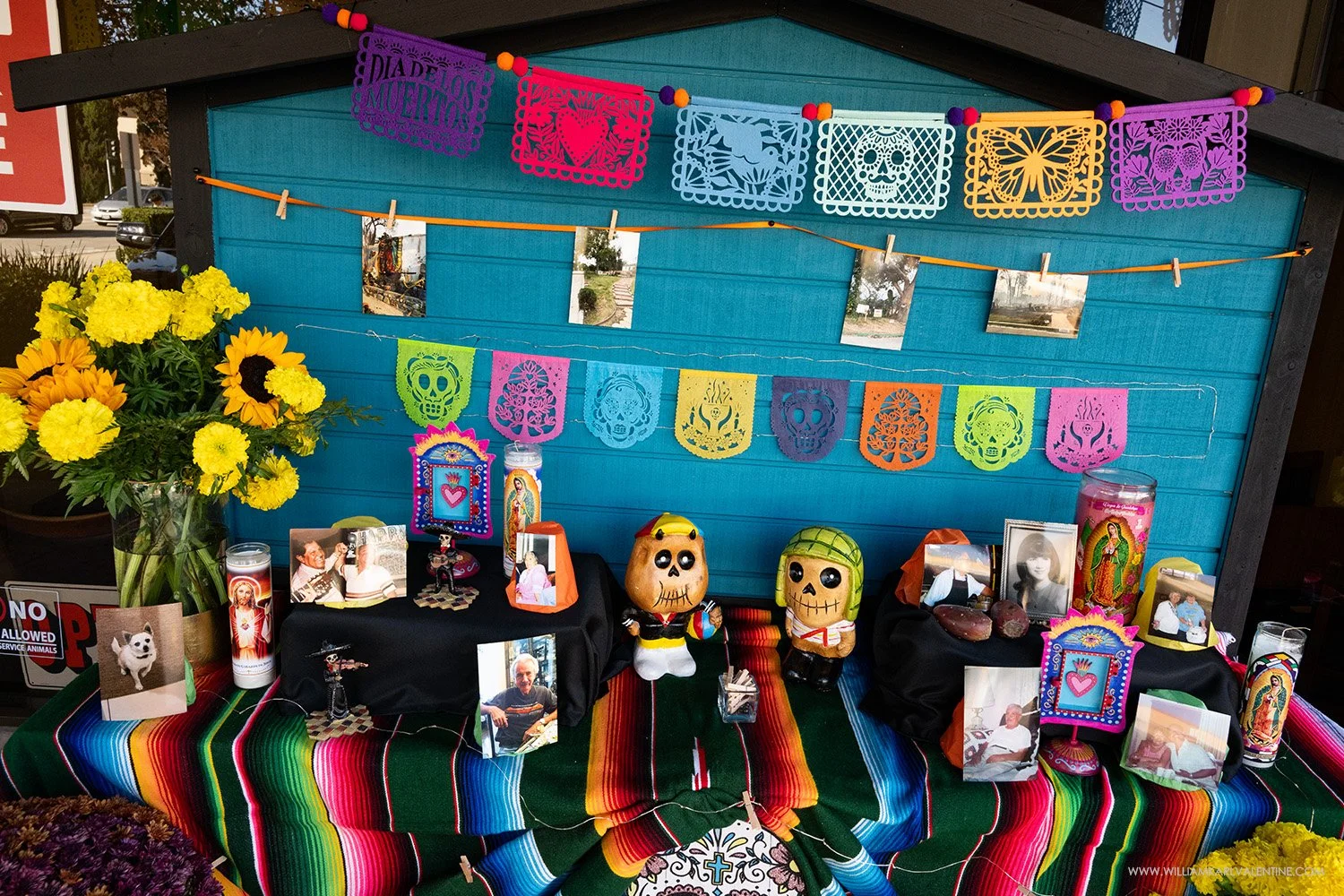
When I began photographing the aftermath of the Eaton Fire last January 2025, I came across numerous homes that still had Christmas decorations up when they were destroyed. Wreaths were still hung on fences, burnt strands of lights, and melted decorations. Every time I saw that it magnified the fact that each mound of rubble had been a family's home. Everything I saw obviously was a reminder but with Christmas you think of joy and hope, children, and home. When I saw homes in April and May that hadn’t burned but still had Christmas decorations up, I knew those people were still displaced waiting to get their homes cleaned. I reminded me that the impact went beyond just the homes that were lost.
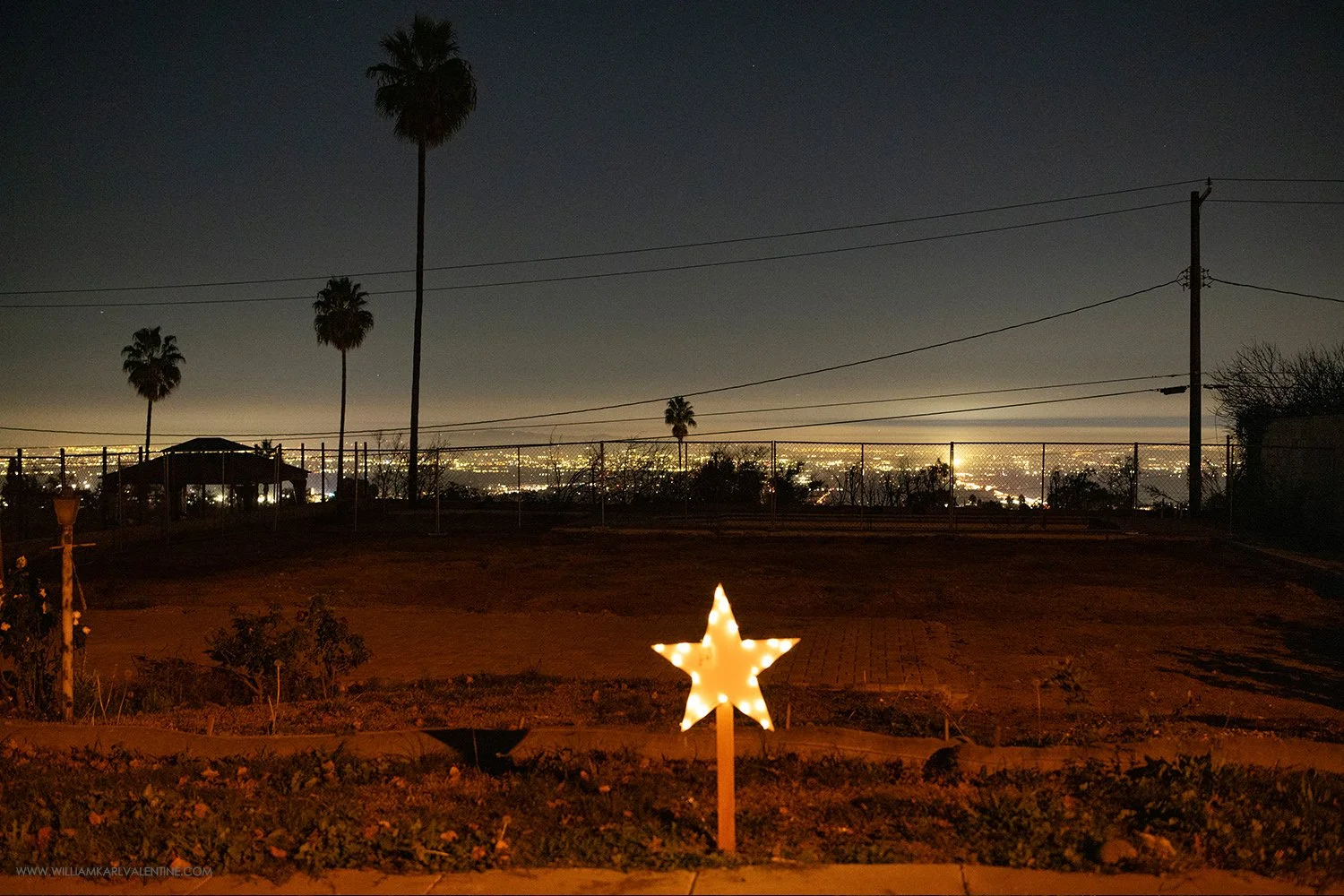
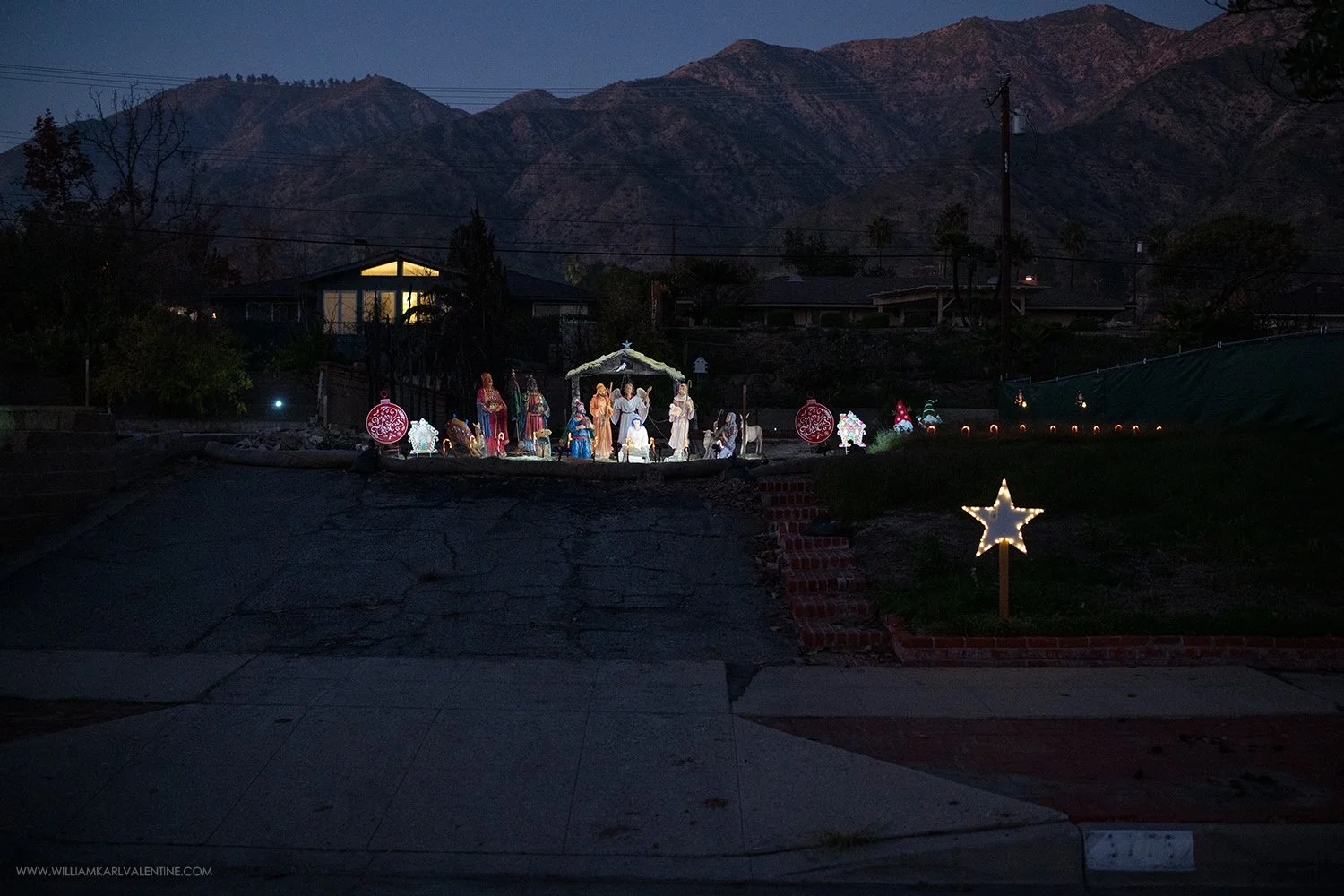
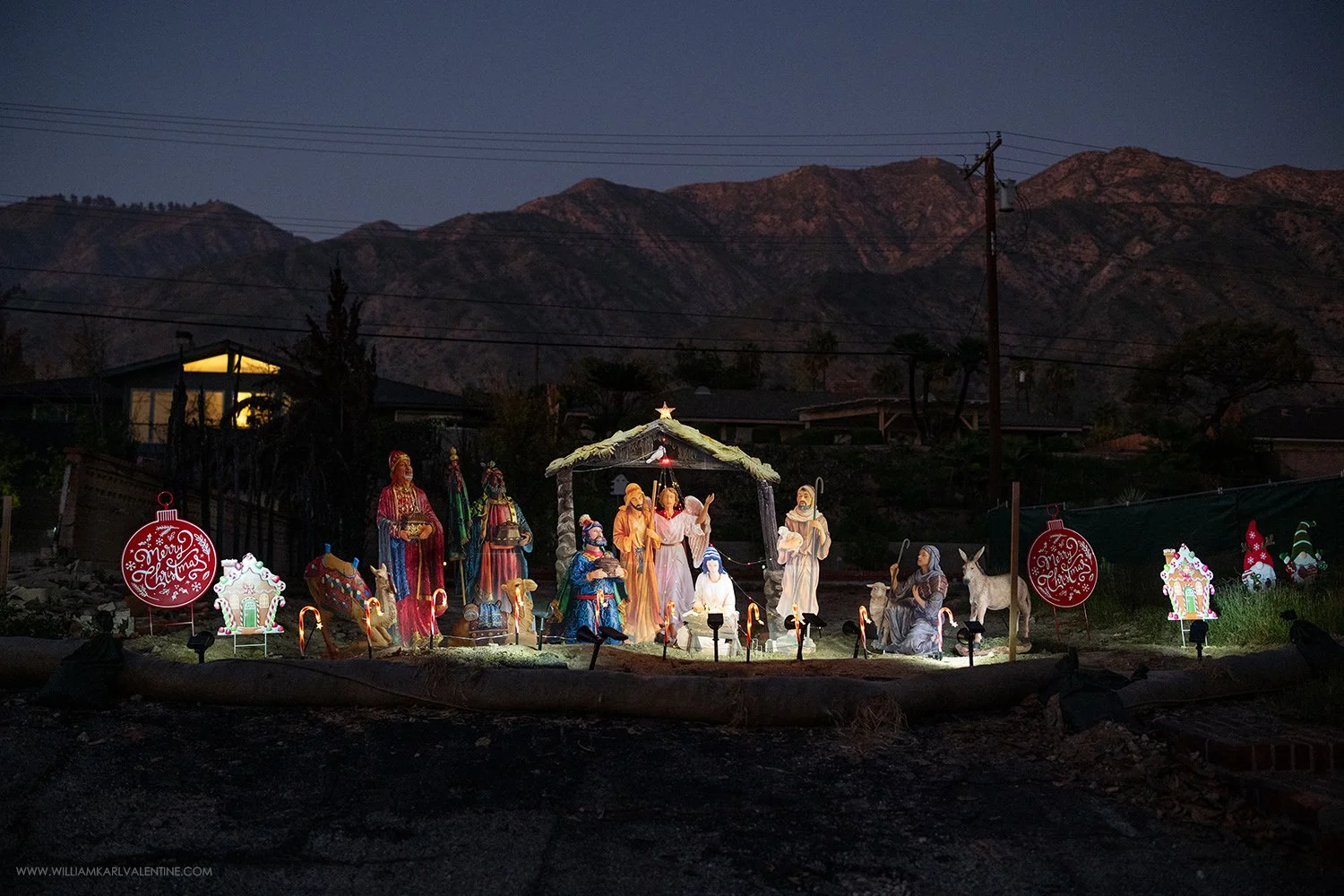
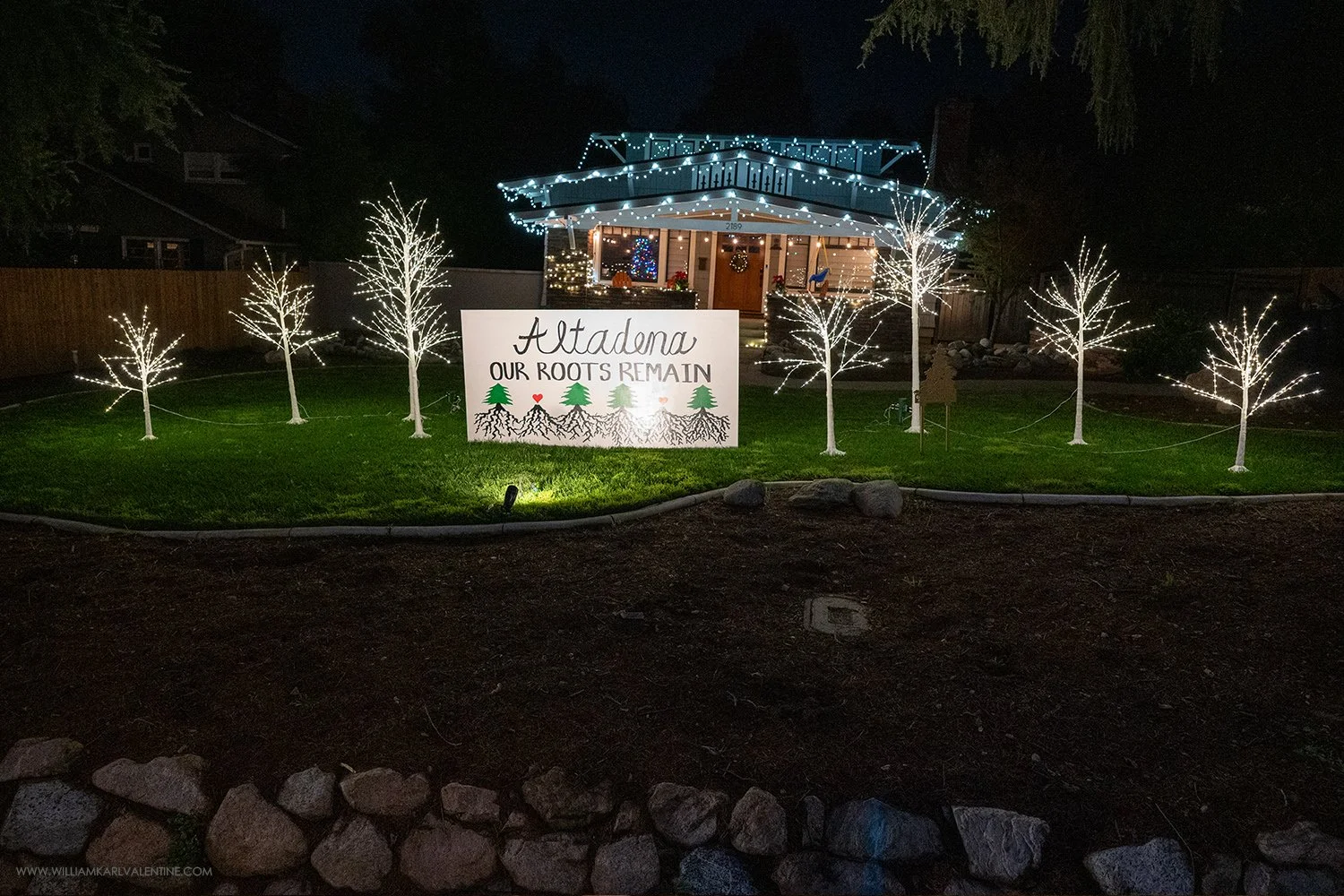
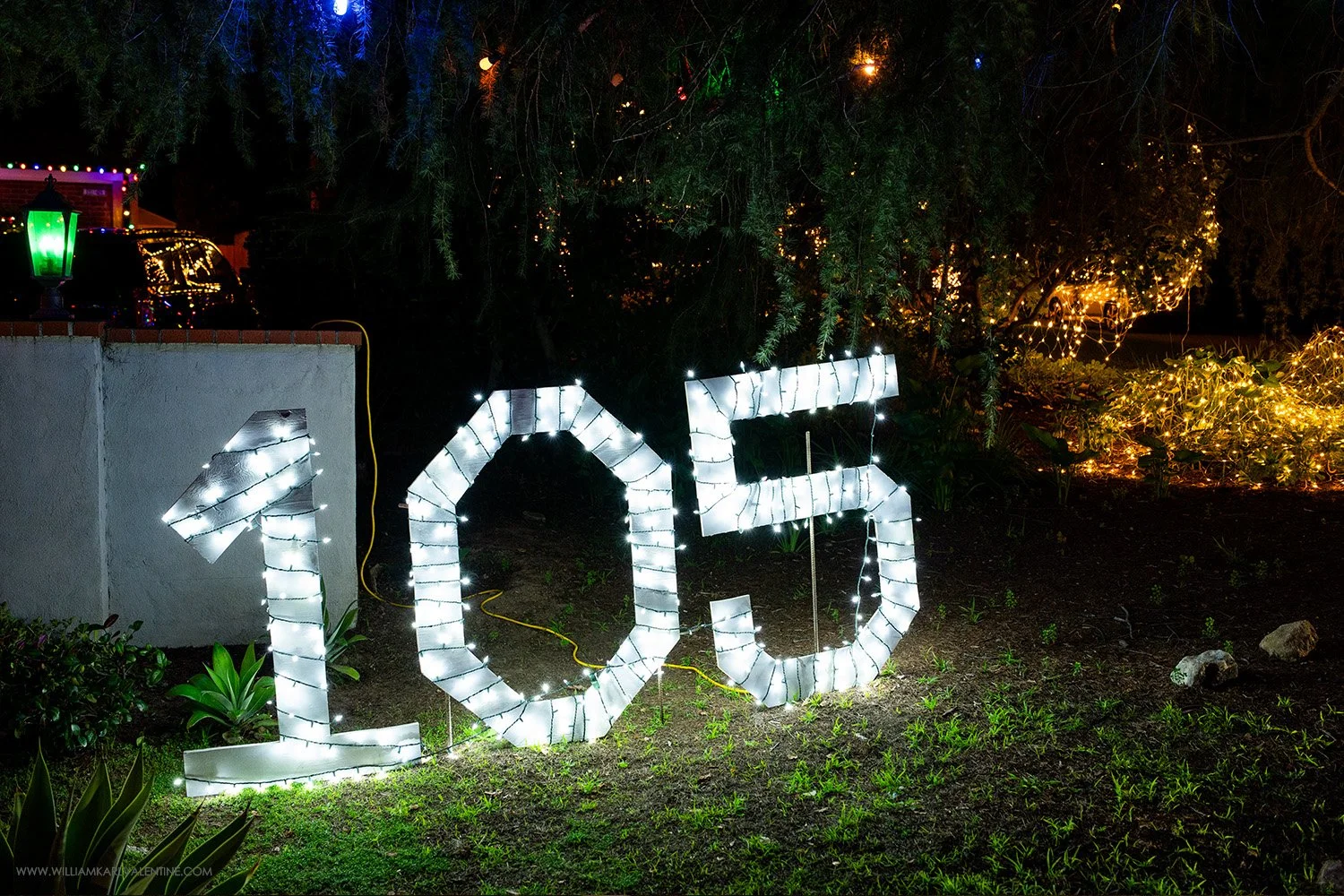
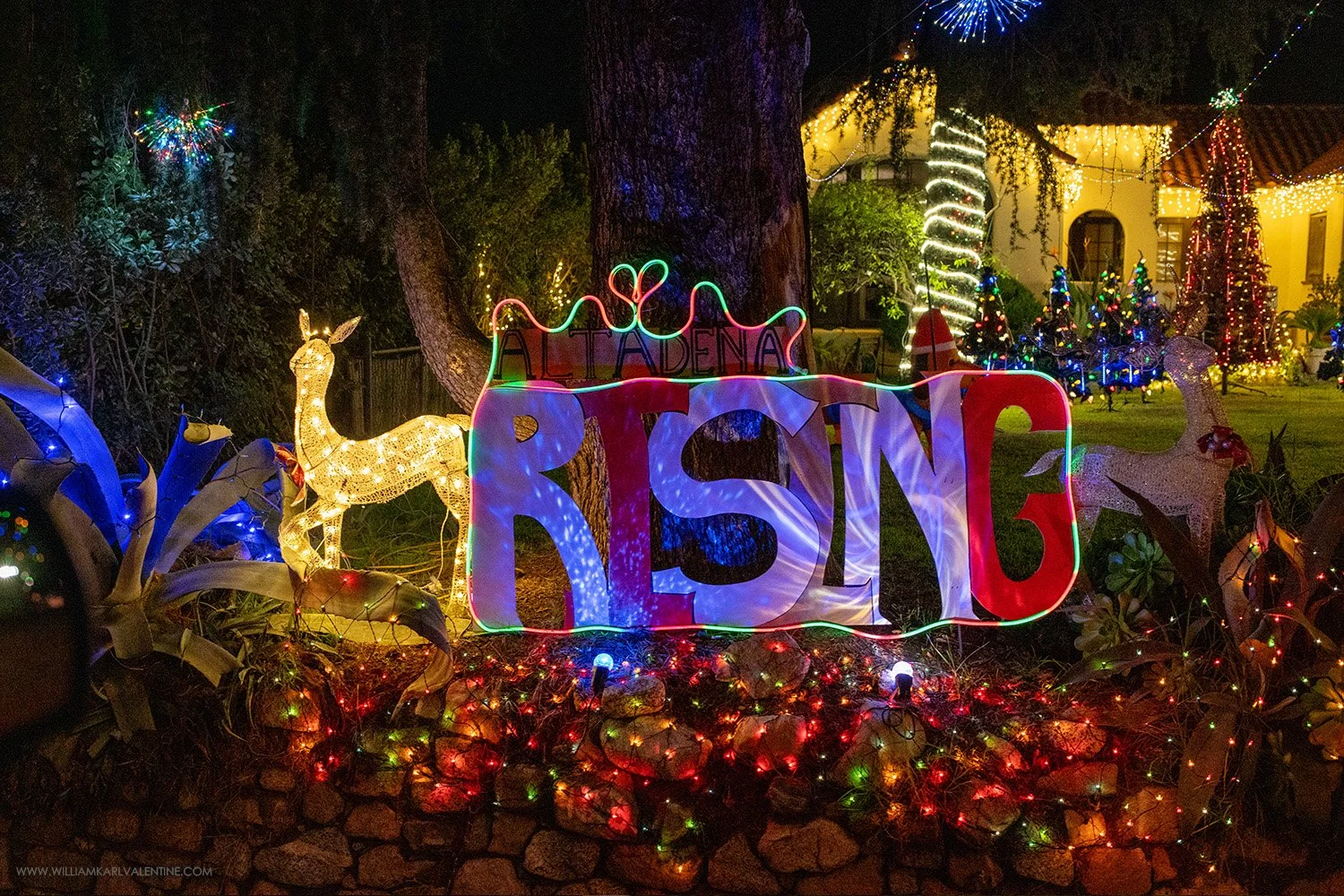
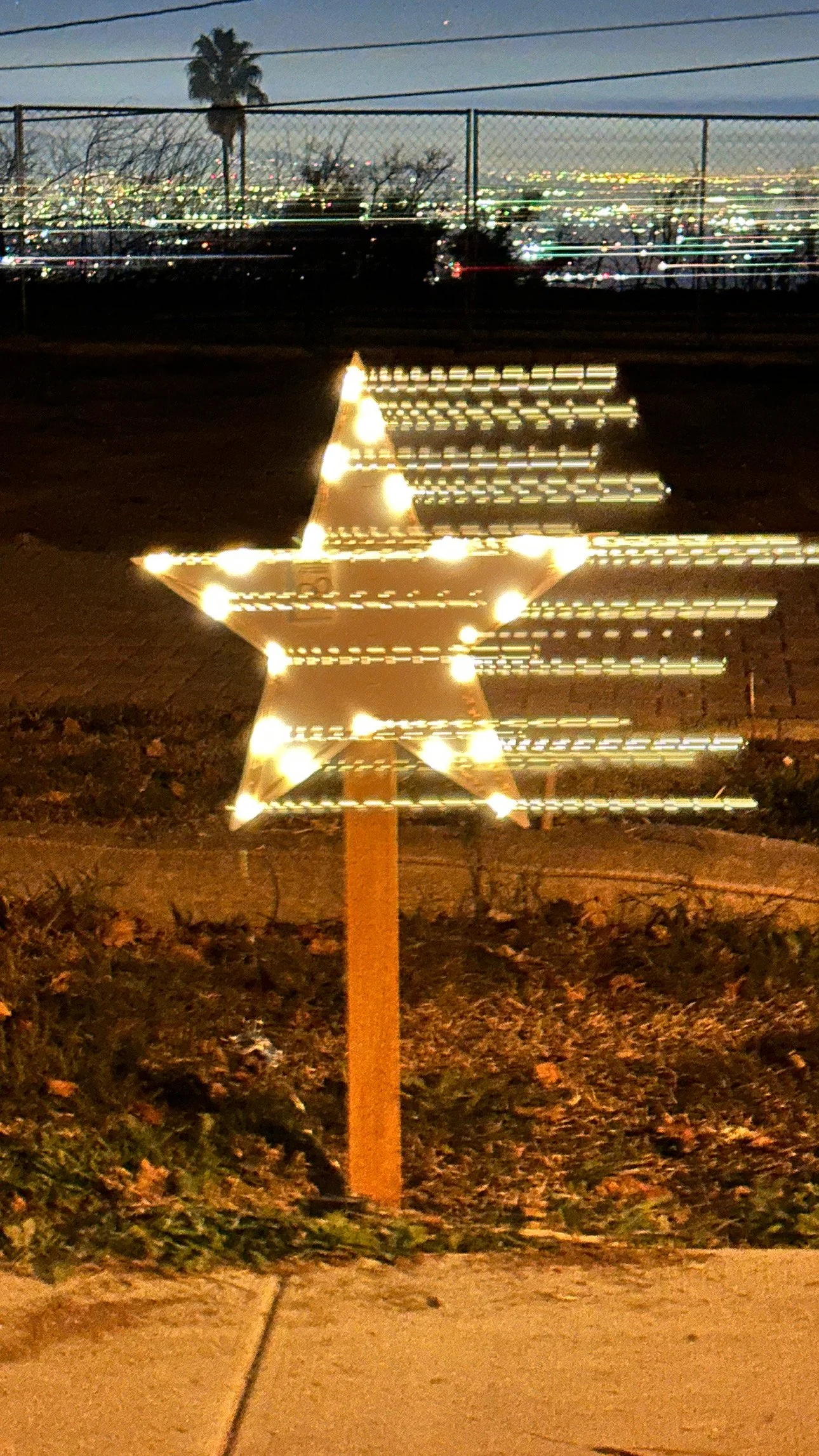
This year I have returned to some areas multiple times to photograph. There is one lot that the homeowner decorated for every holiday. The Werewolf of Altadena also changed attire for holidays, and this past month I saw lots of people making a point to recognize the hope of Christmas by still decorating in some way. In Upper Hastings Ranch the community there has a long tradition of decorating each street as a different theme. I remember going there as a child and my parents driving me around to see the lights. Dozens of homes were lost in Upper Hastings Ranch and the association there has placed a lighted star in front of each house that was lost. One owner set up a Nativity Scene where their home once stood. I have seen lots of signs of hope and resilience throughout the burn zone. This past month I have met people effected by the fire and with each conversation I have been impressed with their resolve.
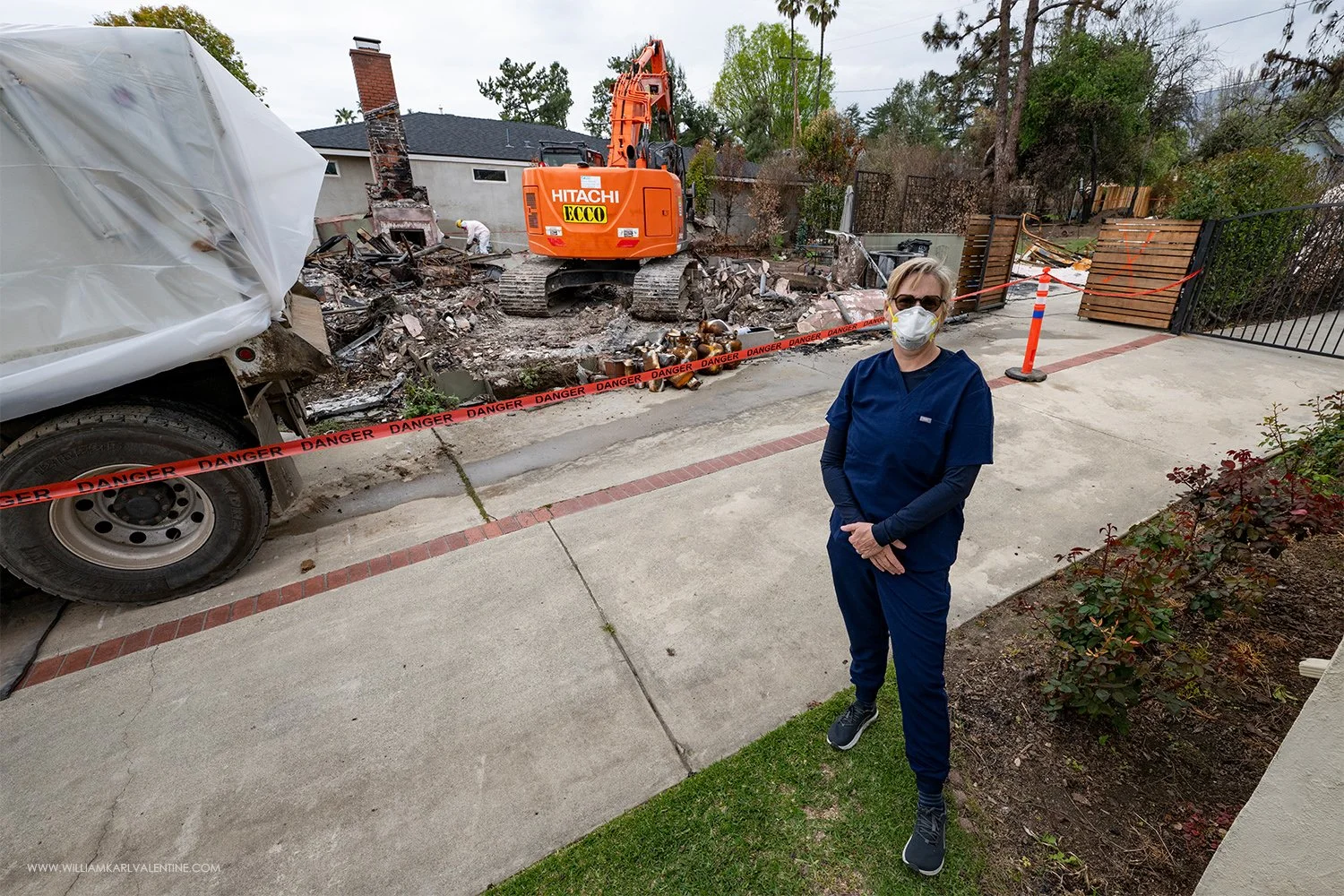
As we approach the 1st anniversary of the fire on January 7th, I wanted to showcase my recent images from Altadena and Pasadena to show how far people have come and how much further the area has to go to recover.
Christmas Tree Lane - Altadena
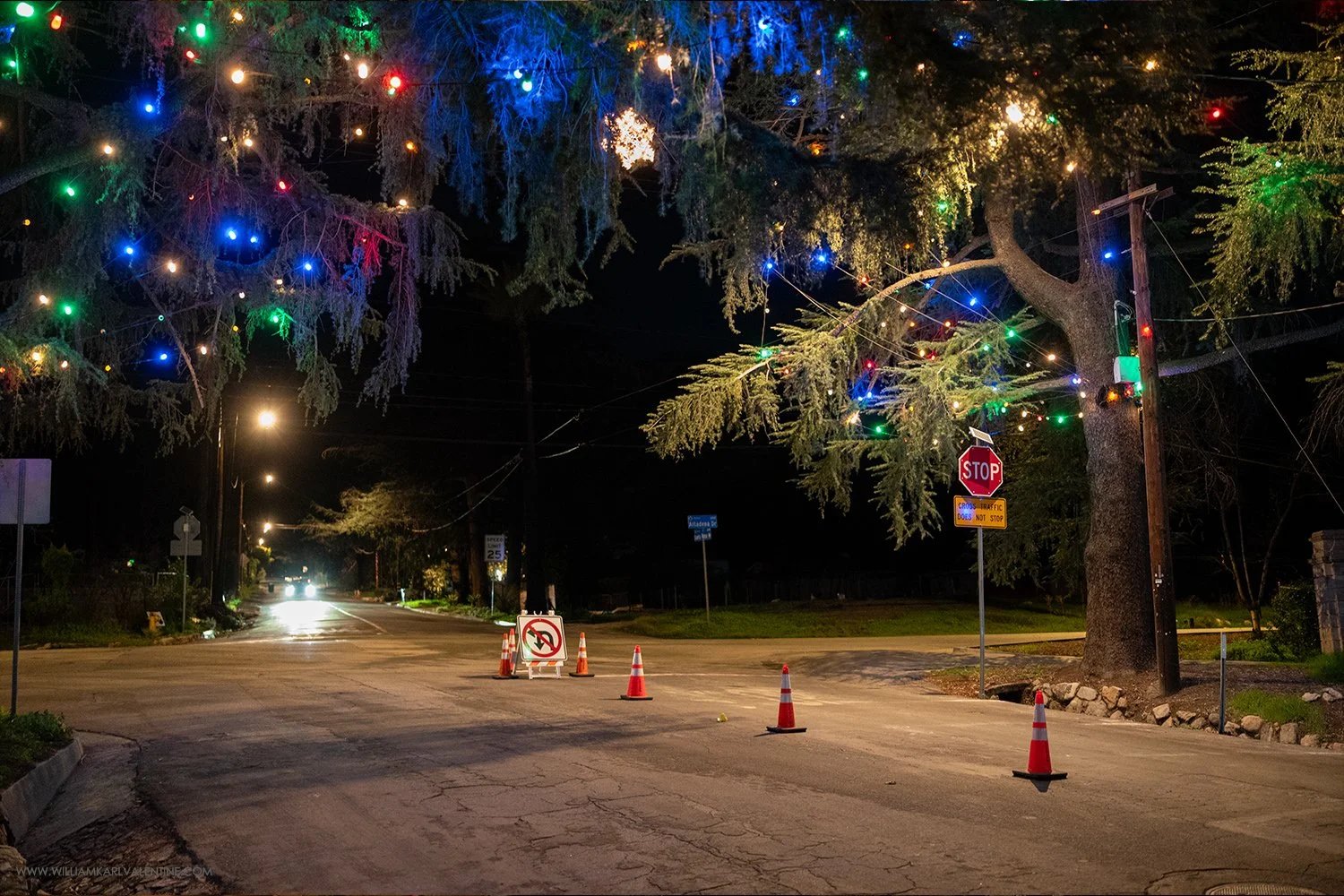
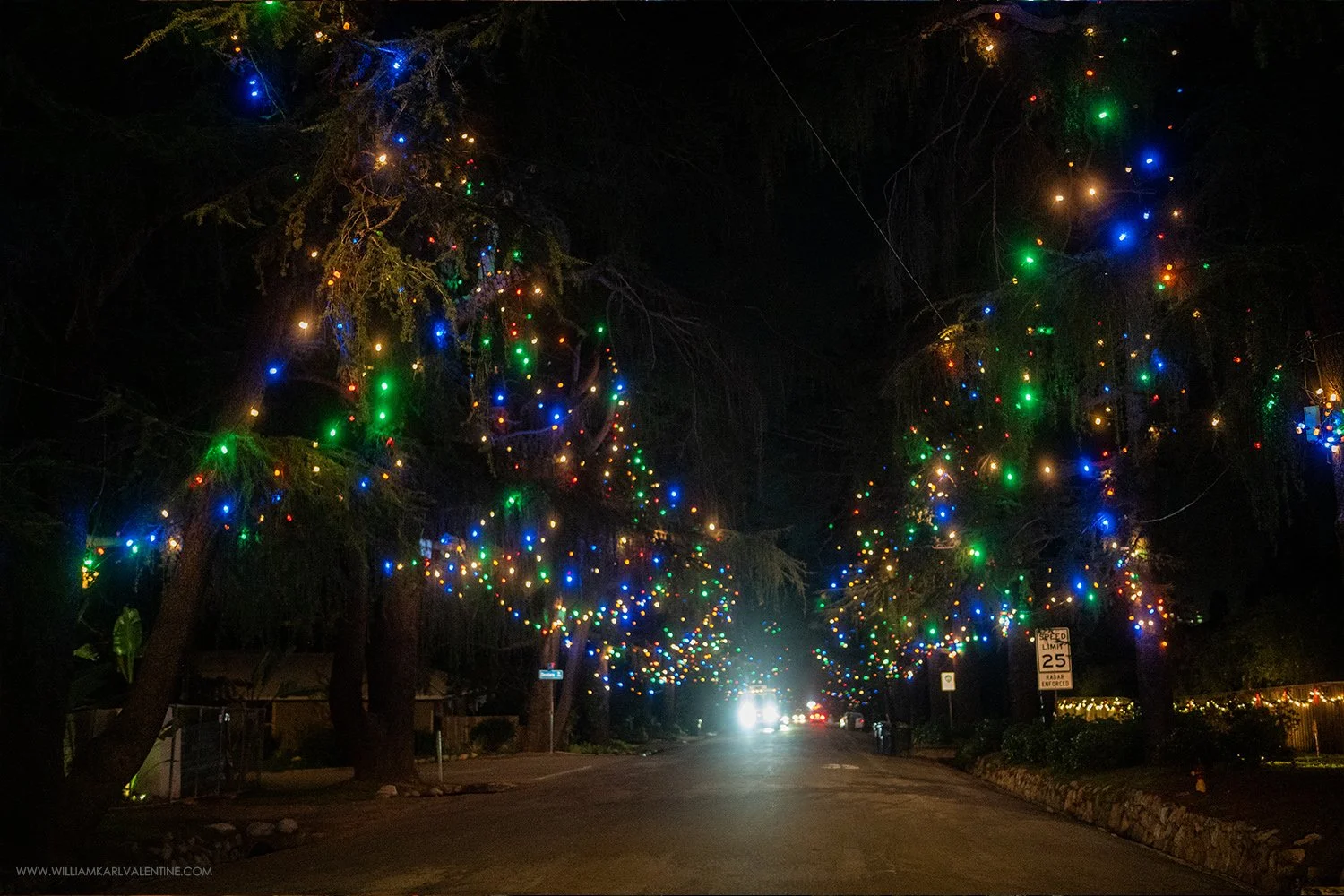
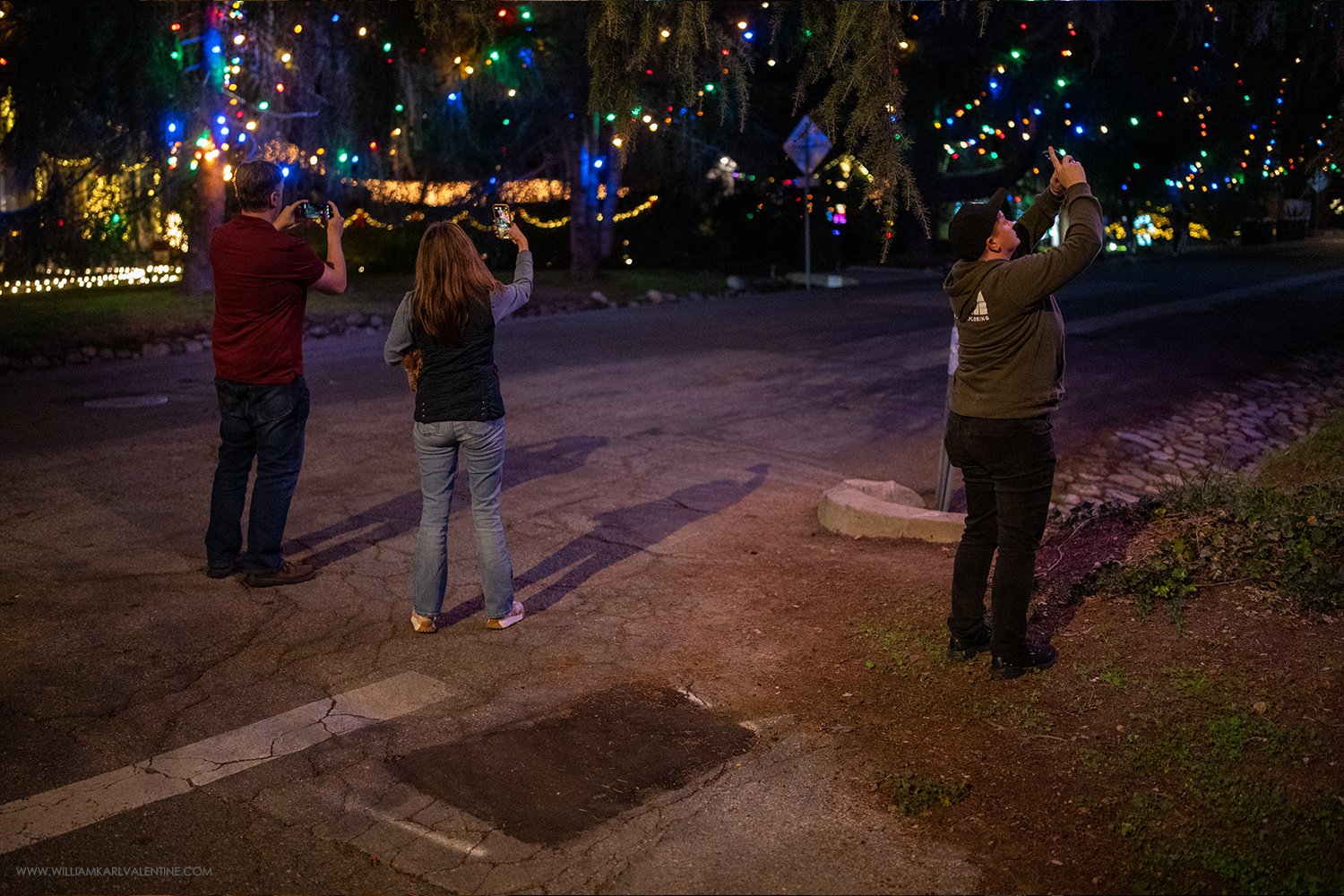
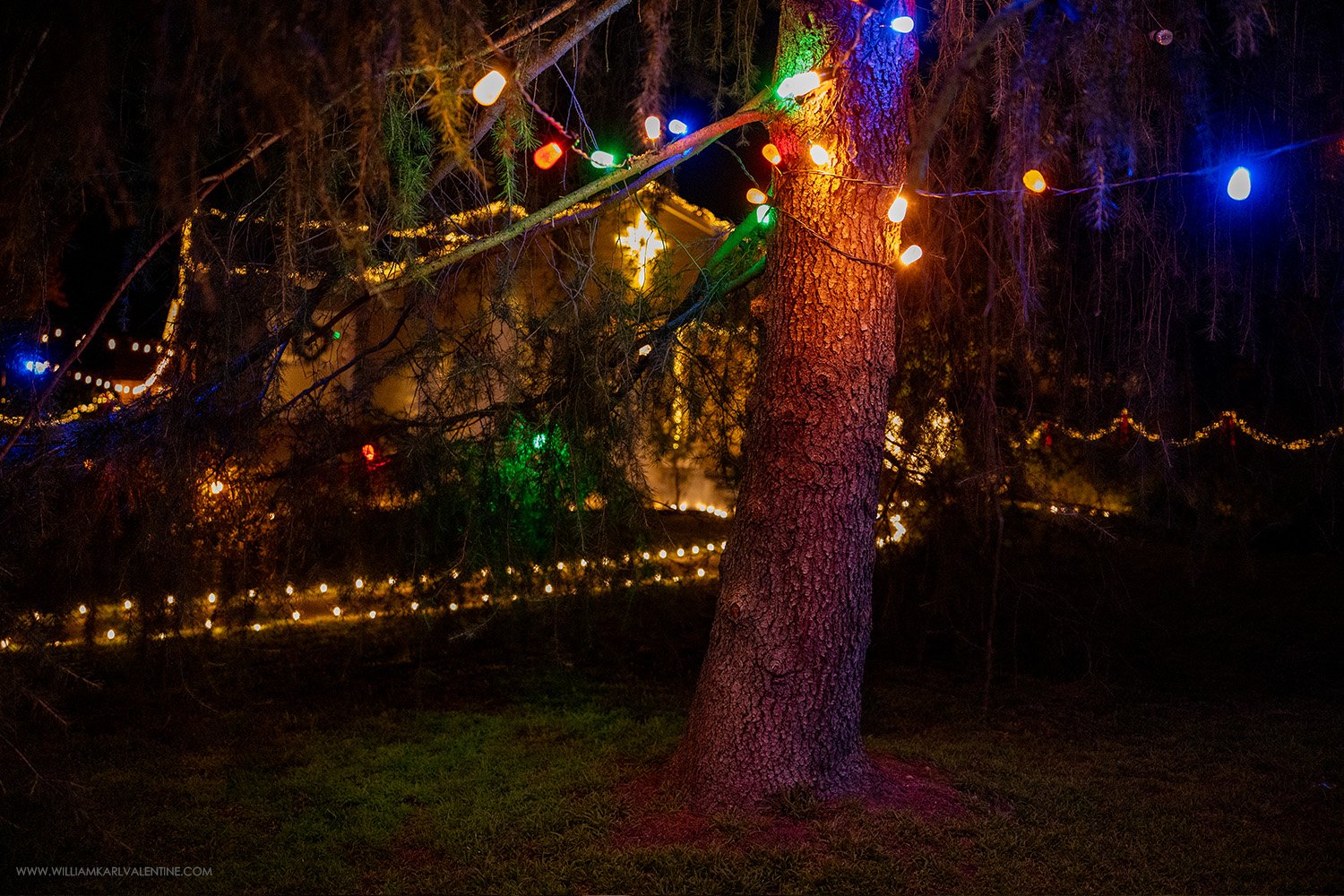
Deodar Pine trees line Santa Rosa Avenue in Altadena and for 105 years the residents have hung Christmas lights on the trees. Miraculously none of the trees were lost in the Eaton Fire (the trees have properties that protect them from fires) but unfortunately several homes on the street were lost. At least one of the homes has already started reconstruction. It is a tradition I remember from my Childhood and I am so grateful that it wasn’t lost in the fire.
Adrian Molina - Owner of Sidecca
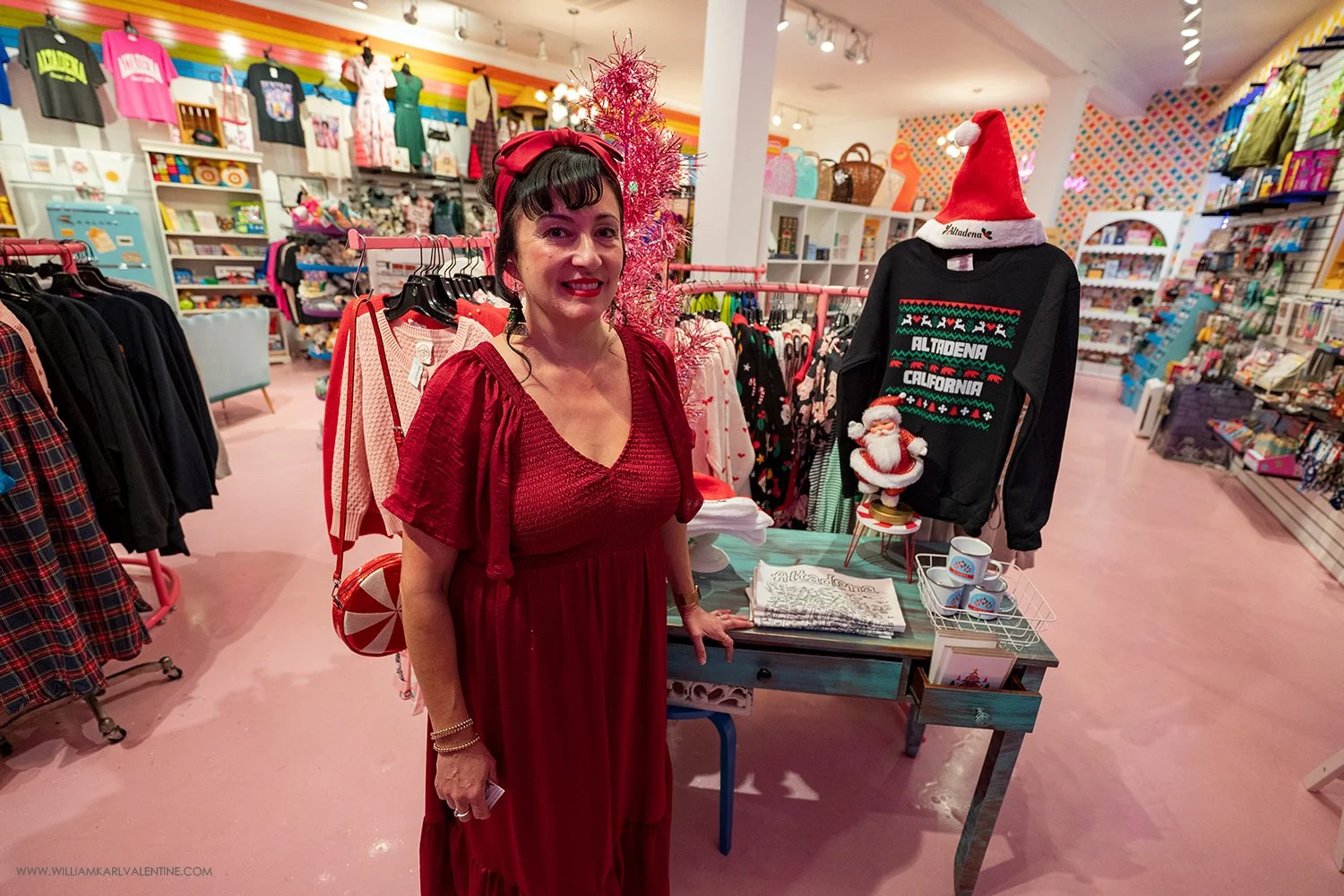
CA DSC 5920 11-30-25 Adrian Molina
Sidecca is a boutique shop in Altadena on Lake Avenue which survived the fire with just smoke damage. They have long carried Altadena themed products and really represents the community well. I was able to get Adriana to pose for a photo shortly after she reopened in November. She had to shut down again a couple weeks ago when heavy rains caused massive leaks in her shop. She is amazingly resilient, and I am sure she will be back because I know her customers will continue to rally around her. www.sidecca.com
A Couple Images from my Phone:
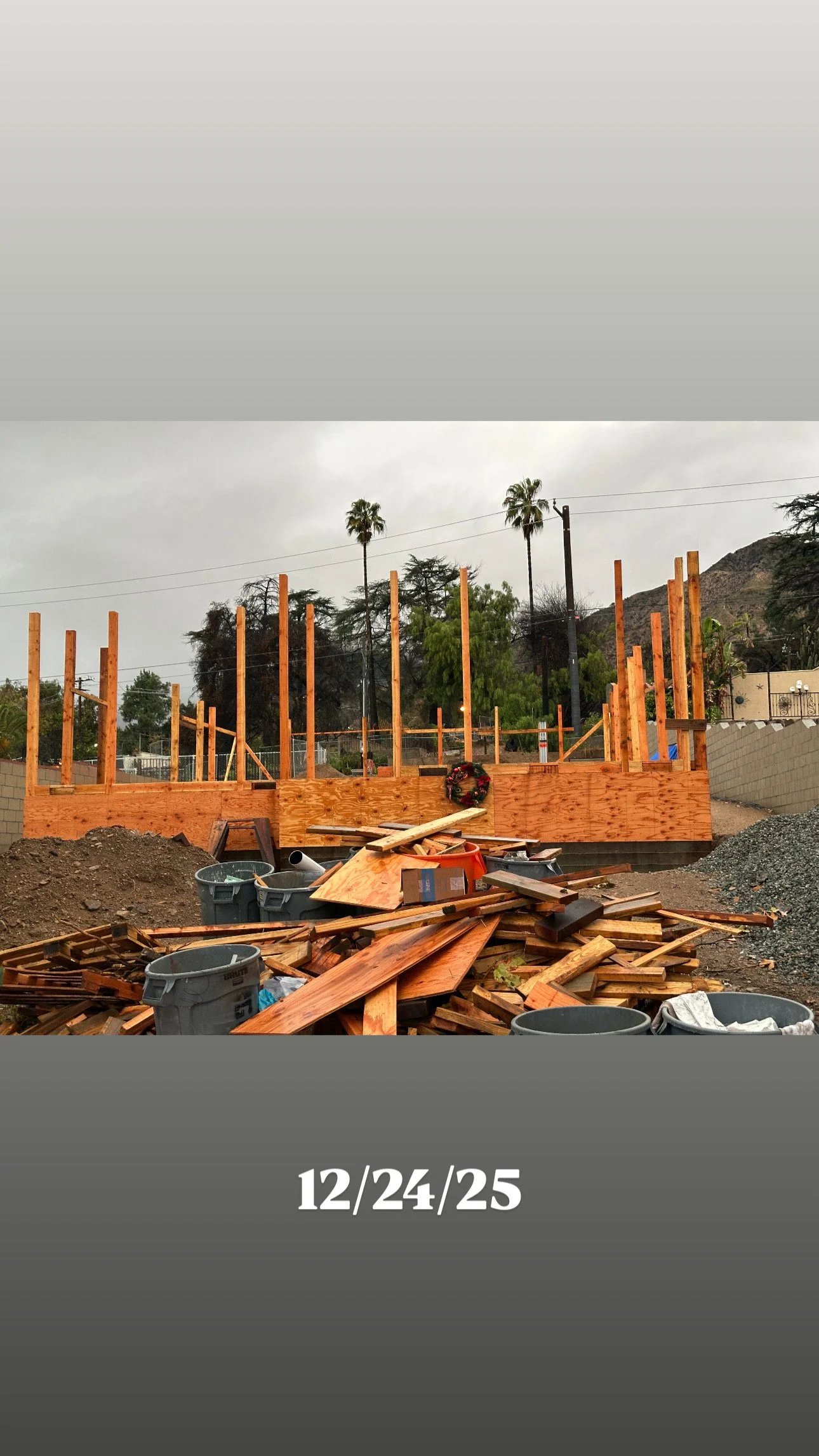
Finally, two images from my phone. One from Christmas Eve when I found a house that is in the process of being framed where the owner had hung a wreath on the plywood. The other is something my phone created when I apparently moved during a long exposure in Hastings Ranch. Happy New Year and may the recovery from the Eaton Fire pick up speed in 2026. Lots of people still hurting up there.
CA DSC_7379 11-22-2025 - Jun Li Lujan, First to rebuild and move back into a home lost in the Eaton Fire. Pasadena
The Eaton Fire this year really reminded me to be thankful. First that my mom, who lives in Pasadena, was fine and our family came through it pretty well. But then every day I photographed in burn zone and saw the incredible loss it reminded me to always be grateful for what I have.
Most the time when I photograph in Altadena it is in solitude since so few homes have been rebuilt. I have been lucky though to have had some incredible conversations with people this year. A lot of people just wanted to tell me how they felt, or what they witnessed, or what special item they lost. A lot of these conversations have been really powerful, especially when they talk about their resolve to rebuild. It is also so random how I have come in contact with some people, like I was guided to that spot.
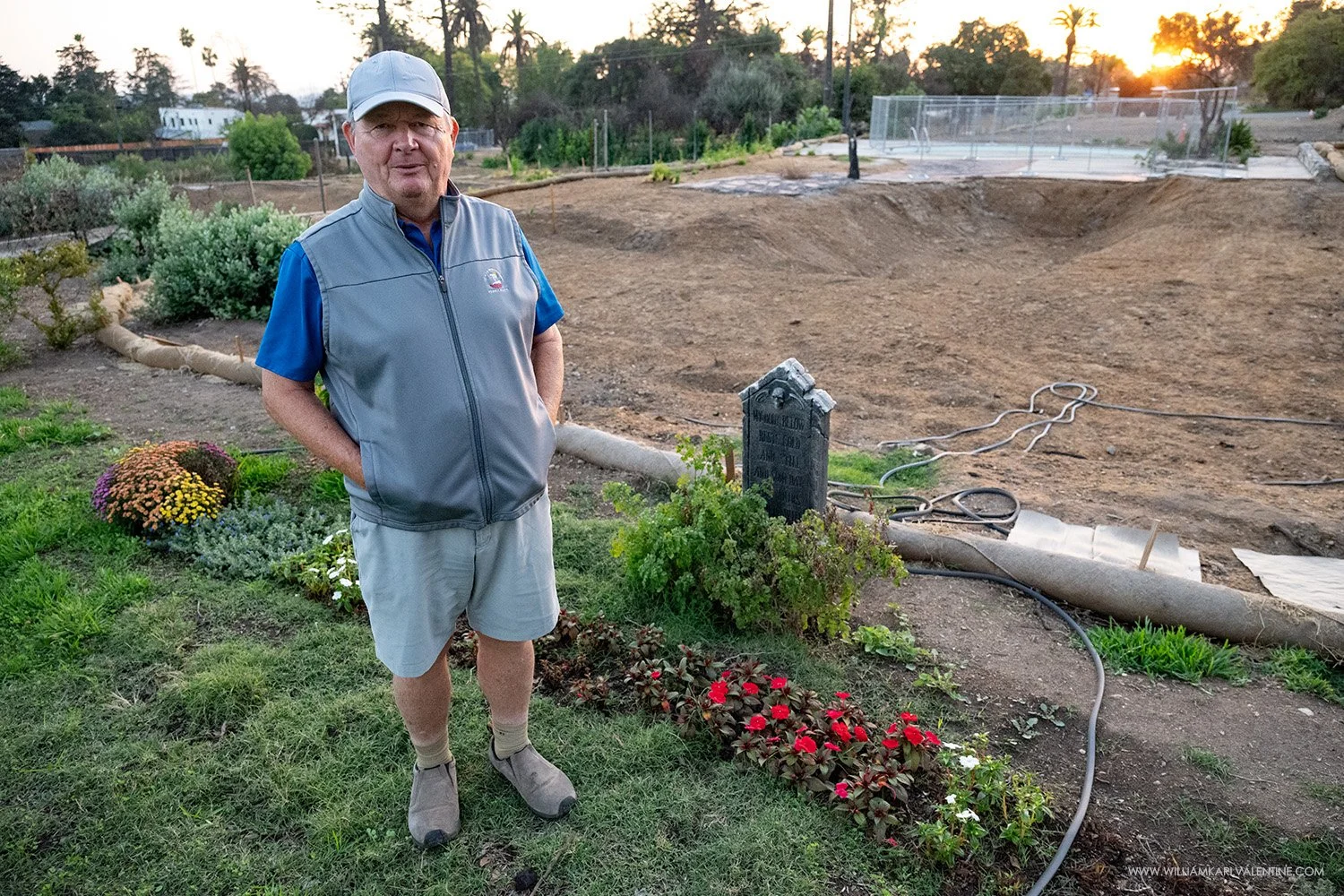
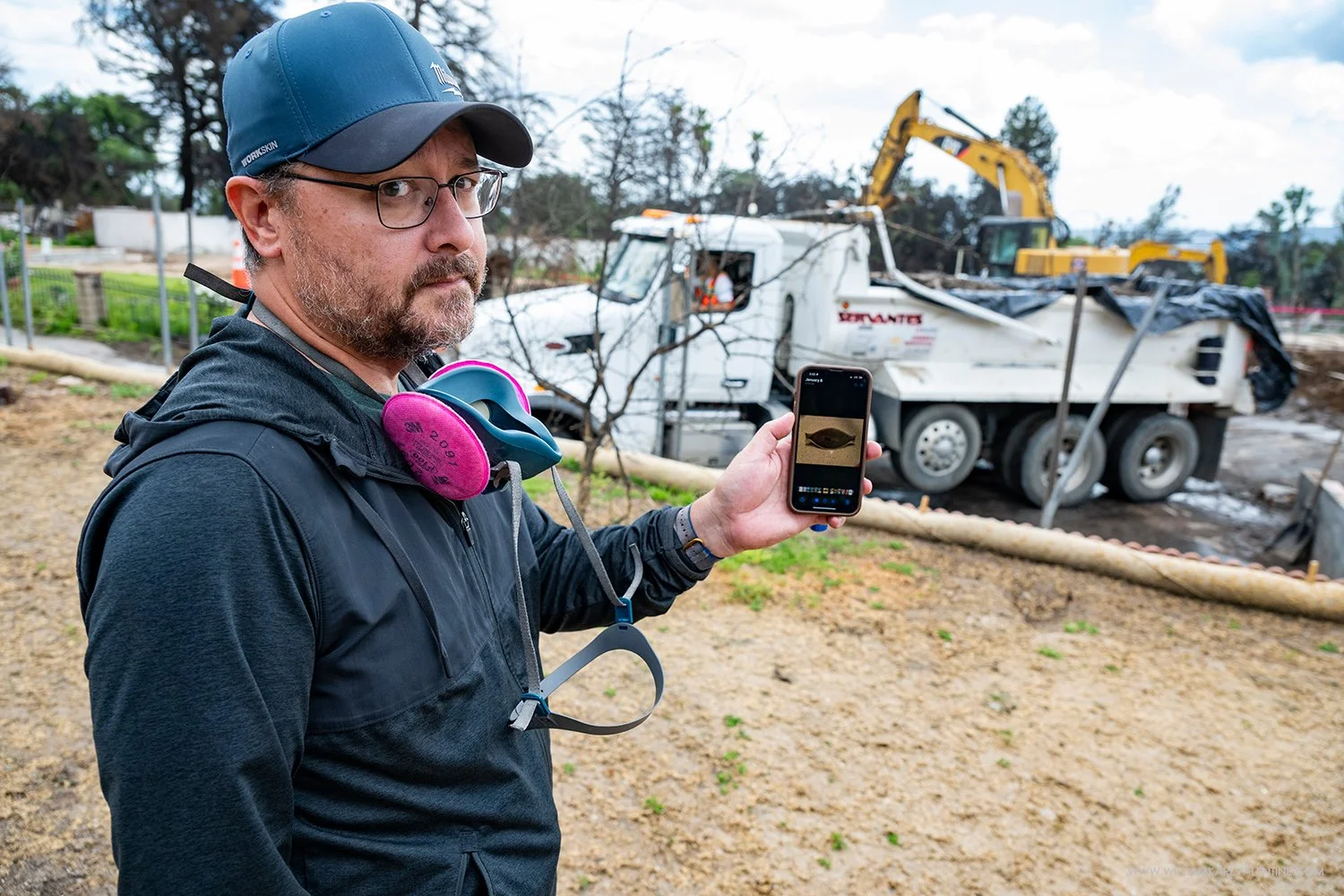
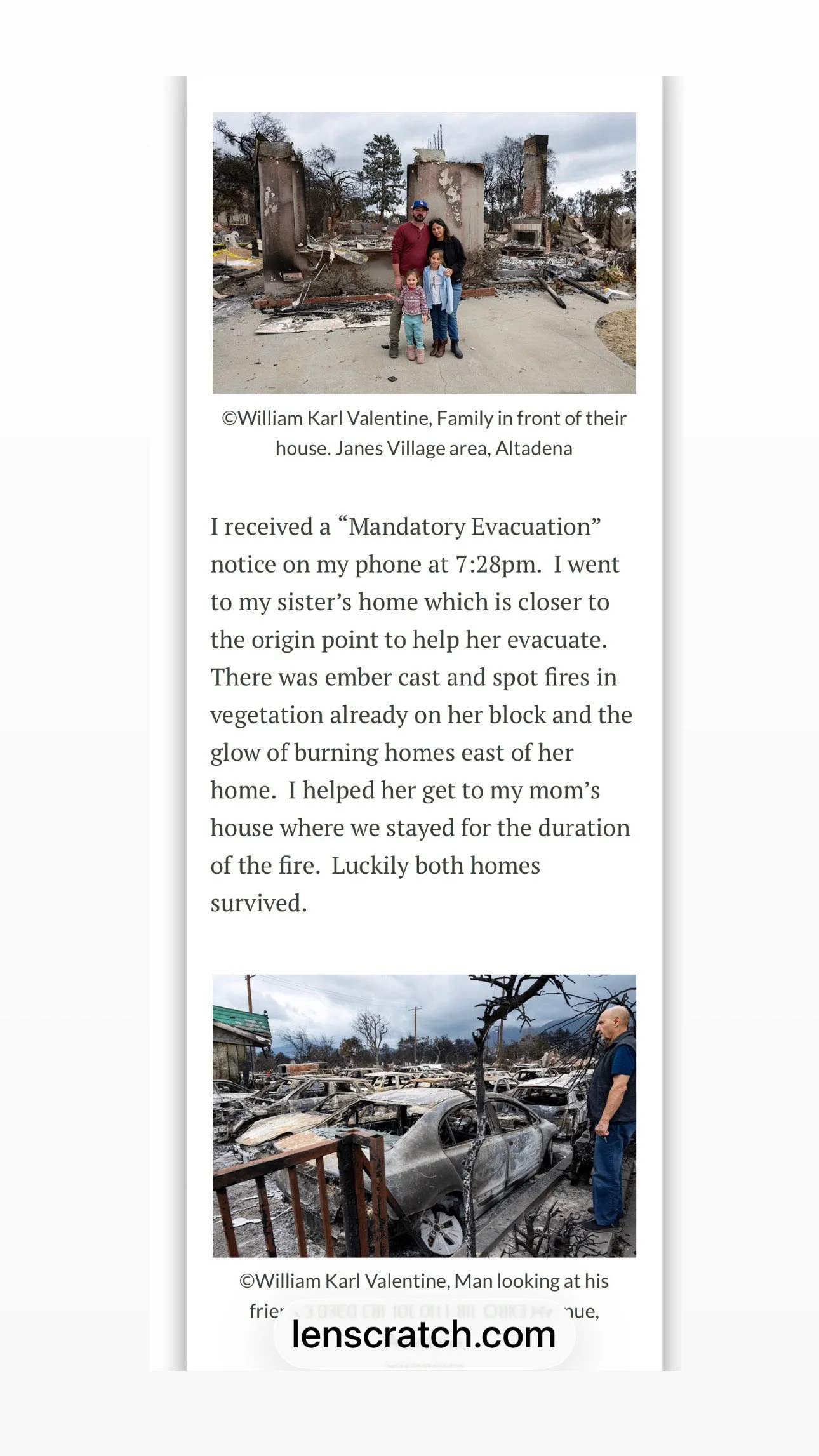
I saw Jun Li Lujan being interviewed on TV last week about being the first resident to be back living in a home that was rebuilt. I figured out what street she lived on and went over to photograph the house. As luck would have, I caught her at home and was able to photograph her. Her house is in Hastings Ranch, in Pasadena. Jun is a dynamic human, and she took the loss like it was a challenge to rebuild. She is a contractor and home designer, and she had built the home that was lost. Her positive outlook was admirable. In May I talked with Rob Moreland for half an hour about his Eaton Fire experiences. I learned a lot about the progression of the fire and timeline from him. He was another person with a positive outlook as was John who I met in September. There were a lot of great neighborhoods with good people who were impacted in the Eaton Fire. A lot of people up there are still hurting.
I believe my Eaton Fire Portfolio was assigned to me. Too many times, I have been at the right place at the right time to get amazing images or meet people. Although this process has been hard on me, I am grateful the task was given to me, and I will continue to do my best to complete the mission.
One final thing, I am also still thankful for the photographic talent I was born with and for everyone who has helped developed me as a photographer since then.

CA DSC 9701 1-14-25 - Del Reay Avenue, Pasadena, California - probably less than ½ a mile from my mom’s home.
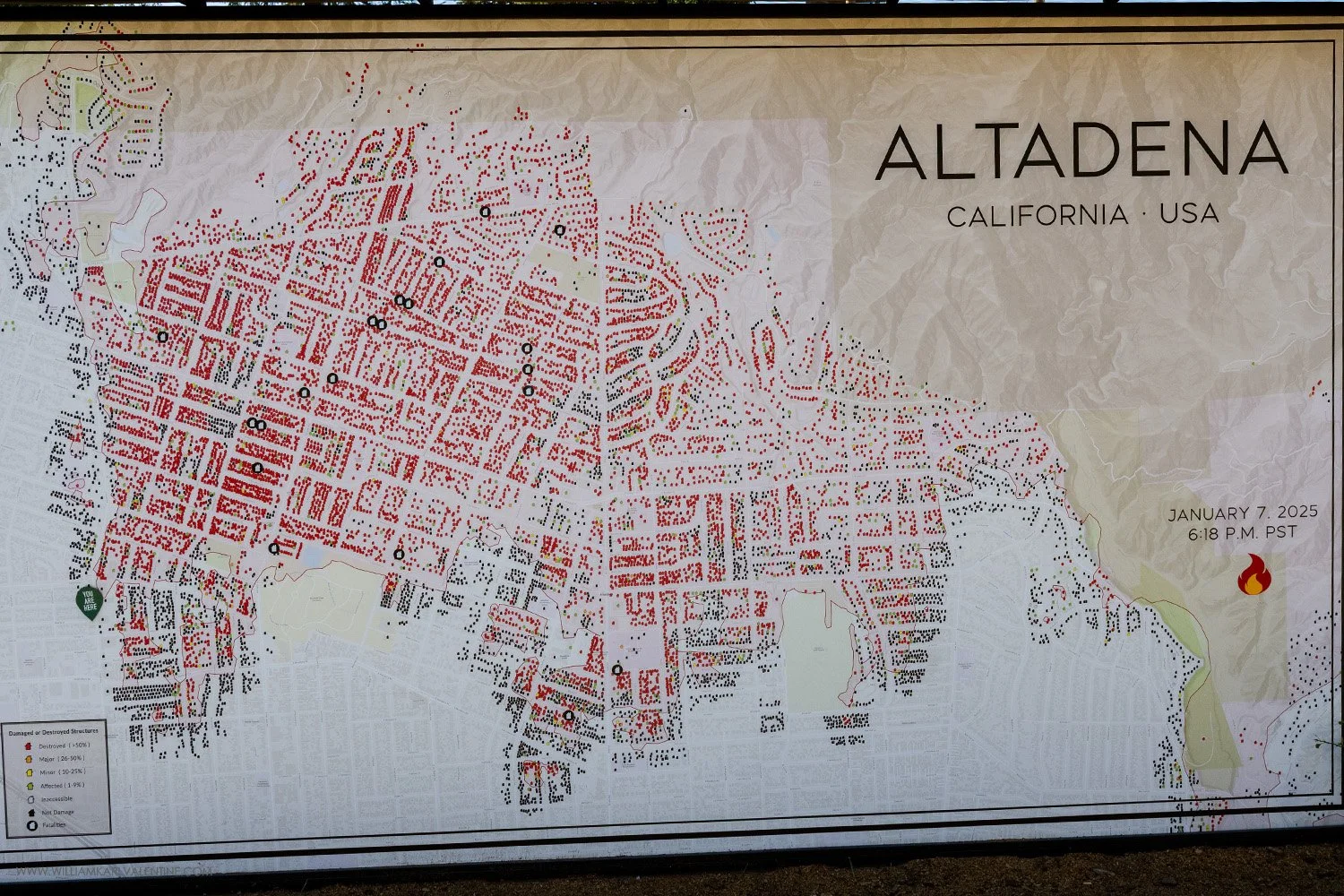
CA DSC 7092 10-31-25

Eastbound Crary at Valencia - CA DSC 01168 1-07-25

Eastbound Crary at Valencia - CA DSC 9571 1-14-25
I have been photographing in Altadena and Pasadena so much since the Eaton Fire on January 7th that I have become behind in the blog posts I want to share related to that portfolio. I have been pretty good at reviewing images as I go and getting content into the portfolio on my website, but not as good with the blog and I have not worried about Instagram.
I attended Arizona State University a few years after Mark Klett completed his Rephotographic Survey Project, so I was very familiar with it and I loved the concept. I never studied under Mark there, but I got to know him, and I like him and absolutely respect his work. Since those days I have found most any project where a photographer chases another photographer’s tripod holes to be interesting, and I like to return to locations of my own photographs to document change.
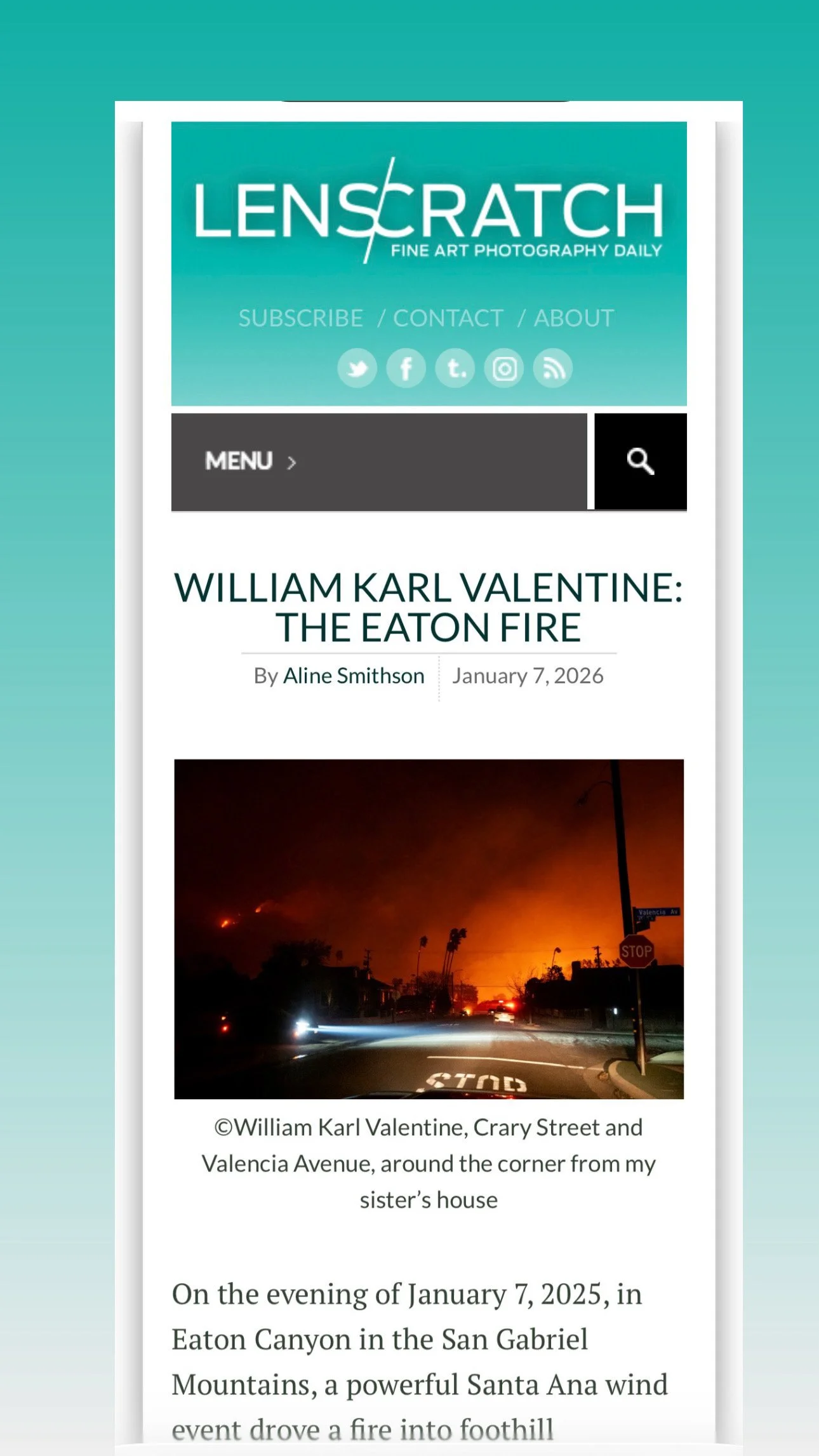
Crary and Valencia is in unincorporated Pasadena about a block from my sister’s home which has been in the family for about 90 years. The one image is obviously from the night of the fire, and I made the exposure at a time I was really worried about where the fire was spreading to. Luckily at this point the winds were driving the fire in this area mostly South along Altadena Drive (as you look at the image that would be left to right).
When I made this exposure I could obviously see the mountains were burning and I thought the large orange glow at the end of the block was from Kinneloa Mesa burning, but the second image confirmed I was wrong since you can see the homes on Kinneloa Mesa survived. The glow was from a large townhome complex that had built along, more likely on, the Eaton Canyon Reservoir. To be honest I never realized they were there since they were tucked back in our of sight.
The car on the street burned but was removed before I got back to see it. These images are a week apart; I couldn’t get into that area at first because of LA County lockdown restrictions. I looked at the ground where the car was and I am assuming that leaves and other debris from the winds had piled up under the car and that an ember lit them on fire which burned the car. The palm tree trucks burned some but they survived, and the house appeared to be undamaged. I assume the fire engine which showed up for the car fire kept it from spreading to the homes.
The devastation I have photographed is so surreal, especially because I know the area so well. Comparing these two images I am still amazed how some areas came through the fire so well and other areas became rubble and ash.

My observation of the Eaton Fire, before, during, and after.
Read MoreI am proud to announce that I have two photographs in the Atlanta Photography Group’s annual Airport Show which opens later this month at the Hartsfield-Jackson Atlanta International Airport.
Juror Lisa Volpe selected 30 photographs, from over 500 images which were submitted, to exhibit in the central atrium of the airport. Hartsfield-Jackson Atlanta International Airport is the world’s busiest airport with an average of 260,000 visitors a day. In 2019 Atlanta had 53.485,000 total visitors, the next closest airport was LAX at 42,880,000.
The 2022 Airport Exhibition is scheduled to be up September 22nd, 2022, to January 25th, 2023, and this is the second, consecutive year, I have exhibited two photographs in the APG’s Airport Exhibition.
My two included photographs are from two different series. The above image (PPD- 057 #14) is one of my favorite images from my Pasadena Police Department portfolios. I photographed Officer Kevin Hall on December 1st, 1985, at the Do Dah Parade in Pasadena. This parade is a spoof on the annual Rose Parade and the mid 1980’s was when the parade was at its height of popularity. I have always seen this image as symbolic of all the different threats and unique incidents that police officers encounter daily.
The image below (BOS DSC 8022 March 6th, 2021) is from a trip to Boston last year when I discovered Ponyhenge in Lincoln, Massachusetts. The link is to my blog post detailing that experience with numerous other photographs from there.
Having Lisa Volpe select two of my photographs for this exhibition is very exciting. Her insight of the medium is outstanding, and she has so much passion for photography. This interview of Lisa by Aline Smithson for Los Angeles Center of Photography gives fantastic insight to who she is and her thoughts about photography.
If you are in the Atlanta airport later this year hopefully you can check out this exhibition. It is outside of security in a food court area so it’s hard to get to if you are connecting to another flight there. I will try and update this post when more information as it is available.
I had another Photography first this summer when I licensed one of my images to be an album cover. The Spanish band Beautiful Senoritas found the above photo from my Pasadena Police Department Portfolio and really wanted to use it for the album cover of their new record “So Good!”. I had to hear their music and read the lyrics to “Call the Police” before considering the licensing. I liked their sound and there wasn’t anything negative in the lyrics, so I was good with it. I then called up “Caps” to make sure he was fine with the use, and he was. The band is emerging still, so the album will probably be a small project, but I have to admit the band members were so professional during the process. One of the best licensing experiences I have ever had. Hopefully the album takes off and does well because I love seeing good people have success. I just got a proof of the artwork and wanted to share it.

P.C.622 Gallery - The Old Pasadena Police Station at 142 North Arroyo Parkway
California Penal Code Section 622 states the following: Every person, not the owner thereof, who willfully injures, disfigures, or destroys any monument, work of art, or useful or ornamental improvement within the limits of any village, town, or city, or any shade tree or ornamental plant growing therein, whether situated upon private ground or on any street, sidewalk, or public park or place, is guilty of a misdemeanor.
The first time I exhibited any of my photographs was in April 1985 at the Northlight Downstairs student gallery at Arizona State University. it was a small space near the darkrooms but it had lots of traffic and great visibility with my peer group. It also gave me my first experience editing and sequencing an exhibition. I exhibited some early images from my Pasadena Police Department series , which to this day is still my strongest body of work.
I began photographing the Officers of the Pasadena Police Department during Spring Break in 1985 as a class project while studying at Arizona State University. My father was a well-respected Reserve Police Officer, and he arranged the opportunity. I rode with Sergeant Tom Oldfield the first night who was one of my dad’s close friends. Being a Sergeant, Tom had the ability to respond to any interesting call to try and get me as much action to photograph as he could. The most eventful thing was a woman named Tina Hart who committed suicide in the middle of a street by shooting herself. The rest of the week I rode with individual officers and photographed whatever incidents they were involved in. When my professor, Tamarra Kaida saw my early images she realized how good the series was and encouraged me to continue photographing the department beyond the class assignment. Another professor, Bill Jenkins (best known for curating the important New Topographics exhibition) also liked the early images in this series. Bill gave me some outstanding advice when he suggested I start using a wide-angle lens to photograph this series. Initially I had used a 50mm lens and in some instances, I had stood back from incidents to stay out of the way. Bill explained that using a wide-angle lens would force me to get closer to my subjects and make the images more powerful. The combination of putting on a 35mm lens and gaining more trust from the officers I was photographing to my images to another level. Using wide angel lenses has helped me capture most of my best images.
During the first few weeks of the summer of 1985, I started to develop good rapport with most all the officers. I knew how to stay out of the way and not let my photographing interfere with their job even though I was usually making exposures at night in low light conditions using a large off camera flash. I would make prints for the officers, and everyone liked seeing photographs of themselves working. Early in the summer of 1985, I become a Level 3 Technical Reserve Police Officer, which allowed me to volunteer in Police Department’s own photo lab most days before going on ride a longs with officers at night to photograph. It was an ideal situation because it gave me darkroom access while I was away from ASU.
One day I noticed a large empty bulletin board in the main hallway of the Police Station. The area had lots of foot traffic, department personnel as well as public visitors. I recognized the bulletin board could be a decent gallery space to showcase my photographs. I figured my photographs would be good for department morale as well as having a public relations benefit for public visitors. I asked for permission to turn the bulletin board into a gallery and it got approved. The photograph above it from the first group of prints I exhibited. I tried to change out images on a regular basis to keep interest.
I named the space the P.C. 622 Gallery to discourage any of the officers from adding comments to the prints or vandalizing them. Being around the officers I knew how much banter and teasing went on. Lockers were routinely written on highlighting recent exploits or mistakes and I knew officers started doing similar things to my photographs I would lose the space. I searched the Penal Code for sections which would cover that and discovered P.C. 622 which specifically covered destroying or defacing artwork. For the year plus the gallery was up we only had one instance where a print was written on and that was when the group of prints were not changed out for three months during a spring semester. I came across the above photograph of the gallery this week while organizing files and decide to share the story of the gallery. I also think this post also pairs well with my post on the opening of the exhibition at the Atlanta Airport Exhibition space this week, I, like most photographers, always enjoy seeing my photographs exhibited in traditional gallery and museum spaces, But I also love showing my images and prints in non-traditional spaces that have high traffic volume. There is always value in having images seen and experienced by others, especially in print form.

Installing the exhibition - push pins, level, tape measure, and “eyeballing it” 1/24/20
I drove the 500 miles home from Tucson on Sunday afternoon after everything with the Legacies of LIGHT symposium wrapped up. The next day I headed to Pasadena to check in on my mom and run some errands.
I stopped in at Samys Camera to get a couple things and to tell my friends there about the experience I had at the symposium. While talking with Jeff O’Brien he told me how the prints on the store’s small gallery wall had been up almost three months and he wanted to get some new photos up. He knows my work well and asked me to come up with something. I immediately agreed and started thinking about what I would do.
I realize the back wall of a camera store is not necessarily prestigious but in this case it had a lot of value. First of all the wall is very prominent and accessible. Almost every customer sees the wall when the exit the store and any customer going to the rental department walks right by it. This store has lots of knowledgeable photographers who are customers, plus it is two block away from a Pasadena City College which has an outstanding photography department. So the volume of potential viewers is very good.
I grew up in Pasadena and went to Pasadena City College, for me there was sentimental value to go home again. I had also exhibited work at Flags Photo (camera store) in Pasadena during the 1990’s, the store Jeff’s father had owned. I know that most any opportunity to showcase your work is a good thing because you never know who may see your images. I also know the process of editing and presenting an exhibition is a great exercise for a photographer.
When it came to what images to show I knew I had to include the image from my Pasadena PD series which was in the CCP’s Qualities of LIGHT exhibition, but I didn’t want to only showcase images from that series because they are from 34 years ago. I knew I wanted to give an overview of my work when I started editing for it, was thinking a linear display at first, and wanted to highlight images which had been in prominent exhibitions or were in permanent collections. I also had only glanced at the wall, had a guess at the size, but I hadn’t measured it.
Because I wanted to turn the project quickly I decided to make prints specifically for the show and didn’t want to deal with framing them. Michal Raz Russo’s presentation at the Legacies of LIGHT about some of the LIGHT gallery’s installations was fresh in my mind, so I started thinking about a simple way to the present work. The more I thought about it I realized I wanted to avoid a single straight row of prints and that I wanted to break up the pace of the images visually. I decided to make digital prints that were all consistent with each other even if the images were from film. I just can’t bring myself to casually display good silver gelatin prints since it takes so long to make them.
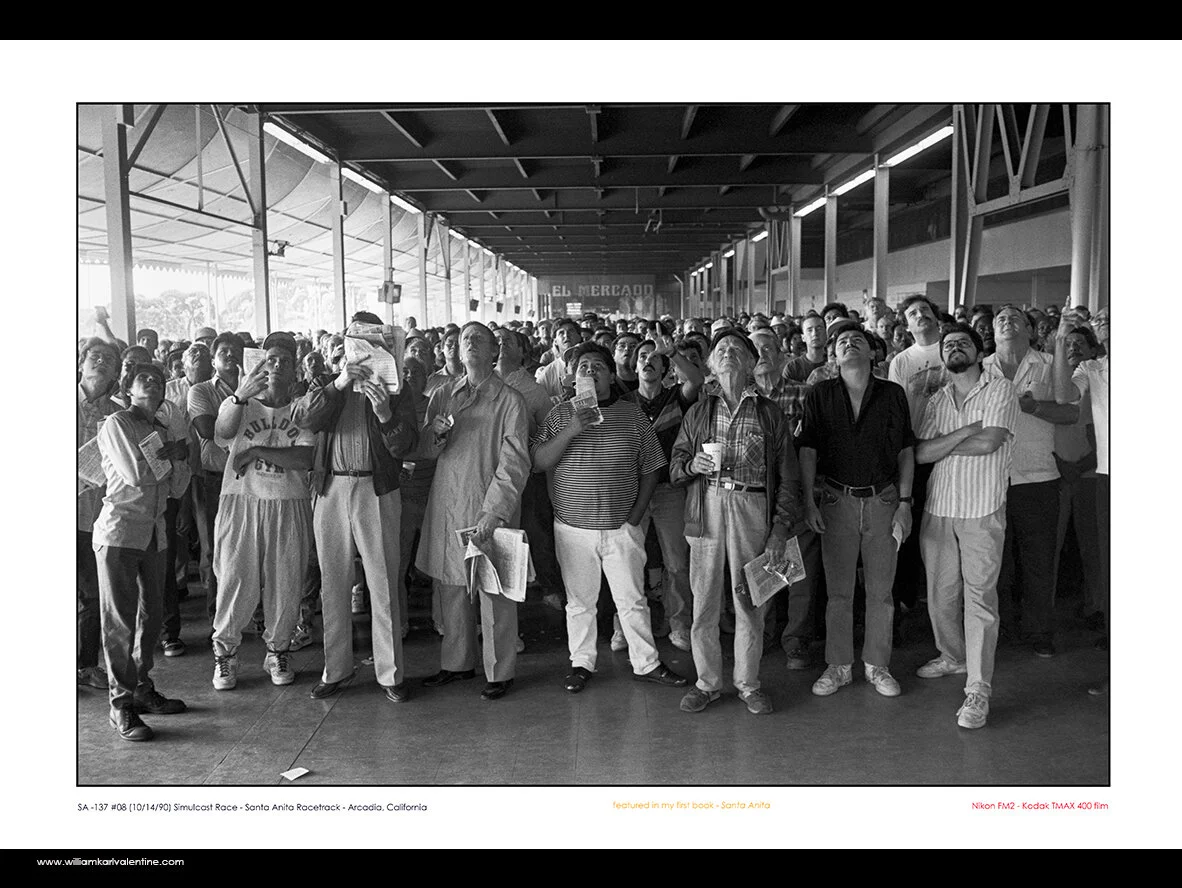
I started going through my image files thinking about which other images would fit. Lee Baroni applying the Carotid hold on the Duster jumped out as a good companion to the CCP image. The photo of Lee is in the permanent collection at the University of New Mexico. The Photograph of the motorcade from Officer Russ Miller’s funeral was another obvious choice. It was featured in the Billboard Creative in Los Angeles a couple years ago and is a signature image. “The Killing Fields” image is in the permanent collection of the Fogg Museum at Harvard, plus it represented my Rio Hondo Police Academy series well. I chose the “Simulcast Race” image from my Santa Anita book because it is one of my favorites. I also wasn’t looking to inspire any more debate over the horseracing industry which an actual horse related image might do. I chose the photo of the Giants coaches to represent my Cactus League series because it really captured how pure spring training used to be. In today’s world I would never be able to access to stand in that position to capture that exposure. I liked the Mariano Rivera image to represent my Wrigley-Fenway-Tiger series because it would help transition well into my street photography images. An interesting side note had never printed the image as large as I did for this exhibition and when I did I found new and exciting details in the image I had not seen in the 23 years since I had made the exposure. The view of the World Trade Center from the Empire State Building was another obvious image and one I have wanted to show more.
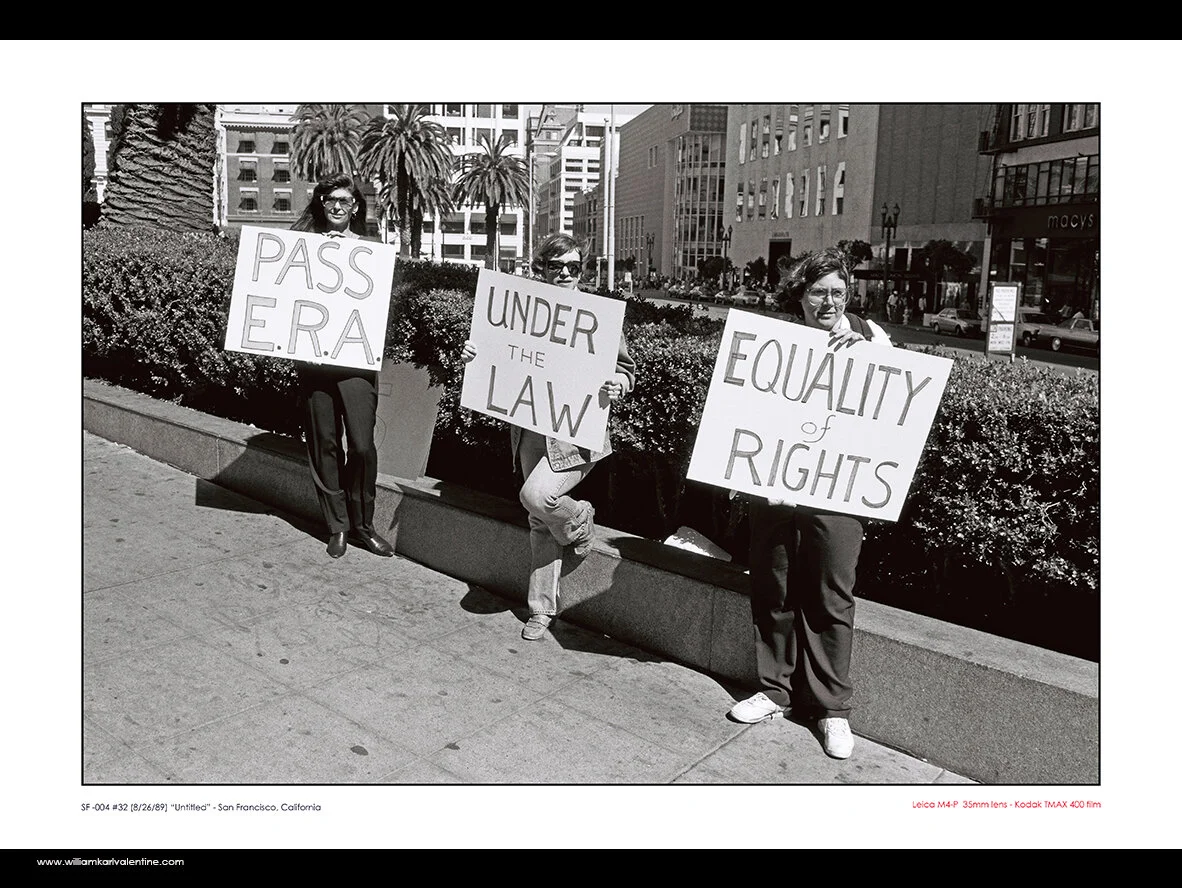
After selecting those 8 images I figured I probably had enough images but decided to choose more images so I would have options in my wall design since I was going to figure things out as I installed it. The ASU pool party image was a good representation of my Alphaville series and I came across a scan of ERA activists from San Francisco in 1989 which really jumped out at me. I have become so tired of today’s world with people who have differing opinions screaming at one another and thinking they are properly applying their 1st Amendment Rights. After these choices I selected five recent images that I keep returning to. I wanted to have images from Chicago, New York, and Newport Beach in the show if I could. One image was in color from the 4th of July and I didn’t think it would fit but I decided to print it and just see if there was a place for it.
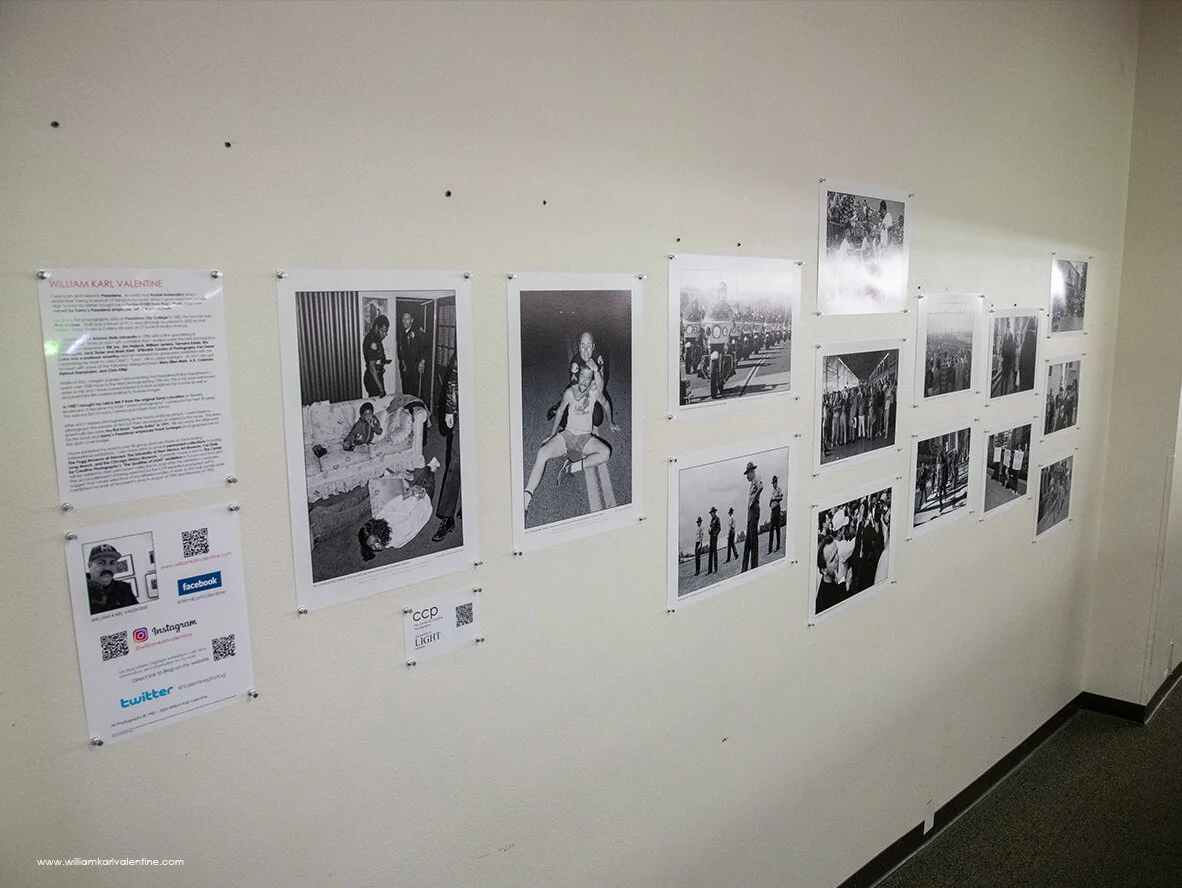
Since the prints were just for this exhibition I added text to the prints below the image so I wouldn’t have to deal with identification labels. I put the image information and because they were on display in a camera store I also added information about the camera I used and the film type for the older images. I also listed information if the image was in a permanent collection or had been in a recent prominent exhibition. After making the 15 different prints I made a single 8.5 x 11 print with all the images on it in a rough design which I thought might work. Actually I thought the first four rows would be as they were and the last row was just a reference point of the images, that I would only use a couple of them maybe.

The reference sheet I used while designing installation of the exhibition.
I wrote the artist statement specifically for this exhibition with the primary focus being my connection to Pasadena. Realizing many viewers would be passing by quickly I used bold font to highlight key points so the statement could be quickly scanned. Because I am always trying to increase the exposure of my work I created several QR codes with links to my Instagram and website then created an information page for people who wanted to learn more about my work. I also created a smaller page with a QR code link for the Qualities of LIGHT exhibition.

I decided to pin the images to the wall, because it was a quick and secure way to install the show plus it would do minimal damage to the wall. I also liked the look and feel of presenting that way, but I knew I needed to have metal push pins for it to be right. I thought the idea of the pins was a simple one until it came time to buy them. I literally had to go to four stores to finally get enough pins for the exhibition, thank God for Office Depot still carrying them.
I began the installation process with a tape measure, note pad, and math. I also realized the angle of the floor next to the wall was greater than I remembered since it really a ramp allowing handicap access to the store and easy carryout for large amounts of rental equipment. So obviously the sight line of the space changes and I had to take that in to account.
I always remember from my Northlight days at ASU that the center line of artwork should be like 56” from the floor. I know I am 6’5” and that I like a higher center point, plus I realized the way the store was configured I wanted to have at least some of the prints high enough to be seen above the displays to draw viewers in. Using blue painters tape I marked the center line from the floor up. I taped up a couple test prints and I had my friend who is much shorter than I am go along the wall to find what her eye level was. From that point I went by feel and judgement to adjust the center line and then kept it fairly consistent to the floor by measuring for each new row of prints.
I found that double stacking two vertical images made them too hard to view so I adjusted the Pasadena PD images to go side by side. I decided to pin the prints keeping a 3” gap between all prints. I also used my level with a built-in ruler to keep things accurate. I then kept putting up prints, designing as I went. I had the one-color print left over, but I soon found a place for it. The next section of the wall surface changed, and it had a large framed color print on it which was is a permanent thing but lots of blank wall before it. So, I found a home for the 15th print.
I know this is a relatively long blog post on a simple thing but I thought some readers may find value with the insight in to my process.
This Samys Camera store is located at 1759 E. Colorado Boulevard in Pasadena, California and is open daily 8am to 6pm. I am not sure how long the exhibition will be up, most likely through the end of March.

William Karl Valentine

Pasadena PD Officers Naum Ware & Darin Craddolph conducting a search warrant related to rock cocaine sales. March 1987 (PPD-177 #23)
I am proud to announce that a print of the above image has been included in the Center for Creative Photography’s Qualities of LIGHT Exhibition which opened December 13th and runs through the end of May 2020.
This image is from my Pasadena Police Department Series which is one of my most important bodies of work. I began the series while studying at Arizona State University and exhibited the work at the Northlight Gallery just before I graduated. The ASU faculty arranged for Van Deren Coke, at the time the Director of The San Francisco Museum of Modern Art’s Photography Department, to meet with me privately in the gallery to review my work. He compared my images to Larry Clark’s work which will always be one of the highlights of my career as a photographer. Photographing the Pasadena PD eventually led me to chose to a career in law enforcement which allowed me to continue photographing more than most other professions would have. The Pasadena PD series has also had increased interest in recent years and I should be producing a book of this work in the near future.
As for my image above, as stated in the title it was from a search warrant related to rock cocaine sales. For me, I saw the damage first hand that the rock cocaine era in Southern California did in the 1980’s. Pasadena’s Northwest area was ravaged with drive by shootings, property crimes by “baseheads”, and gang activity. So many good people lived in that part of town and they basically had to stay inside at night for their own protection. I knew people I went to grade school with who were killed during this time, like Danny Harris who was shot in a drive by shooting while selling rock cocaine. Then I also saw the harm done to small children like the boy in this photograph, Officers like Naum and Darin cared about the community and worked hard to make it safer by taking people involved in crime off the street. An approach that worked in many ways then which we have abandoned today because of political concerns. Could the approach in the 1980’s have been better? Yes with hindsight things can usually be done better but the over all approach to fighting crime prior to 2000 was better for society than it is being portrayed today. Naum made over 1,000 hand to hand undercover “buys” of narcotics during his career, most all in dangerous situations. Darin, recently retired after a 30 year career. Both these officers cared and put their own safety on the line to protect others. Some people today may wrongly interpret this image as oppression by the means of law enforcement, I know the truth behind it because I was there.
To be included in this exhibition has helped me achieve several long time career goals. I wanted to have my work exhibited at the Center for Creative Photography, arguably the most important photography archive in the world, and eventually have some of my prints added to their permanent collection. Being included in the Qualities of LIGHT exhibition accomplished both goals, with hopefully more to come at the CCP in the years ahead. One other interesting thing I discovered at the opening, for me at least, is this is the first time one of my prints has been in an exhibition with a Garry Winogrand print. (Winogrand is my favorite photographer - I traveled to New York in 1988 to see John Szarkowski’s retrospective of Winogrand at MoMA, to San Francisco to see his entire Women are Beautiful series exhibited at Pier 24 in 2017, and again to San Francisco in 2014 to see the SFMoMA retrospective of Winogrand’s work.)
The Qualities of LIGHT Exhibition documents the history of the LIGHT gallery which existed in New York City between 1971 and 1987. This was a critical time in the development of the medium of photography being accepted as art and LIGHT was one of the first galleries to concentrate solely on exhibiting photography. This exhibition examines LIGHT’s impact on the medium which continues on to this day. One important aspect of the LIGHT gallery was it showcased emerging artists and had work from multiple photographers readily available for view by patrons in flat files. My print was selected, along with other emerging artists’s prints, to document that important part of LIGHT.
For more information about the exhibition please follow this link: The Qualities of LIGHT: The Story of a Pioneering New York City Photogaphy Gallery.

Last year I licensed images for use in “Can We All Get Along?: The Segregation of John Muir High School” which is a 49 minute documentary film by Pablo Miralles, who graduated from Muir in 1982. The film explores the history of Pasadena’s schools which were desegregated by court order in 1970 (something I personally experienced as well having grown up in Pasadena at the same time).
The film is currently being well received and winning awards. Please follow the links below to discover more about this documentary film and its producer:

Review of the Boston Museum of Fine Art’s Unexpected Families exhibitions
Read More