• PORTFOLIOS
  • Prints
  • Licensing
  • Books
  • About
  • CONTACT
  • Blog
  • Instagram
  • TECH INFO
  • LINKS
Menu

William Karl Valentine

  • PORTFOLIOS
  • Prints
  • Licensing
  • Books
  • About
  • CONTACT
  • Blog
  • Instagram
  • TECH INFO
  • LINKS

Chris Field

Chris Field - Visual Engineer

April 22, 2023

I watched an episode of The Green Planet this week and saw at the end where they showcased the inventions of Chris Field that allowed to capture time lapsed images in the rain forest.  The images that Chris’s rigs captured are amazing.  They were basically able to document the process of photosynthesis and show things like the relationship of ants and plants in the rain forest food chain.  The images on their own were beautiful and I continue to be blown away by what the technical advances in cameras allow us to document.  For me when I consider the complexities of the food chain it bolsters my faith, I know science answers many of life’s questions but when I see how well designed our world, I just can’t believe all this happened by a collision of a couple of rocks.  The Green Planet episodes also remind me we need to do better to cherish our planet.

 In the simplest of terms Chris designs camera systems (rails, camera mounts, computer programing of their movement and function) which allow cameras to track and photograph subjects like bugs and plants.  The camera captures time lapse images which are then used to create video.  Some of the lenses he uses are micro lenses with built-in ring lights which allow the camera to photograph tiny creatures in tight dark spaces.  Much like drone cameras, his designs allow the documentation of things most of the world has never seen before.

Being a documentary photographer who works with still images I don’t have the need to use any of the rigs like Chris designs, but I found his story interesting and since it is a photography subject I decided to write a blog post about it.  In researching Chris, I didn’t find a whole lot about him.  The BBC mentioned he was an engineer in the US Military but I don’t see much more on line other than he was based in Colorado and I found his email address. After gathering my links for this post, I decided to something I don’t do much, I reached out to Chris, explained I was doing a post and asked if he would be willing to answer a few questions.  He replied immediately and the time he took to answer my questions exceeded my expectations.  When I read them I knew I picked a great topic for a blog post, his insight is outstanding.  Below are my questions and Chris’s answers:


WKV-  I would like to know more about your technical background.  Is there greater detail you can share about your military background and how it gave you the skills needed to create these rigs or inspired your interest in building these.  Was there another background that gave you your technical skill set.

CHRIS - So there is a little bit of confusion there with the whole military engineer thing, I think they should have put a comma between Military and Engineer.  I spent 4 years in the military working on telecommunications. But I never have considered that engineering, but it did give me a great trade to fall on when I got out of the military, I ended up spending 20 more years in Telecommunication working on repair, test and turnup, new product implementation, and was tasked with quite a bit of telecommunication engineering as well as tier 2/3 support for newly developed products. I eventually ended up in charge of my own team. It was a wonderful career which paid well enough for me to really dive into my hobbies. As for mechanical and robotic engineering this has been mostly self-taught over time. A huge part is learning how to use Arduino, they are incredibly useful in this line of work and have an easy learning curve. These devices became critical to learn in order to build out the automation that I needed as there are really no good off the shelf solutions that can coordinate the camera, plumping, motion control, environmental, etc. I remember seeing the end of the tropics episode where it mentioned “Chris Field, an ex-military engineer” and suddenly those words were all over the place and there was not much I could do about it. I think “Chris Field, a self-taught engineer” would have been closer to how I would have written it. While I was in a technical field, the “military” portion makes it sounds like I was doing crazy DARPA stuff. I was in the USAF from 96-2000. I did 4 years and I’m proud of that service and continue the tradition, but it is not something I define myself by.


WKV – Did you have an interest in capturing visual scientific information about plants and animals to learn more about them? Is this a business concept where you saw a need and thought you could develop a niche that was profitable? Do you just like complex challenges and building rigs capable of capturing such amazing images just motivates you?

CHRIS - The why stretches back to when I first got into photography and astrophotography. I fell in love with hacking and building, and saw a timelapse with the milky sliding past and I was hooked. I gave up astrophotography overnight and started learning how to do timelapse. A friend of mine and I built a slider, and people started asking us to build them one. That led to a small side business that was ultimately a lot more work than pay. We eventually got burned out and stopped selling them. I had some cameras at that point and a few sliders and wanted to film some stuff, but with it being February in Colorado, it was cold so I bought a hyacinth plant and put it in a spare room in my basement and filmed it blooming. I was mesmerized by the results and started to turn that spare room into a studio.  What I really loved about it was I was producing footage that nobody else was doing. A lot of folks were hiking to beautiful remote locations to film mountains and clouds. But aside from some plant timelapse sequences on BBC documentaries, nobody seemed to be doing it. Probably because it is so difficult and there are a ton of challenges. But it’s really the love of the process and the constant need to overcome challenges that keeps me hooked. I am always building something new, trying a new way to do something, experimenting around.Marketability never really occurred to me, until BBC gave me an offer to work on Green Planet that I could not pass up.


WKV- I was wondering about your photography background.  I am a huge fan of Garry Winogrand who has a famous quote: “Photography is not about the thing photographed, It is about how that thing looks photographed.”  Does something like Garry’s statement apply to you? Did you begin building your rigs to capture things you wanted to see but no one had been able to photograph (or video) them yet?    Do you consider yourself an image maker or filmmaker or are you just focused on the technical aspects of creating the rigs?

CHRIS - I really consider myself a visual engineer, which to me means I create solutions to filming difficult things. I love photography, inventing, engineering, and creating stunning visuals. If I won a billion dollars today, tomorrow I would still get up and do the same thing. The financial aspect of this is certainly a bonus as it allows me to focus so much more of my time and energy to this sort of work, but even if I was not getting paid at all and working fulltime elsewhere, I would still keep doing this.

I am so happy I discovered Chris’ work and thankful he took the time to write back. I look forward to seeing more of his work on TV soon, it truly is amazing.

Chris’s company is Biolapse, please visit his website to learn more about his amazing creations.

I found another interesting article about the Triffid 1 system at TVB Europe’ website.

Finally, this is another video related link which has nothing to do with Chris’s work, but I stumbled across it while researching this post and since I don’t deal with video much, I figured best to share this as an add on rather than never use it. It’s a link to an article about the use of shallow depth of field video using mirrorless DSLR camera bodies to capture sports videos. I watch my fair share of sports and have noticed the trend, so it caught my interest.

In Photography, time lapse video Tags Chris Field, The Green Planet, Visual Engineer, Timelapse, Photography, Micro Photography, Camera Slider, BBC, Documentary Films, Documentary Photography, Filmmaking
Comment

Photo Forward - Los Angeles

February 20, 2023

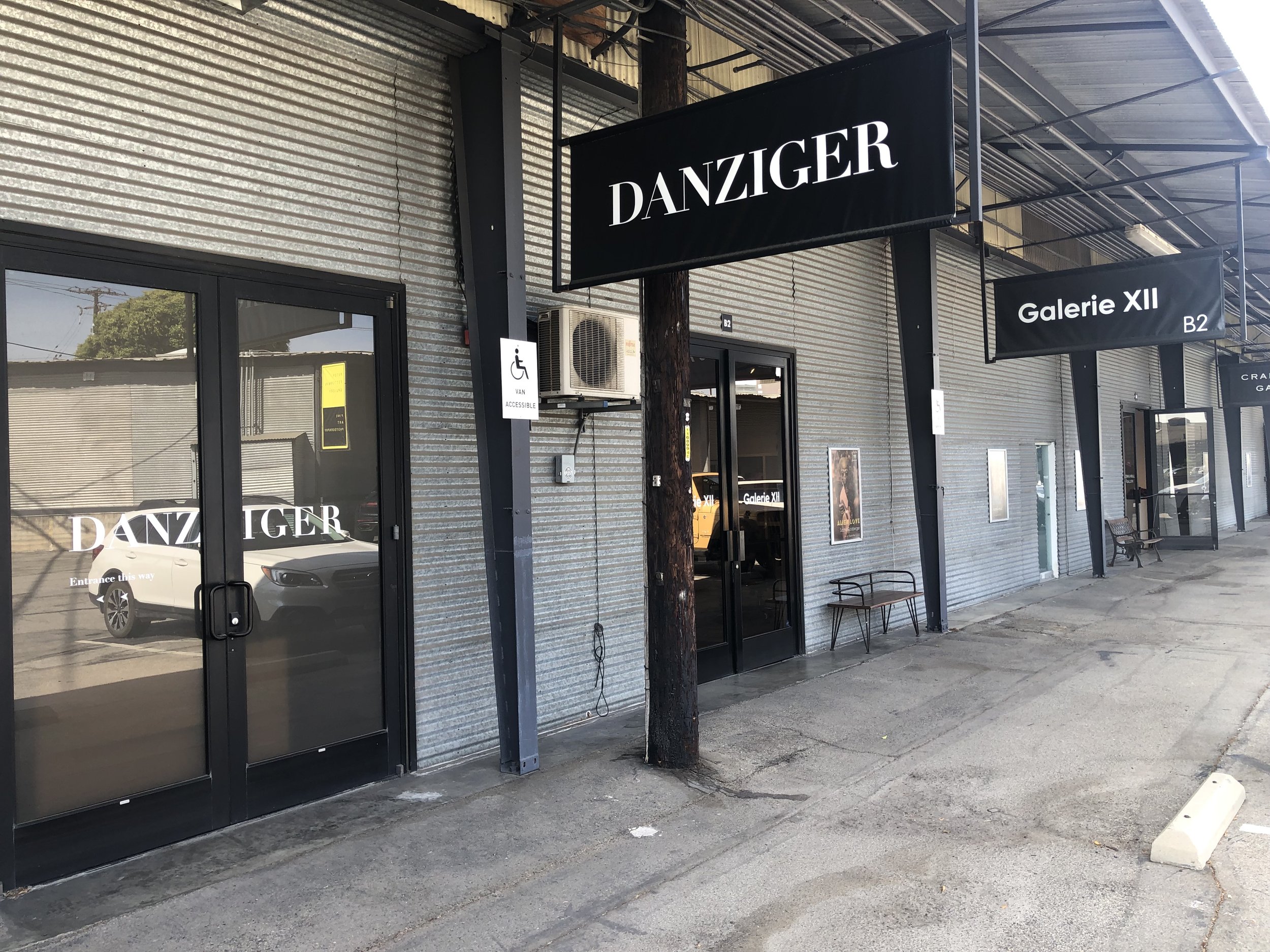
Photo LA has been a long-standing favorite event of mine where galleries from all over the world come together in February, in Los Angeles (Santa Monica usually) and take over a large space and have a photographic art fair for the weekend. It began thirty years ago and unfortunately hasn’t had a full event since 2020 right before the pandemic hit. Thankfully the Photographic Arts Council Los Angeles made the effort to keep it going this year, along with James Danziger who hosted the event, to bring in a dozen top gallerists this past weekend for a scaled-down version of the fair. Danziger Gallery Los Angeles was the perfect host venue and the event seemed to be very well received. I went up yesterday and saw some great images, had some solid conversations, and added three more books to my library. I heard that Saturday was absolutely packed with visitors at Bergamot Station, which is fantastic for our local photo community. Sunday had the perfect sized crowd, enough people so every gallerist was always interacting with someone but with enough room and time to inspect work without feeling rushed.

Danziger Gallery - Photo Forward Los Angeles 2023

Joseph Bellow Gallery

It was good seeing Joseph Bellows again and the selection of work he brought up from La Jolla. I was excited to see that he was showcasing Ave Pidas’s Star Struck limited edition portfolio as well as some of his vintage prints. This was my first opportunity to see some of Ave’s original prints. I purchased a signed copy of a place in the sun - photographs of los angeles by John Humble. This 2007 book was published by The Getty to accompany his exhibition at the museum. It is so well done, and I really like Humble’s photographs. Bellows also had a stack of Humble’s photographs on site which were beautiful, and I thought they were reasonably priced. Some prints were vintage, and others were modern digital prints. I really like John Humble’s photographs and encourage you to get to know his work.

View fullsize Ave Pildas's Star Struck limited edition portfolio
Ave Pildas's Star Struck limited edition portfolio
View fullsize Joseph Bellows Gallery
Joseph Bellows Gallery
View fullsize John Humble's prints
John Humble's prints
View fullsize IMG_1270.jpg
View fullsize John Humble
John Humble
View fullsize IMG_1272 (1).jpg

Aperture

I have been wanting to add Stephen Shore’s Uncommon Places, published by Aperture, to my library for a while. I think I was at the MFA in Boston the last time I saw a copy of it, and I didn’t want to deal with lugging it home then (I had already bought a few other books on that trip). So, when I saw a copy on the Aperture table, I decided to buy it. That’s when I met Kellie McLaughlin, Aperture’s Chief Marketing and Sales Officer. Kellie was so engaging and enthusiastically pointed out how the other Stephen Shore book they had, Selected Works 1973-1981 was a perfect complement to Uncommon Places and how it was unique in its own right. I love meeting people like Kellie who understand the medium of photography and are passionate about it. Kellie made me an offer that I couldn't refuse, and I ended up with both books. I did put one condition on the sale that she introduce me to Sarah Meister, Aperture's Executive Director and former MoMA curator, who I had seen talking to James Danziger in his office. Meeting someone like Sarah was amazing, she was so gracious and I’m still excited about the introduction.

View fullsize Uncommon Places
Uncommon Places
View fullsize Stephen Shore
Stephen Shore
View fullsize Selected Works 1973-1981
Selected Works 1973-1981

Danziger

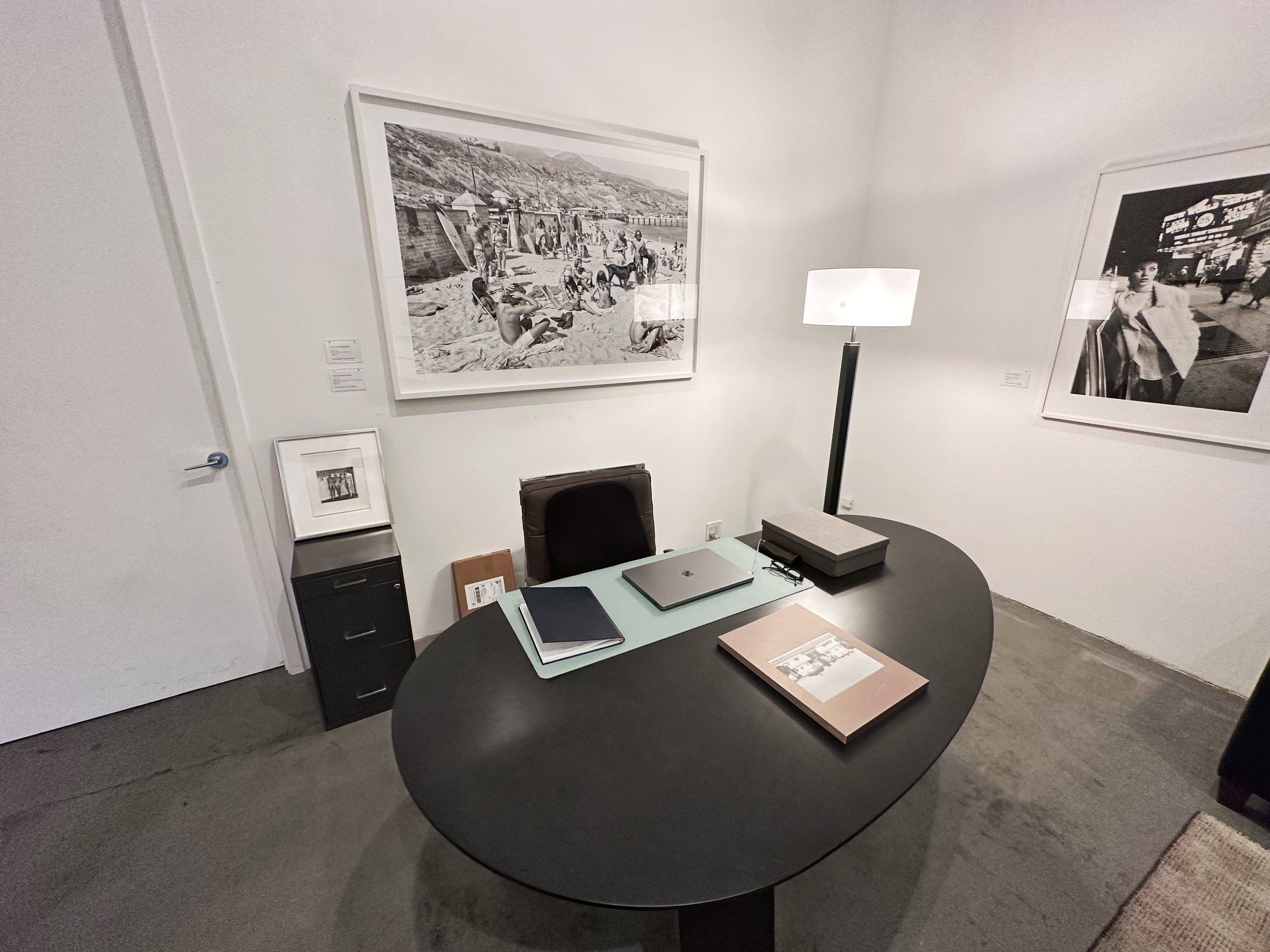
For this event James Danziger gave most of his 4,000 sq ft gallery space to other exhibitors and showcased his holdings in his private office, which was open to the public. I was in there looking at photographs when I realized Sarah Meister had come in from NYC for the show because I recognized her talking to James. It was interesting to see the selection of work James had up in his office for this event. Over his desk was a large Tod Papageorge photograph from The Beaches exhibition they showcased last year. There were O. Winston Link prints, and fittingly a famous Julian Wasser print. All the prints were amazing, as I expected they would be.

James Danziger’s Office. Sarah Meister speaking with James and another person.

View fullsize IMG_1231.jpg
View fullsize IMG_1230.jpg
View fullsize IMG_1234.jpg
View fullsize IMG_1232.jpg

Etherton Gallery

Terry Etherton brought some amazing pieces including a portfolio of The Bikeriders by Danny Lyons.

Skidmore Contemporary Art

Every time I go to Danzinger I stop in to Skidmore Contemporary Art to check out their latest exhibition. Skidmore shows a lot of photo-realism paintings which is I really like; I know that’s shocking being that I am a documentary photographer. Below is the is the work that stood out to me. Eric Nash’s A Pool in Hills is epic Los Angeles, love it.

View fullsize Andy Burgess
Andy Burgess
View fullsize Eric Nash
Eric Nash
View fullsize Eric Nash
Eric Nash
View fullsize Eric Nash
Eric Nash
View fullsize Eric Nash
Eric Nash
View fullsize Michael Ward
Michael Ward

While at Bergamot I also stopped in to check out Robert Berman Gallery and had a great talk with Gallery Director Jason Vass. Berman’s current exhibition Focus on Women in Photography runs through March 14, 2023. It showcases over forty different female photographers. I immediately noticed two recent photographs from Los Angeles that I had never seen before. The photographs were by Rezeta Veliu who I had not even heard of. Jason explained how Rezeta’s husband was successful in the entertainment industry and was a big part of why she was in the area. To prepare for writing this post I researched more about Veliu. She was born in Kosovo in 1999 and came to New York city basically as a refugee in 2013. She married Rich Cook in 2020 and they have already started their family. Cook is a producer and co-founder of Range Media Partners. Veliu is also an actress and I assume a model; she is absolutely stunning.

Rezeta Veliu - Born and Raised -Los Angeles 2022

What impressed me most about Rezeta Veliu’s photographs is she is willing to go to hard areas to photograph. She takes her camera in to areas like Venice, Compton, and other rougher parts of Los Angeles and she gets among the people and photographs. I can tell by the images she often uses a wide angle lens and her subjects know she is photographing them. I respect that so much. Few things bother me as much as photographers who use a telephoto lens from safe locations and lay claim to being a street photographer. There is a time and place for both long and short lenses but to be a good street photographer you have to move amongst people sometimes. I spent time looking at Veliu’s work and saw a lot of good images. I also saw a photographer who is still emerging and needs to continue to hone her craft. She speaks of documenting Los Angeles extensively by visiting 43 different areas of the city over 6 months. I have been photographing in Los Angeles for 40 years and I still feel like I am just scratching the surface when it comes to documenting Southern California. Six months in LA is nothing, it is probably one of the hardest cities in the world to photograph because it is so big and diverse. Someone could get a good portfolio to document a small area, like say just Venice or just Malibu in six months but for Veliu to claim she documented that much in such little time shows Veliu still has a lot to learn. She also tells us she shoots on film and her prints are on “cotton paper”. Why? and can she tell me more? I have exposed, and processed, a few thousand rolls of film in my life. I used film because that was the best medium at the time, with today’s technology if someone is photographing on film, they should have a real reason other than it is hip. There are so many plus ins available for Photo Shop that most any analogue look is quickly obtainable in a digital image file now. I also don’t know what “cotton paper” means. Say what brand paper you print on, so the buyer knows the archival value. Some of her prints can also be better, some are flat and lack shadow detail. Veliu still has to learn more about the craft of Photography, but with her connection to the entertainment industry here in LA, and her marketability as a person, I expect her work to take off and her photography to become very well known. Veliu’s work is worth getting to know and she is a young photographer worth following.

List of Photo Forward Participants & Links:

Aperture

Joseph Bellows Gallery

Stephen Bulger Gallery

Danziger Gallery

Etherton Gallery

Paul M. Hertzmann Inc.

The Hulett Collection

jdc Fine Art

MacIntosh Collection

Minor Matters

Scott Nichols Gallery

Andrew Smith Gallery

In Art Collection, Galleries, Photography, Photography Books, Photography Collector Tags Photo LA, Photo Forward Los Angeles, Bergamot Station Arts Center, Aperture, Joseph Bellows Gallery, Stephen Bulger Galler, Etherton Gallery, Terry Etherton, Paul M. Hertzmann Inc., The Hulett Collection, jdc Fine Art, McIntosh Collection, Minor Matters, Scott Nichols Gallery, Andrew Smith Gallery, Robert Berman Gallery, Jason Vass, Rezeta Veliu, Skidmore Contemporary Art, Eric Nash, Andy Burgess, Sarah Meister, Kellie McLaughlin, John Humble, Steven Shore, The Getty Museum, Tod Papageorge, O. Winston Link, Danziger Gallery, James Danziger
Comment

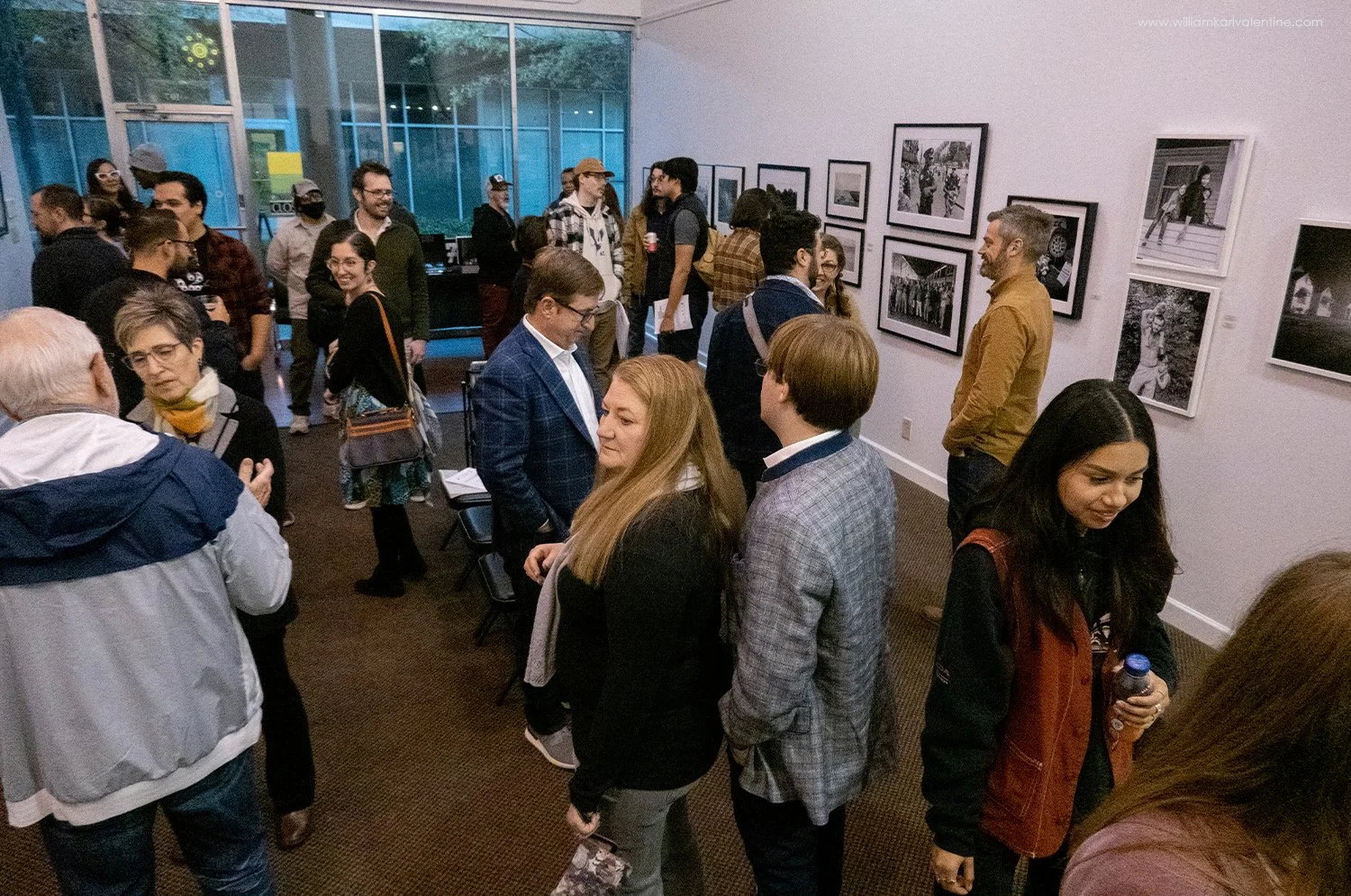
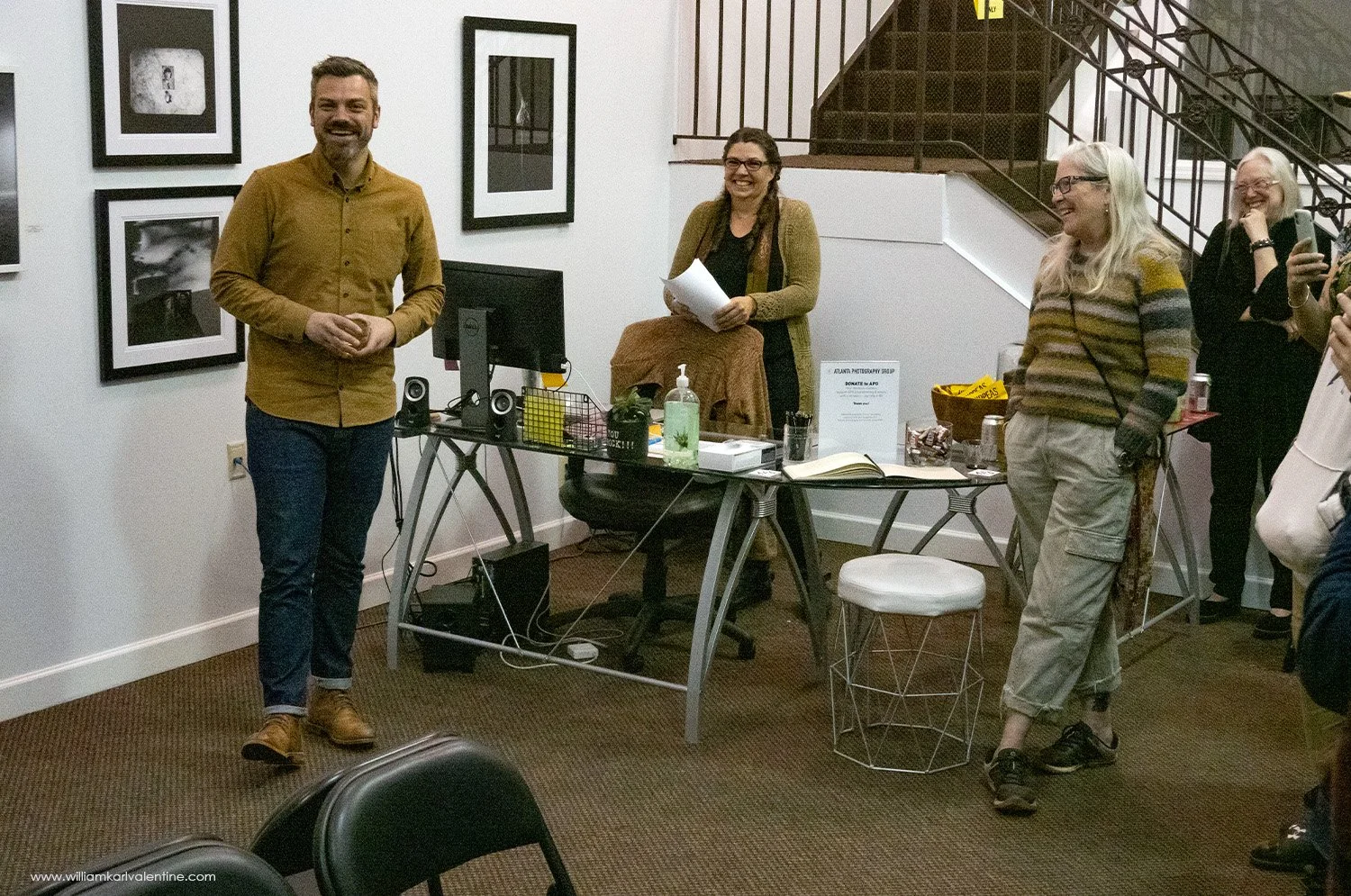
At the APG 2022 Selects opening with High Museum Curator Gregory Harris who curated the Selects exhibition. 10-20-22

Atlanta Photography Group - 2022 Selects - Gregory Harris, Curator

December 9, 2022

In October I flew to Atlanta for the opening of the Atlanta Photography Group’s Gregory Harris Selects 2022 exhibition. 

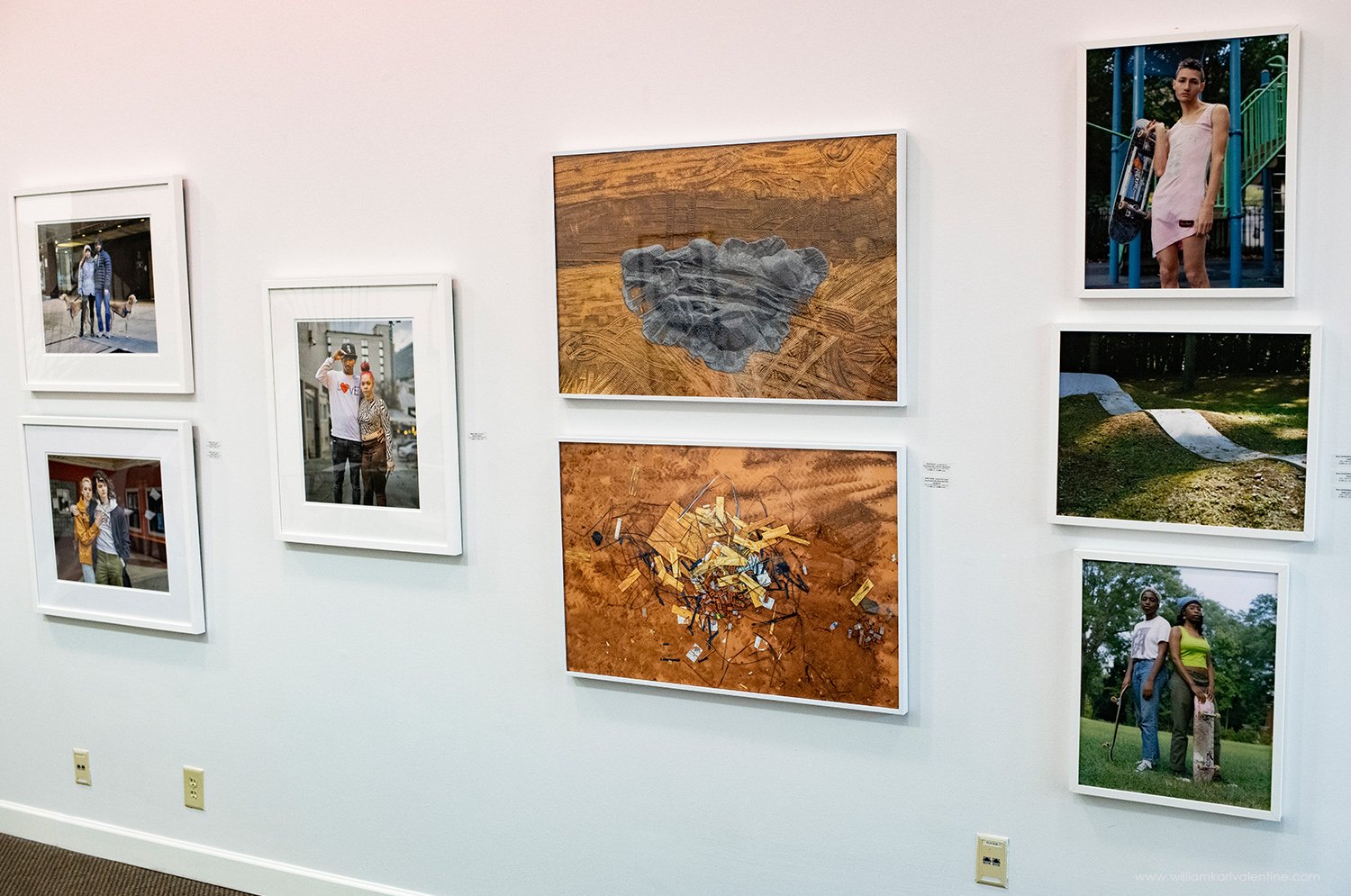
This exhibition was APG’s feature exhibition for Atlanta Celebrates Photography (ACP) 2022, the month-long, citywide photography festival. The Exhibition was open themed and juried by Gregory Harris, the Keough Family Curator of Photography at the High Museum of Art in Atlanta.

APG’s Program Director Nicole LeCorgne introduces Gregory Harris at the opening on October 20th.

I have been a member of APG for several years and this was the fourth APG exhibition I have had work featured in.  Concurrent to this exhibition I also had two photographs up at Atlanta’s Hartsfield-Jackson International Airport in APG’s annual airport show, which was juried by Lisa Volpe the Associate Curator of Photography at The Museum of Fine Arts, Houston.  I also had a photograph in the APG’s 2022 Street Photography exhibition, curated by Henry Horenstein, which proceeded this exhibition. I have been so impressed with how professional everyone at APG is and the list of guest jurors they have brought in the last few years is amazing.  So having the opportunity to see my photographs up in two separate exhibitions, and to also meet a curator like Gregory Harris, I jumped on a flight and headed to Atlanta.  This was also an opportunity for me to visit Atlanta for the first time and explore a region of our country I need to get to know better.

I was honored as soon as I found out Gregory selected my photographs for the exhibition. I knew Gregory has an impressive curatorial resume and focuses on documentary photography when I submitted work for consideration.  I also knew the High Museum has a prominent photography collection.  Below his is statement about the exhibition:

The photographs gathered here are all straightforward pictures that respond to the wonders of quotidian human experience —the abiding pleasures of family and friends, the unexpected beauty of our built environment, the sheer marvel of the natural world—yet plumbing the depths of ordinary life offers boundless possibility for revelation. What links these seemingly disparate images is that their makers felt very little need to overly orchestrate them, and each was masterful at turning the most mundane situations into discretely poetic records of simply what was there before their cameras.  – Gregory Harris

When I landed in Atlanta the day before the opening and immediately went to see the airport exhibition after getting my luggage, it was nice to finally see the space since I have had photographs in the airport exhibition twice now.  The next day I went to the Atlanta Photography Group in the morning to see the exhibition before the opening.  The APG space is outstanding, it has great linear wall space with a high ceiling and is laid out perfectly for a gallery. I was also happy to see that both of my photographs had prominent positioning in the center of the primary wall.  I knew then I had made the right decision to fly back for the opening. 

Going to see the exhibition early also gave me the opportunity to really get to know Nicole LeCorgne who is APG’s Program Director and a Curator.  It was fantastic having so much time to learn about APG, the Atlanta photography community, and Nicole’s photography background.

Nicole LeCorgne, Caroline Hollingsworth, Beth Lilly, and William Karl Valentine

View fullsize web ATL DSC 09308_ 10-20-2022  APG.jpg
View fullsize web IMG_9364 10-20-22 APG.jpg
View fullsize web ATL DSC 09314_ 10-20-2022  APG.jpg
View fullsize web ATL DSC 00112_ 10-22-2022  APG.jpg
View fullsize web ATL DSC 00114_ 10-22-2022  APG.jpg
View fullsize web ATL DSC 0466_ 10-20-2022  APG.jpg
View fullsize web ATL DSC 0469_ 10-20-2022  APG.jpg
View fullsize Nicole LeCorgne and Gregory Harris
View fullsize APG Program Director Nicole LeCorgne
View fullsize Nicole LeCorgne and Gregory Harris
View fullsize web ATL DSC 09338_ 10-20-2022  APG.jpg
View fullsize web ATL DSC 09339_ 10-20-2022  APG.jpg
View fullsize web ATL DSC 09344_ 10-20-2022  APG.jpg
View fullsize web ATL DSC 09345_ 10-20-2022  APG.jpg
View fullsize Dana Weiss
View fullsize Stephanie Hanlon
View fullsize Joshua Walls
View fullsize web IMG_9392 10-20-22 APG.jpg
View fullsize web ATL DSC 09356_ 10-20-2022  APG.jpg
View fullsize web ATL DSC 09357_ 10-20-2022  APG.jpg
View fullsize Beate Sass
View fullsize web IMG_9565 10-22-22 APG.jpg
View fullsize web IMG_9571 10-22-22 APG  .jpg
View fullsize web IMG_9269 10-20-22 APG .jpg
View fullsize web IMG_9270 10-20-22 APG  .jpg
View fullsize Hanry Horenstein's Photographs

APG Member Benjamin Dimmitt

View fullsize Mark Caceres's photographs
View fullsize Peter Essick's Photographs

At the opening I was able to meet several APG’s board members and other long-time members who helped lay the foundation for this outstanding group.  This gave me the chance to go to dinner with Benjamin Dimmitt, Mark Caceres, Peter Essick, Chip Standifer, and Beth Lilly after the opening. It was exciting to learn more about how vibrant the Atlanta photography community is and to just spend the time talking about the medium.  The APG membership has a strong core of established photographers as well as many young emerging photographers, it is a nice mix. For example, I heard 22-year-old Joshua Walls tell us this was his first prominent exhibition when he spoke during the opening. For me, this was my 50th exhibition. The only thing I missed out on this trip was being able to meet APG Executive Director and Curator Donna Garcia in person because she had to be out of town that week.  I have corresponded with Donna numerous times coordinating submissions and she has always been so helpful and professional. Donna is obviously taking APG to the next level.

Holding my photograph from the Street Photography exhibition which preceded the 2022 Selects exhibition. All three photographs were printed on Hahnemuhle Photo Rag ULTRASMOOTH Fine Art Paper and framed by Digital Arts Studio.

I also need to mention Digital Arts Studio in Atlanta and owner Barry Glustoff.  I have used DAS to print and frame the photographs for both of my APG exhibitions this year.  Their product is outstanding, they made the deadlines, and their fees were very appropriate.  I am thankful for their work in really helping my images stand out.  Digital Arts Studio is a qualified Hahnemuhle FineArt Certified Studio, one of fewer than two dozen in the United States as well as an accredited Canson Certified Lab and it shows in their product.

The Exhibition ran from October 17th to November 17th, 2022, and included the following participating artists:

Allison Plass
Beate Sass
Benjamin Dimmitt
Dana Weiss
Daniel Raniner
Ellen Mertins
Gwen Julia
Jo Ann Chaus
John Prince
Joshua Walls
Louis Leon

Mark Caceres
Nancy Marshall
Nate Mathews
Peter Essick
Reid Childers
Ross Landenberger
Seth Cook
Stephanie Hanlon
Willard Pate
William Karl Valentine
Zak Henderson

In Galleries, Photography, Photography Exhibitions Tags Atlanta Photography Group, Atlanta, Gregory Harris, High Museum, 2022 Selects, Lisa Volpe, Allison Plass, Beate Sass, Benjamin Dimmitt, Dana Weiss, Daniel Raniner, Ellen Mertins, Gwen Julia, Jo Ann Chaus, John Prince, Joshua Walls, Louis Leon, Mark Caceres, Nancy Marshall, Nate Mathews, Peter Essick, Reid Childers, Ross Landenberger, Seth Cook, Stephanie Hanlon, Willard Pate, Zak Henderson, Beth Lilly, Chip Standifer, Nicole LeCorgne, Donna Garcia, Digital Arts Studio, Barry Glustoff, Hahnemuhle Photo Rag ULTRASMOOTH
Comment

First exhibition for “Ponyhenge”. Photographed off of a rural road in Lincoln, Massachusetts and now displayed in the busiest airport in the world, Atlanta’s Hartsfield-Jackson International Airport. Last look before flying home on 10-22-22.

Atlanta Airport Exhibition 2022

November 28, 2022

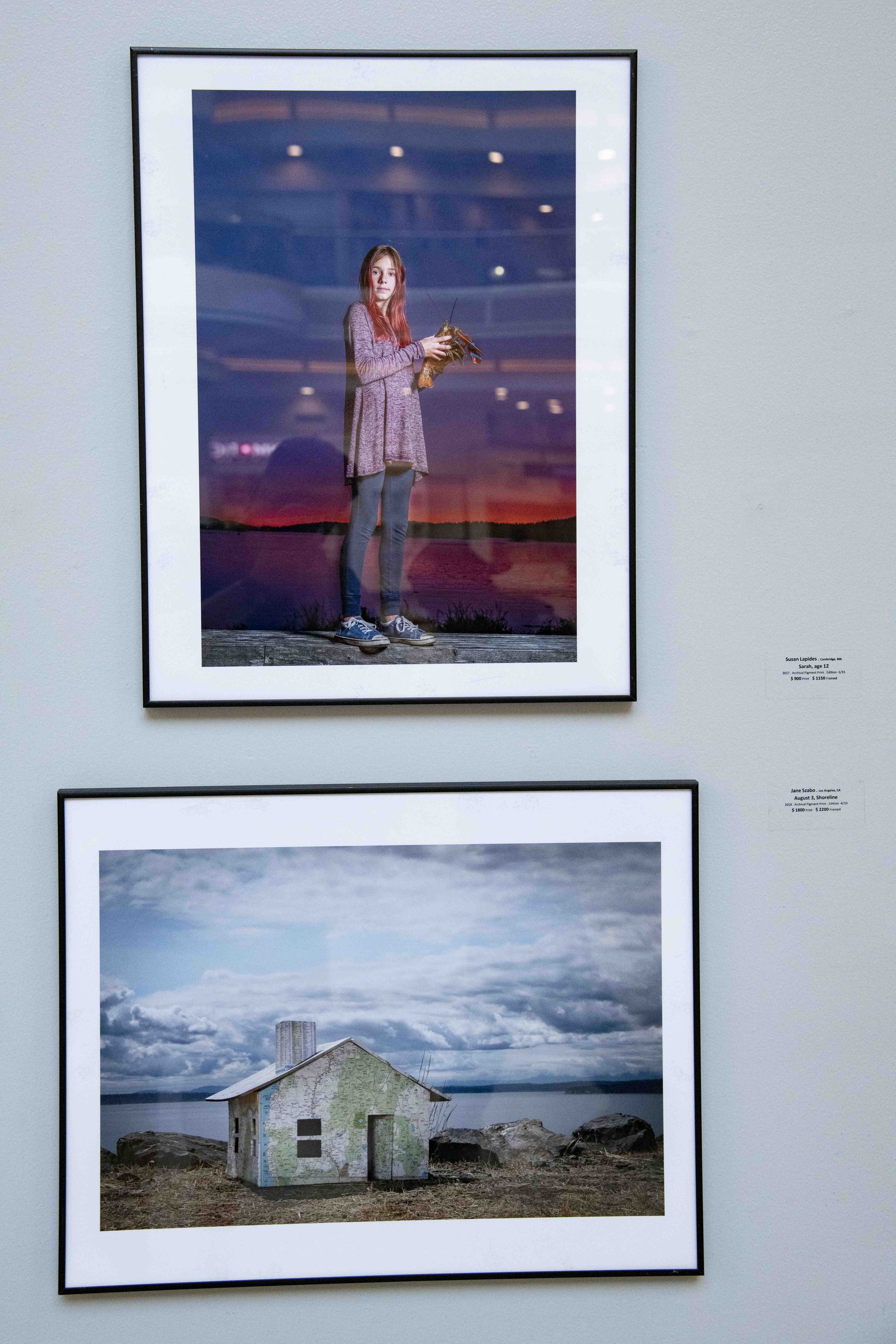
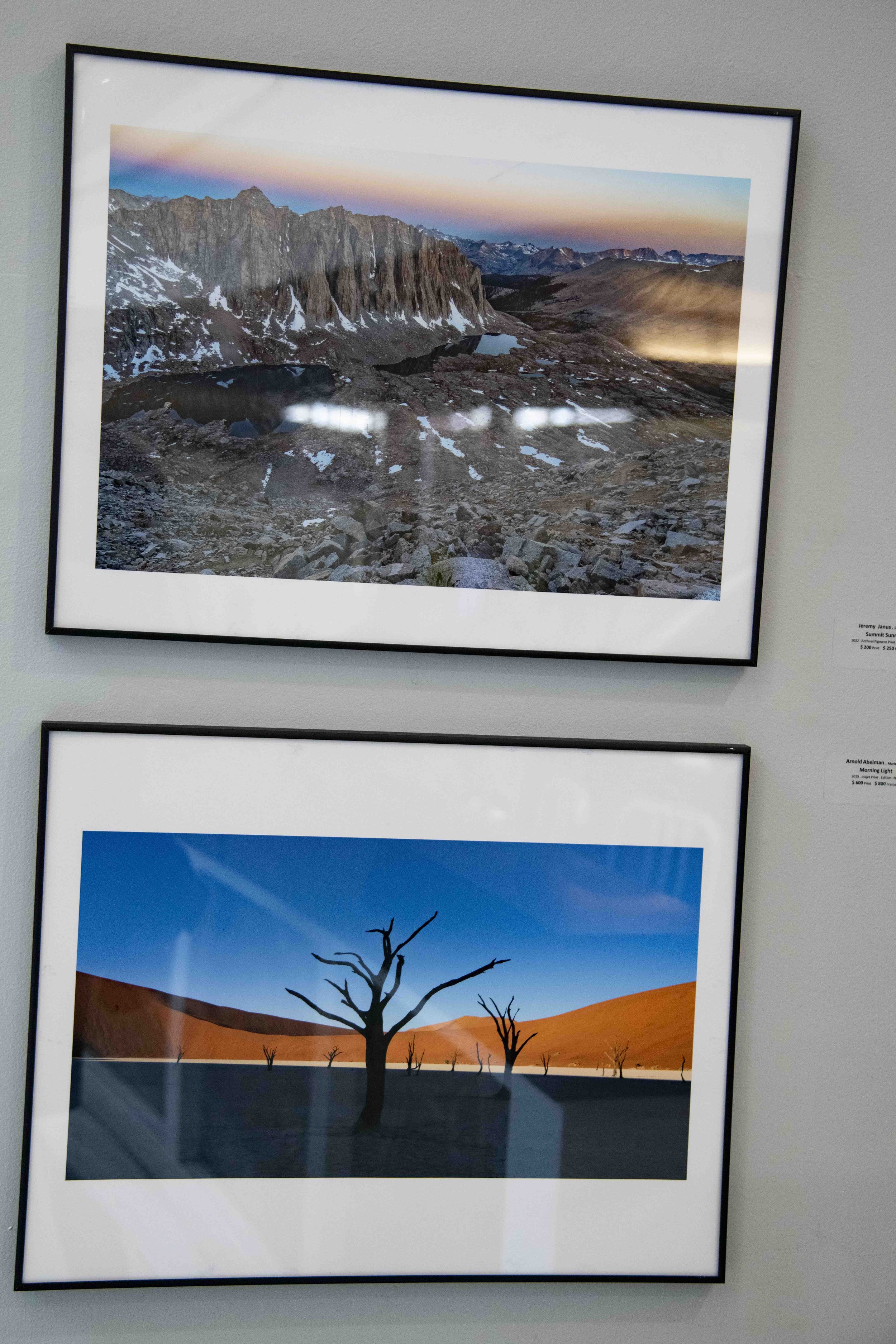
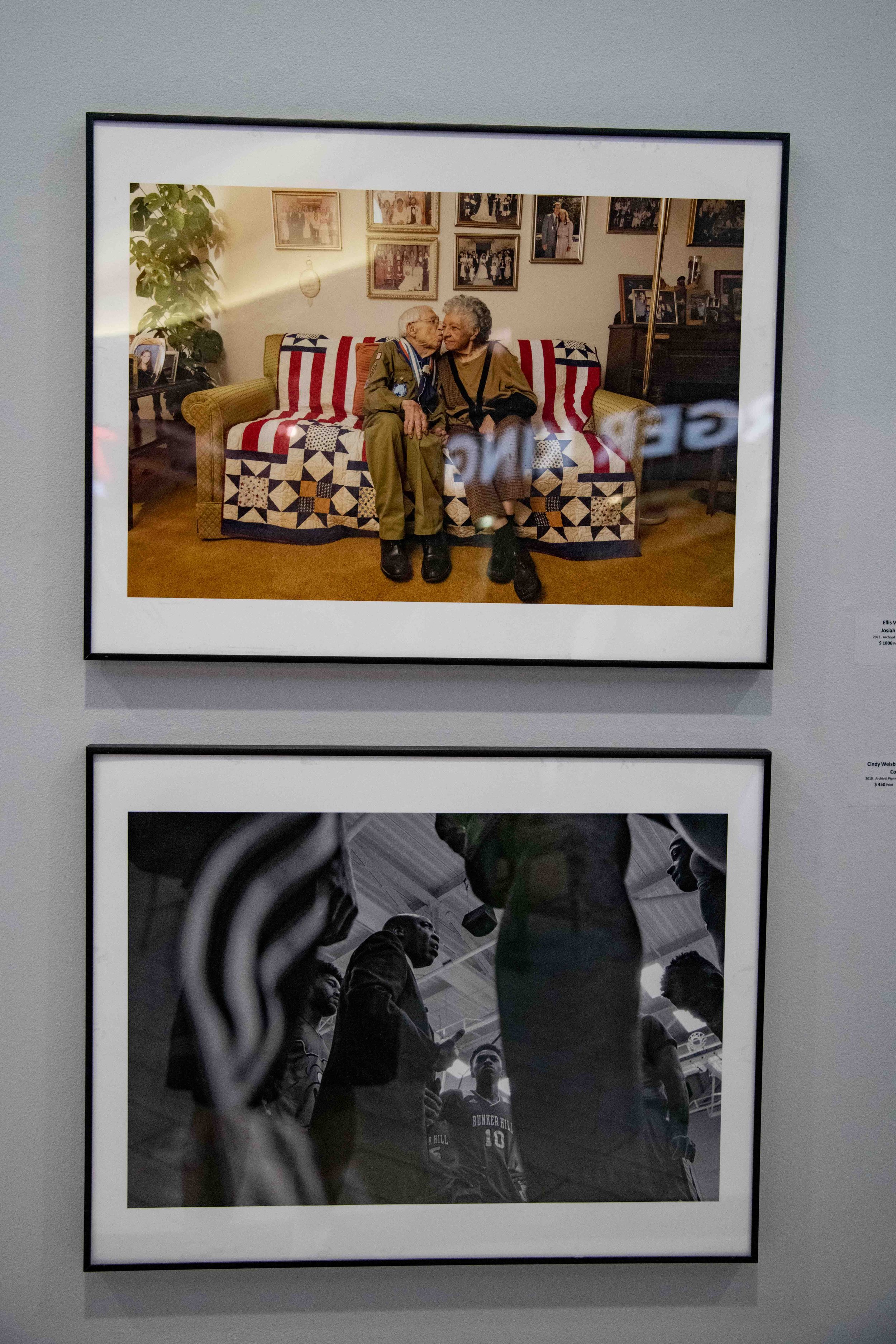
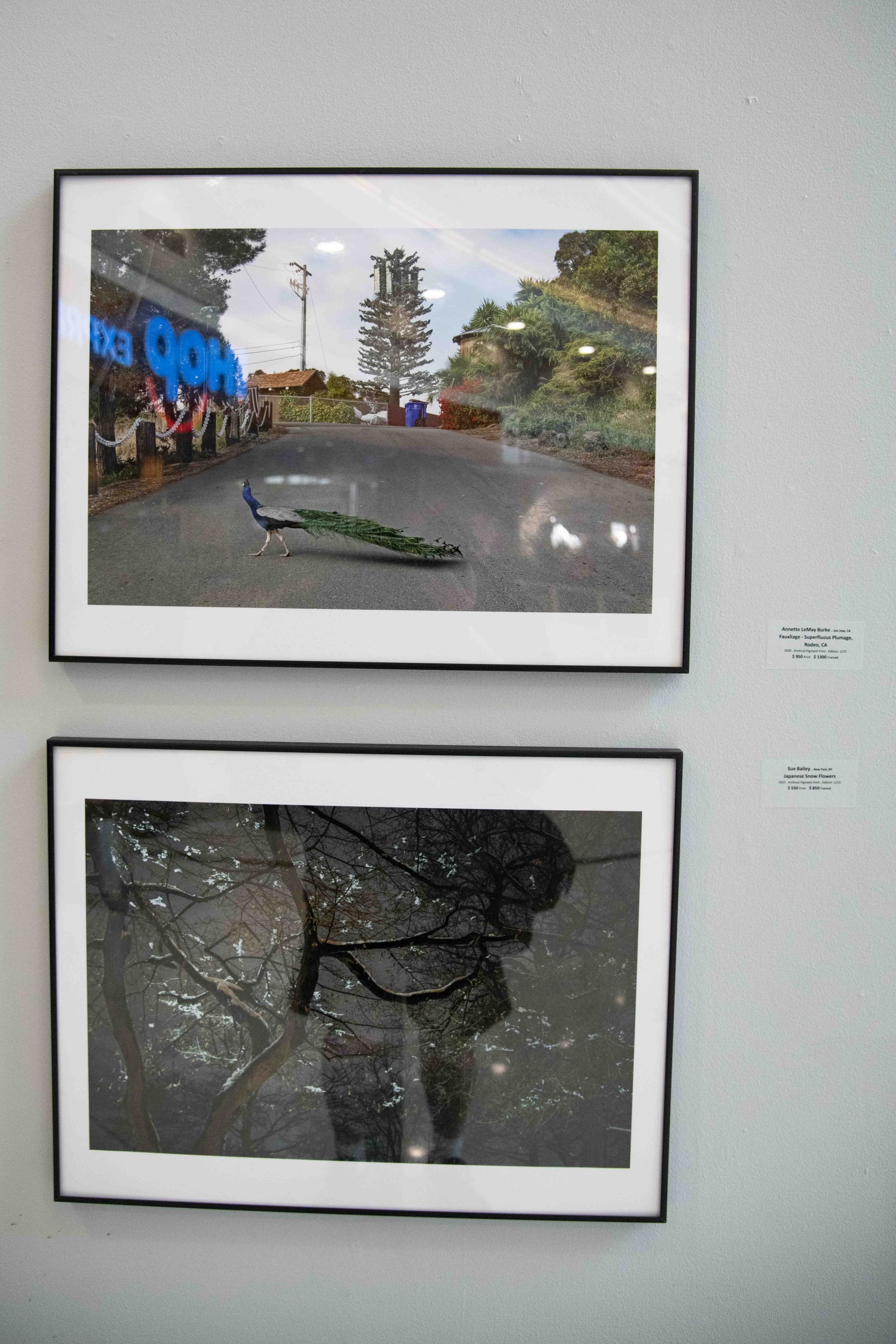
2022 is the second consecutive year I have had two photographs on display in the Atlanta Photography Group’s Airport Exhibition. This year I also had two photographs in the Atlanta Photography Group’s Selects Exhibition, in APG’s gallery space, concurrent with the Airport show, so I decided to fly to Atlanta last month to see both exhibitions and finally visit Atlanta for the first time.

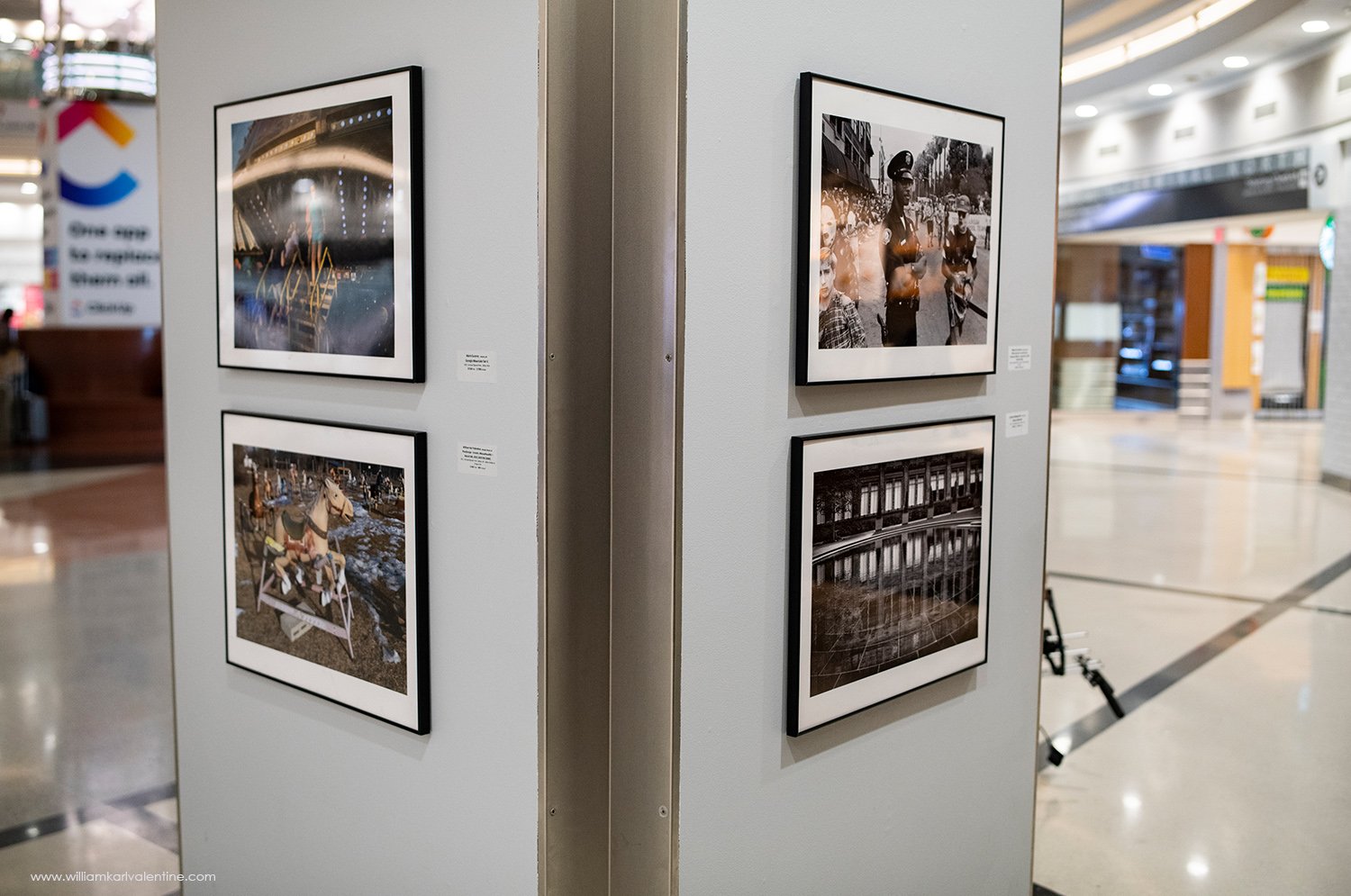
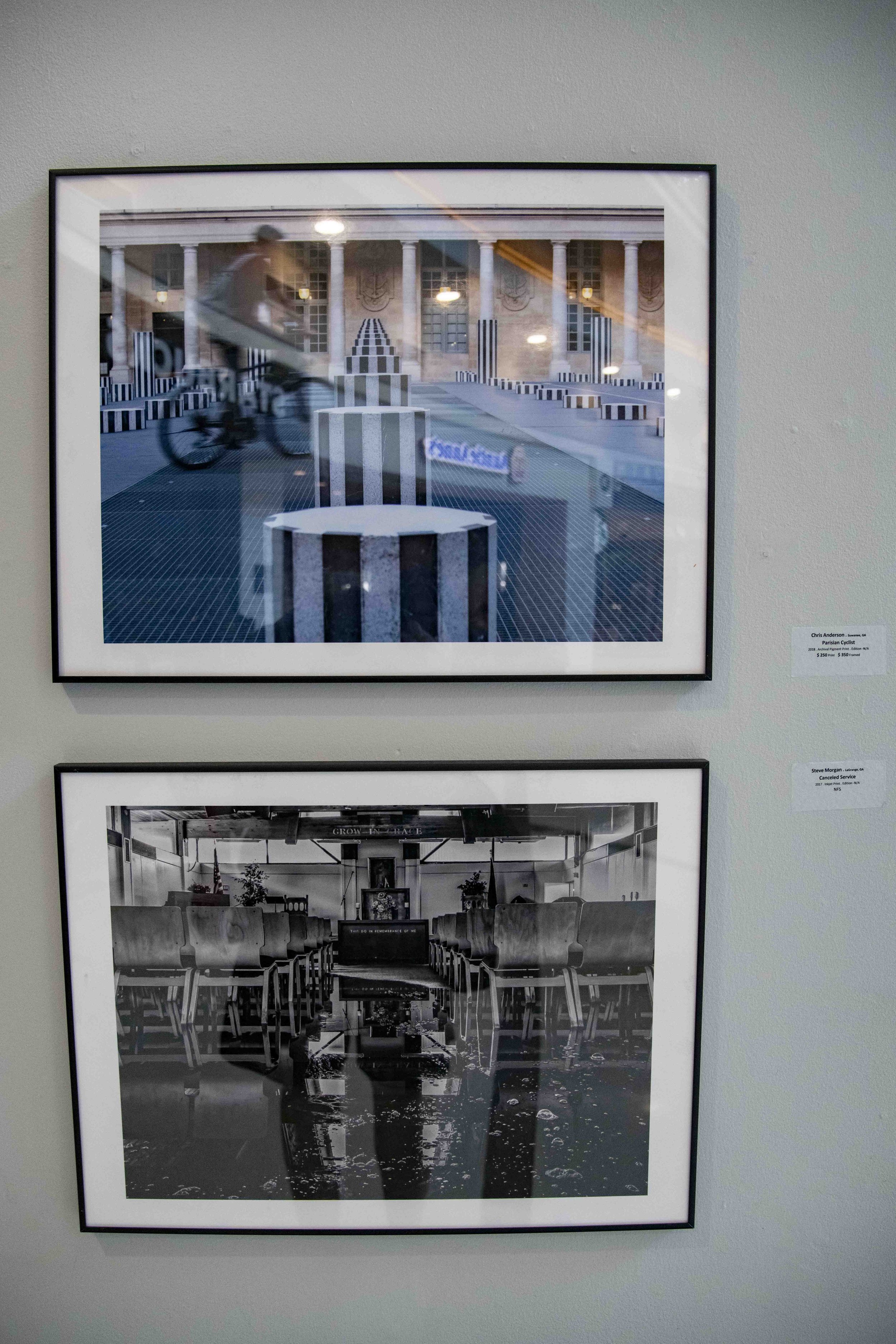
I had never seen photographs of the Airport exhibition space before, but I had a rough idea of where the space in the airport based on its description. I knew it was outside of security in a food court area. After landing I got my luggage and went looking for the exhibition, luckily it was near by the baggage carousels. There are 30 photographs in the 2022 Airport Show by 22 different photographers. The exhibition was curated by Lisa Volpe who is the Associate Curator of Photography at the Museum of Fine Arts, Houston. The prints are uniform in size because of the framing constraints, and they are displayed on four columns within the Central Atrium. My photographs were on a column in front of the Atlanta Chop House; I am sure everyone who knows me would say this is an appropriate location for me and my work. The column had four panels with two photographs on each panel. Below are details of my photographs, the Central Atrium area, and finally a slide show highlighting all the photographs in the exhibition. As I stated in early blog posts about this exhibition, I am honored that Lisa Volpe selected my two photographs to be part of this exhibition. I am thankful that the Atlanta Photography Group arranges this exhibition annually and that they are able to secure top curators, like Lisa, for the selection process. After visiting the space and seeing the exhibition I am even more proud that my photographs are being displayed with so many other strong images, in such a unique space, with so much daily traffic. This exhibition runs through January 25th, 2023.

View fullsize web ATL DSC_1166_ 10222022.jpg
View fullsize web ATL DSC_1172_ 10222022.jpg
View fullsize web ATL DSC_1168_ 10222022.jpg
View fullsize web ATL DSC 0438_ 10-19-2022.jpg
View fullsize web ATL DSC_1196_ 10222022.jpg
View fullsize web ATL DSC 0450_ 10-19-2022.jpg
View fullsize webATL DSC_1158_ 10222022.jpg
View fullsize web ATL DSC 0429_ 10-19-2022.jpg
View fullsize webATL DSC_1160_ 10222022.jpg
View fullsize web ATL DSC 0444_ 10-19-2022.jpg

Slideshow of all 30 prints in the exhibition:

web ATL DSC_1166_ 10222022.jpg
web ATL DSC_1171_ 10222022.jpg
web ATL DSC_1172_ 10222022.jpg
web ATL DSC_1173_ 10222022.jpg
web ATL DSC_1175_ 10222022.jpg
web ATL DSC_1176_ 10222022.jpg
web ATL DSC_1177_ 10222022.jpg
web ATL DSC_1179_ 10222022.jpg
web ATL DSC_1180_ 10222022.jpg
web ATL DSC_1182_ 10222022.jpg
web ATL DSC_1183_ 10222022.jpg
web ATL DSC_1184_ 10222022.jpg
webATL DSC_1141_ 10222022.jpg
webATL DSC_1142_ 10222022.jpg
webATL DSC_1143_ 10222022.jpg
webATL DSC_1144_ 10222022.jpg
webATL DSC_1145_ 10222022.jpg
webATL DSC_1146_ 10222022.jpg
webATL DSC_1147_ 10222022.jpg
webATL DSC_1150_ 10222022.jpg
webATL DSC_1151_ 10222022.jpg
webATL DSC_1152_ 10222022.jpg
webATL DSC_1153_ 10222022.jpg
webATL DSC_1154_ 10222022.jpg
webATL DSC_1155_ 10222022.jpg
webATL DSC_1156_ 10222022.jpg
webATL DSC_1157_ 10222022.jpg
webATL DSC_1161_ 10222022.jpg
webATL DSC_1162_ 10222022.jpg
webATL DSC_1163_ 10222022.jpg
webATL DSC_1164_ 10222022.jpg
web ATL DSC_1166_ 10222022.jpg web ATL DSC_1171_ 10222022.jpg web ATL DSC_1172_ 10222022.jpg web ATL DSC_1173_ 10222022.jpg web ATL DSC_1175_ 10222022.jpg web ATL DSC_1176_ 10222022.jpg web ATL DSC_1177_ 10222022.jpg web ATL DSC_1179_ 10222022.jpg web ATL DSC_1180_ 10222022.jpg web ATL DSC_1182_ 10222022.jpg web ATL DSC_1183_ 10222022.jpg web ATL DSC_1184_ 10222022.jpg webATL DSC_1141_ 10222022.jpg webATL DSC_1142_ 10222022.jpg webATL DSC_1143_ 10222022.jpg webATL DSC_1144_ 10222022.jpg webATL DSC_1145_ 10222022.jpg webATL DSC_1146_ 10222022.jpg webATL DSC_1147_ 10222022.jpg webATL DSC_1150_ 10222022.jpg webATL DSC_1151_ 10222022.jpg webATL DSC_1152_ 10222022.jpg webATL DSC_1153_ 10222022.jpg webATL DSC_1154_ 10222022.jpg webATL DSC_1155_ 10222022.jpg webATL DSC_1156_ 10222022.jpg webATL DSC_1157_ 10222022.jpg webATL DSC_1161_ 10222022.jpg webATL DSC_1162_ 10222022.jpg webATL DSC_1163_ 10222022.jpg webATL DSC_1164_ 10222022.jpg
In Galleries, Photography Tags Adam Forrester, Anna Norton, Carolyn Hollingsworth, Anette LaMay-Burke, Arnold Ableman, Chris Anderson, Cindy Konits, Cindy Weisbart, Ellis Vener, Dolapo Adebola-Wilson, Erica Clahar, Gwen Julia, Harold Olejarz, Jane Szabo, Jeremy Janus, Lisa Cassell-Arms, Mark Caceres, Mony Nation, Steve Morgan, Sue Bailey, Susan Lapides, Lisa Volpe, William Karl Valentine, The Museum of Fine Arts Houston, Central Atrium of the Hartsfield-Jackson Atlanta International Airport, Atlanta, Atlanta Photography Group, Airport Show 2021, Hartsfield-Jackson Atlanta International Airport
Comment

Jackson Fine Art - Atlanta

November 20, 2022

I have known about Jackson Fine Art in Atlanta, and of their reputation as one of the nation's top private galleries, for years.  I have casually followed who they were exhibiting in the past, but I had never seen their space.  So, when I was in Atlanta last month for my opening of the Atlanta Photography Group’s 2022 Selects Exhibition, I made a point to stop by Jackson and finally see their gallery.

The gallery is a converted residence in the Buckhead shopping district neighborhood of north Atlanta.  The gallery layout is a little unique, but it works well the way they designed it.

I planned my Atlanta trip last minute, so I was not able to make arrangements to visit Jackson beforehand; so, this was a complete cold call on my part. I just wanted to see their space and hopefully introduce myself to someone on the staff.

The visit exceeded my expectations, Gallery Director Coco Conroy and the staff were so nice, and Coco was gracious enough to spend half an hour showing me the current exhibition and talking about the gallery. We even were able to talk briefly about my own work and Coco was even able to introduce me to the owner, Anna Walker Skillman.  I can see why Jackson has the reputation and client list that they do, everyone is professional, and their artist roster and inventory is large.

With Gallery Director Coco Conroy - Jackson Fine Art

Jackson was featuring the work of Tabitha Soren, who they represent, when I was there.  Soren is a former MTV reporter and is married to Michael Lewis who authored the famous book “Money Ball”.  Her prints are often individually unique.  For her images from her “Relief” portfolio she damaged the print surface by causing small holes (from an airsoft gun or knife) or even burned some prints slightly to use that damage to create a finished work that better captured her feelings; the damage added an interesting element of texture to the photographs. Prints from her “Surface Tension” portfolio were also on exhibit.  These large prints were made from 8”x 10” negatives where she photographed the reflective surfaces of iPads with vernacular images on the screen.  She was interested in capturing the viewers fingerprints on the surface of the iPad to highlight the connection between the viewer and the electronic device.  Soren’s photographs allow for a lot of viewer interpretation and for me they seemed to have lots of layers of meaning.

I would strongly recommend Jackson Fine Arts for anyone interested in purchasing photographs in the region. Jackson has a national client base and provides services to many top institutions as well as collectors.  Hopefully I will have a chance to visit Jackson again soon as well as spending more time with Coco talking about photography.

Jackson Fine Art
3115 East Shadowlawn Avenue
Atlanta, GA 30305

info@jacksonfineart.com

Tel 404.233.3739
Fax 404.233.1205

Tuesday - Saturday, 10am - 5pm 

View fullsize IMG_9528.jpg
View fullsize IMG_9527.jpg
View fullsize IMG_9526.jpg
 
In Art Collection, Galleries, Photography, Photography Collector Tags Jackson Fine Art, Atlanta, Coco Conroy, William Karl Valentine, Photography, Tabitha Soren, Michael Lewis, Moneyball
Comment

Beautiful Senoritas - So Good! Album is now Available

November 15, 2022

A week or so I got an email from the Beautiful Señoritas updating me that the album which I provided the cover image for had been released along with the great new it was being well received. Here is what they said:

“The record is in the market. Bellow some links of interest (the record in the label web, metions in national and international podcasts, spotify, youtube, etc). The front is being quite and event for the Spanish public. It is being tremendosuly striking and all those who give us their evaluation begin with the great originality of the photo. When it is with others fronts, all the sights go to Gary. In January we should start to make the shows where we sell even more than now. We will keep you informed about all the news.”

I am so happy for Jose, Ale, and Blas. They have been so professional to work with, I dig their music, and I respect how dedicated they are to their music so much. With any success you must follow your passion and work hard to achieve your goals then your dreams will have a solid chance of coming true.

View fullsize IMG_0107.jpg
View fullsize IMG_0106.jpg

Please check out their music at the links below that they provided:

https://www.folcrecords.es/

https://www.youtube.com/watch?v=GJ7MHp3EtNk&list=OLAK5uy_k_-iHHsXq9UrM-49GICdd4d9sqGJ01K9M

https://open.spotify.com/album/2r2I3O1oceuM7LQQMmye7F

So Good

Beautiful Señoritas · Album · 2022 · 8 songs.

open.spotify.com

https://folcrecords.bandcamp.com/album/folc189-beautiful-se-oritas-so-good 


https://itunes.apple.com/album/id/1651636521 


https://music.amazon.es/albums/B0BKPLC4TV?marketplaceId=A1RKKUPIHCS9HS&musicTerritory=ES&ref=dm_sh_DRgo8FeAn9ssOhqQcVTCyObij 


https://www.deezer.com/album/370034107 

https://www.mixcloud.com/jason-tattum/oh-no-not-garage-and-hardcore-punk-ep-85-26-10-22/?fbclid=IwAR3xXa7N8GhfoWhpzXKWOIXR6gE16OoS3owrzvv3h_dFLXIVNSVAmd-nwaM

Oh No! Not Garage and Hardcore Punk! Ep 85 26-10-22

New Punk stuff:

www.mixcloud.com

https://www.ivoox.com/behringer-del-capi-programa-348-audios-mp3_rf_94999707_1.html

https://www.ivoox.com/podcast-motel-bourbon-73-audios-mp3_rf_95015396_1.html

Descripción de El Podcast de Motel Bourbon #73 - ivoox.com

Escucha y descarga los episodios de El podcast de Motel Bourbon gratis. Una nueva cita con la distorsión. Ración de mandanga antes de dar la bienvenida a noviembre. TIPARRAKERS - Noche trankila BEAUTIFUL... Programa: El podcast de Motel Bourbon. Canal: El podcast de Motel Bourbon. Tiempo: 01:00:23 Subido 28/10 a las 08:11:12 95015396

www.ivoox.com

In Photography, Copyright Tags Beautiful Senoritas, William Karl Valentine, Pasadena Police Department, Album Cover
Comment

Andy Adams

Andy Adams launches FlakPhoto Digest newsletter

September 13, 2022

Andy gives this online description of himself:

Andy is a cultural producer + digital director. He has consulted with arts organizations and cultural institutions that use the Internet to engage and educate the public since 2004.

In 2006, he founded FlakPhoto Projects, an online digital/arts lab promoting photography + visual culture.

Andy also hosts the FlakPhoto Network, an 18,000-member online community focused on conversations about visual/media culture.

Like 50,000 + other people I have been following Andy Adams and his FlakPhoto on Instagram for a while. I always appreciated the images he shared, and the conversations he raised, with his posts. I was in awe of, and jealous of, his passion and energy for the medium of photography and his ability to dedicate so much of his life to the medium. I also like the fact that his posts have that feel of Midwestern nice. Even if I didn’t like an image, or disagreed with a concept, it never bothered me because his presentation of different material was usually unbiased and always professional. It was so refreshing that in our divided world today someone still understood how to present different ideas in a way that encouraged dialogue not division.

On September 8th Andy announced he was going to launch FlakPhoto Digest, a subscription digital newsletter. Andy decided on using this platform to showcase his material because he thought it was a better way to share content. Like most of us, Andy has become frustrated with the current state of social media and was looking for a better way to get the information to his audience.

With the announcement of the FlakPhoto Digest, Andy also asked photographers to email him to tell him about themselves, their work, and provide links to their work. I sent an email with my information last weekend and got a reply email two days later thanking me for signing up and asking me to spread the word about his project. I know it had to be a cut and paste reply with the volume of emails he received but I was impressed that he took the time to personalize it, so I decided to author this blog post about his project to honor that request. I know over 2,000 photographers have already signed up for the newsletter, and I know some of you reading this post already know all about Andy and FlakPhoto, but if you haven’t checked out FlakPhoto yet please do. I also encourage you to sign up for the newsletter, knowing the content Andy has shared in the past I am confident the Digest will quickly become a top resource for contemporary photography.

FlakPhoto Digest Newsletter Link

Andy Adams Bio Link

In Photography Tags Andy Adams, FlakPhoto, FlakPhotoDigest, Online photography community, Photography
Comment

Beautiful Senoritas - So Good! Album Cover Licensing

September 3, 2022

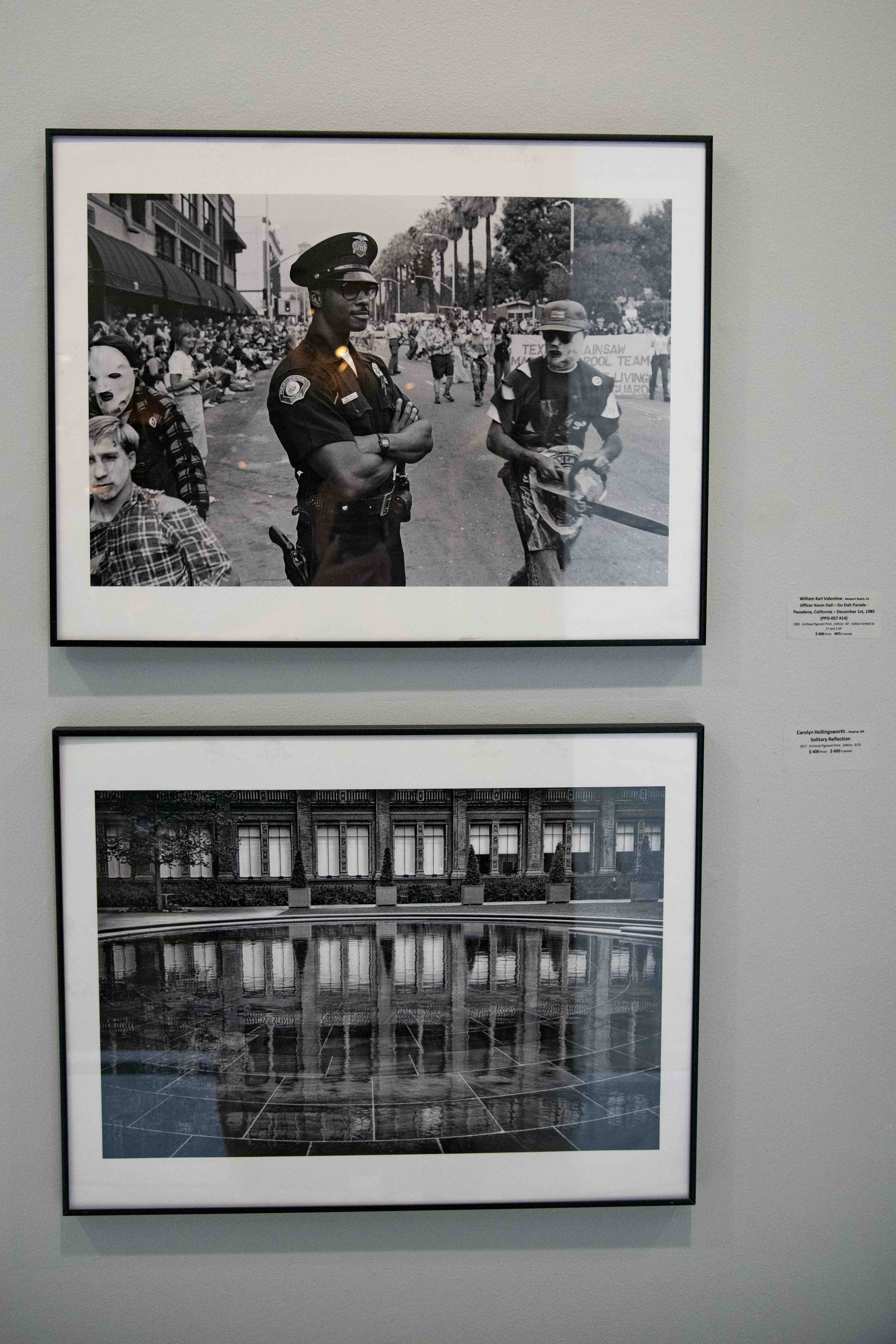
Officer Gary Capuano "Caps" PPD-075 #05 (1/17/86)

I had another Photography first this summer when I licensed one of my images to be an album cover. The Spanish band Beautiful Senoritas found the above photo from my Pasadena Police Department Portfolio and really wanted to use it for the album cover of their new record “So Good!”. I had to hear their music and read the lyrics to “Call the Police” before considering the licensing. I liked their sound and there wasn’t anything negative in the lyrics, so I was good with it. I then called up “Caps” to make sure he was fine with the use, and he was. The band is emerging still, so the album will probably be a small project, but I have to admit the band members were so professional during the process. One of the best licensing experiences I have ever had. Hopefully the album takes off and does well because I love seeing good people have success. I just got a proof of the artwork and wanted to share it.

In Photography Tags Beautiful Senoritas, Album Cover, Pasadena Police Department, Pasadena, William Karl Valentine, Folc Records
Comment

Tod Papageorge at Danziger Los Angeles

July 23, 2022

I was able to get up to Danzinger yesterday afternoon and it was absolutely worth the drive. Danzinger is a great space, in Bergamot Station which has so many cool gallery spaces and is actually pretty easy to get to considering how hectic summer traffic can be in Santa Monica. The staff at Danzinger is also outstanding, they know the exhibition well and were actively engaging visitors to explain interesting facts about the work. The staff obviously has a passion for art and are motivated, I wish every gallery was like that.

Read More
In Galleries, Photographer, Photography Tags NY Times, Tod Papageorge, Santa Monica, Malibu, Venice Beach, Documentary Photography, Vintage Surf Photos, Surfing
Comment

Bergamot Station Arts Center - Santa Monica

July 23, 2022

In the other blog post I am putting up today I talk about the Todd Papageorge exhibition at Danziger which is why I went to Bergamot Station Arts Center yesterday. While I was there, I bounced around the other galleries and found enough other good work that I liked so I decided to do a separate post on the other spaces.

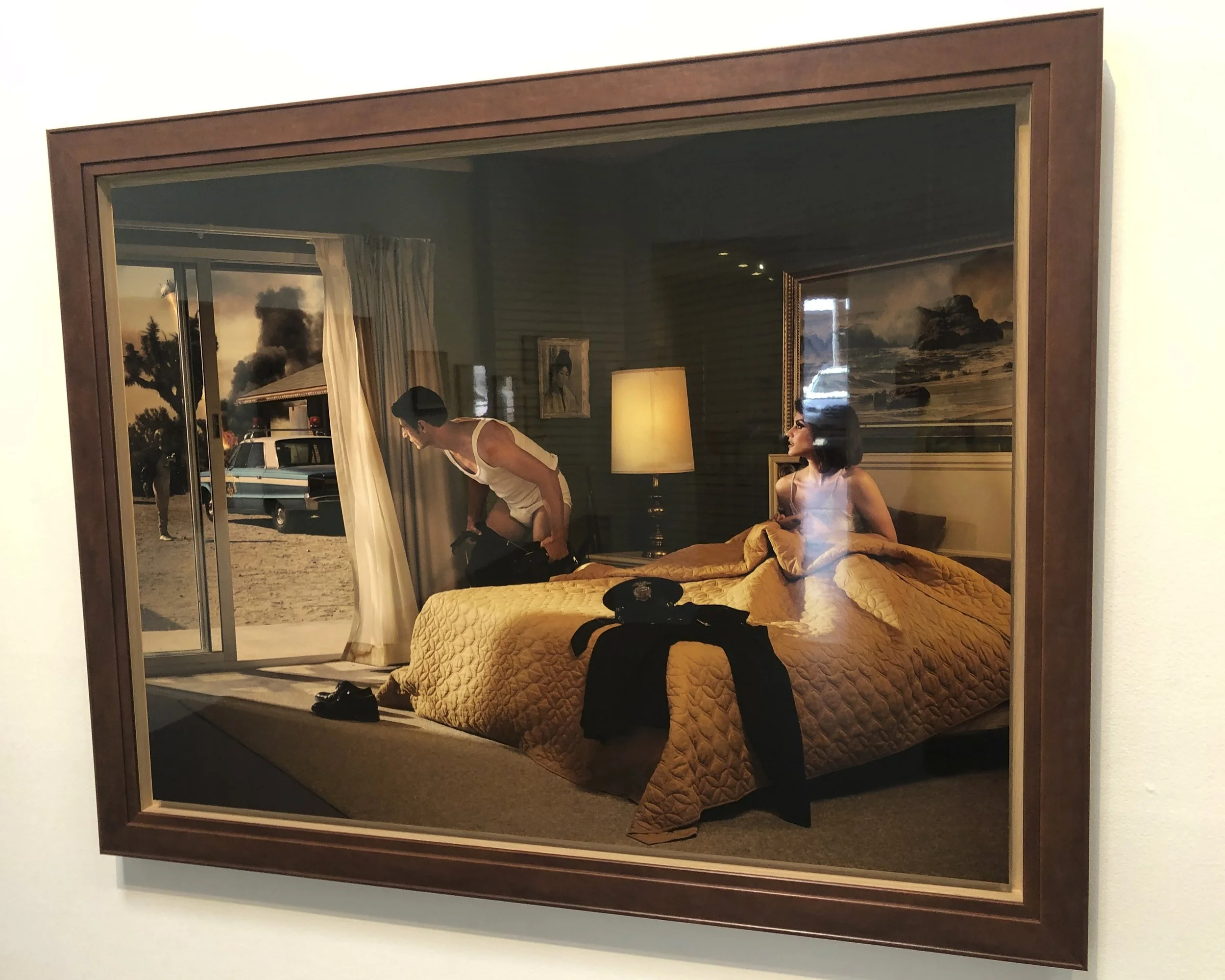
Galerie XII - Los Angeles. French photographer Sacha Goldberger’s first Los Angeles solo exhibition “Alien Love” is a lot of fun. His images are stunning, so well made, and the story line is hilarious. 1950’s Sci Fi feel with the clean look of modern image making. There is an accompanying DIY book of the Alien Love portfolio, which is interesting, but I took pass on it. The book printing is okay, but it doesn’t come close to the beautiful prints in the exhibition, so it wasn’t the same for me. It is a solid exhibition still which runs through September 3rd. Below are my two favorite photographs. I am sure my law enforcement background, my ties to Arizona and its Saguaros, and my appreciation of beautiful brunette women had something to do with these prints standing out for me.

View fullsize 1 IMG_6953.jpg
View fullsize 1 IMG_6952.jpg

Galerie XII was also showing Matthew Arnold’s “Longing for Amelia”. I was not familiar with Arnold or his work but found “Longing for Amelia” to be a tight exhibition with lots of unique details. I felt it had good value.

Rose Gallery had Life:Still by Godeleine De Rosamel which I would best describe as pottery-based sculpture. I thought it was interesting and fun, I enjoyed viewing it, but it doesn’t fit my collecting interests.

I absolutely loved some of the paintings up at Skidmore Contemporary Art. Jessica Brilli’s “Chrystler in Carport” brought me back to my mom’s blue Chevy station wagon I grew up in and Jessica’s “Morning of the Camping Trip” was equally beautiful. I love her style. Richard Baker’s “Sonoran Sunset” was also awesome. Reminded me of Ed Mell’s work, one of my favorite painters. Lia Skidmore has a solid eye for work and a nice space, I will definitely be back there again.

View fullsize Chrysler in Carport, 2022 - Jessica Brilli
View fullsize Morning of the Camping trip, 2022 - Jessica Brilli
View fullsize Sonoran Sunset, 2022 - Richard Baker

Peter Fetterman Gallery had his “Power of Photography” exhibition up to coincide with the release of his new book of the same title. I love the fact he chose a Max Yavno photograph for the book cover, I love Yavno’s work, and how he used a long lens to flatten out his subject matter, an interesting different perspective and wonderful prints. The same print is on the wall in Fetterman, and it is such a beautiful rich print. Fetterman always has classic prints up, always something good to see there. It should be noted that Peter also has a book signing and discussion scheduled at Arcana Books in Culver City on Saturday August 13th from 4:00 - 6:00 PM. Arcana is one of the best fine art photography bookstores in the country, their stock is amazing, great space, and knowledgeable staff. John Divola is also signing his new book “Scapes” at Arcana tomorrow, Sunday July 24th from 4:00-6:00 PM. See Map below for Arcana Books location:

 
In Galleries, Photography Tags Bergamot Station Arts Center, Santa Monica, Galerie XII, Sacha Goldberger, Alien Love, Matthew Arnold, Peter Fetterman, Power of Photography, Max Yavno, Arcana: Books on the Arts, John Divola, Richard Baker, Ed Mell, Godeleine De Rosamel, Skidmore Contemporary Art, Lia Skidmore, Jessica Brilli, Rose Gallery
Comment

PD-029 #33 5-02-92 Bill in front of his laundromat - Los Angeles, California

30 years ago today, I was at the LA Riots

May 2, 2022

As a documentary photographer, the fact that I was unable to photograph some of the most surreal things I ever witnessed will always bother me.

I was a Police Officer for the City of Chino in 1992 and at work when the LA Riots erupted.  Chino is forty miles East of downtown Los Angeles, just outside of Los Angeles County in San Bernardino County.  I remember watching Reginald Denny getting dragged from his truck and beaten on the TV in the watch commander’s office as our dispatchers took 911 calls from our citizens pleading for our officers to nbe sent to help stop the things they were witnessing on.  I was expecting that there would soon be a mutual aid request soon from LAPD and I started lobbying to go when that call came.  I knew Los Angeles better than most my peers and I wanted to get into this fray.  The rioting grew that night, but the mutual aid request never came.

I lived in Pasadena then and when I got home, I could smell the smoke from the fires in Los Angeles.  One buddy I grew up with was a Pasadena cop and he let me know Northwest Pasadena was rioting too and their department was on tactical alert.  It immediately reminded me of my father’s stories from the Pasadena Gambling House riot which occurred during the Watt’s Riots in 1965, just after he had joined Pasadena PD. 

I watched a lot of news before my next shift as rioting spread on April 30th.  I knew I wanted to get to Los Angeles but was torn because part of me wanted to go photograph it and the other part wanted to go as a police officer to deal with the looting and rioting.  I knew to go photograph on my own would be dangerous and logistically nearly impossible. 

Finally on May 1st Los Angeles sent out a mutual aid request to San Bernardino and Riverside Counties.  I was one of nine officers sent from Chino PD, we took three older police cars.  We were to the Los Alamitos National Guard base where we staged and waited for our assignment.  I remember we left in the afternoon and traffic on the 57 freeway was so heavy we had to drive down the center shoulder to get there.  Looking at the people we were passing most of them looked serious or nervous.  I remember people were worried the rioting would spread throughout Southern California.  I was focused on what awaited us in Los Angeles, we were not saying much, mostly listening to the Am news radio.  I was expecting to get into a lot of conflict, so I had the pregame type of focus.  I was thinking of what I had seen on the news, and I was trying to run as many of those scenarios through my mind as possible to prepare. 

We sat at Los Alamitos for over an hour then they told us they were cooking steak dinners for us before we went it.  The last thing I wanted was a military grade steak dinner, I just wanted to get to Los Angeles while things were still going on.  After dinner we were sent to the City of Inglewood in a task force of mostly officers and deputies from San Bernardino County agencies.  The only agency from our county that didn’t go with us was Ontario PD because they had been assigned to escort a shipment of ammunition to Compton PD shortly after they arrived at Los Alamitos.

It was evening when we finally started our drive up the 405 Freeway.  Our convoy of over 30 police cars, every unit with 3 to 4 cops wearing helmets, and support vehicles was pretty impressive looking, a strong show of force.  The San Bernadino Sheriff even sent his mobile communications center semi truck so our radios would still work outside of our normal range. As we got near the 110 Freeway, I could see plumes of smoke all around South-Central Los Angeles.  The columns had orange tints from the late afternoon sun, and the scene was almost apocalyptic.  I knew a full curfew was set to go into effect at sunset, or 8pm, and I was hoping to get deployed before that.  We got to Inglewood and staged in the parking lot of an eight-story hotel on Century Boulevard just off the freeway, today it is a Motel 6.  Once again, we all stood around and waited, now as the sun was setting and the curfew was going in to affect.  The Inglewood officials didn’t seem to know what to do with us.  By that point rioting in their city had calmed down.  Los Angeles and Compton were still rioting but Inglewood officials didn’t want to send us over to those areas in case Inglewood had more problems.  I also think a lot of people saw us come into the city and officials just liked our presence as a deterrent.

We were eventually sent to guard a gas station on the north side of Inglewood, I think it was on La Brea near Centinela.  The small mini mart portion of the Chevron had already been partially looted but I was able to find a map inside so we could figure out where we were (pre-cellphone era when gas stations sold maps).  With the curfew in place we hardly saw anyone out and about.  I could still hear gunshots occasionally, but everything sounded a couple blocks away, and no one was shooting at us.  A couple of us eventually talked our Sergeant into letting us scout the surrounding area.  Inglewood residents still had electricity so except for the looted businesses it looked normal. But once we went a few blocks East into Los Angeles where there was no power, so everything was pitch black. In Los Angeles we came across a market that was still burning, LA City Fire engines were on scene working it with CHP officers providing them security.  On one block we found a corner market that had burned to the ground, a pilot light for some appliance was still burning and that little two-inch flame was the only light we could see on the entire block.  We saw a few people moving around in the darkness but for the most part the streets were deserted in that area.

It was well after midnight when we returned to the hotel at the end of our shift.  Things were still disorganized.  The San Bernadino County Sheriff’s Department had allocated all the rooms at the hotel for their people, and no one had any idea where to put us.  We waited for a long while and I finally got fed up. I told my sergeant if he’d let me drive to a pay phone I would find us a hotel. He asked how and I said I would just come up with something, he agreed since there wasn’t another option.  The first hotel I could think of was the Bonaventure Hotel in downtown Los Angeles.  I knew they would be empty and assumed they would be happy to have Officers on site given everything that was happening.  I made the call, spoke with the manager, and he invited us come on over.  They comped us on everything and their only request was that we park our units up front so anyone coming to cause problems would see them. 

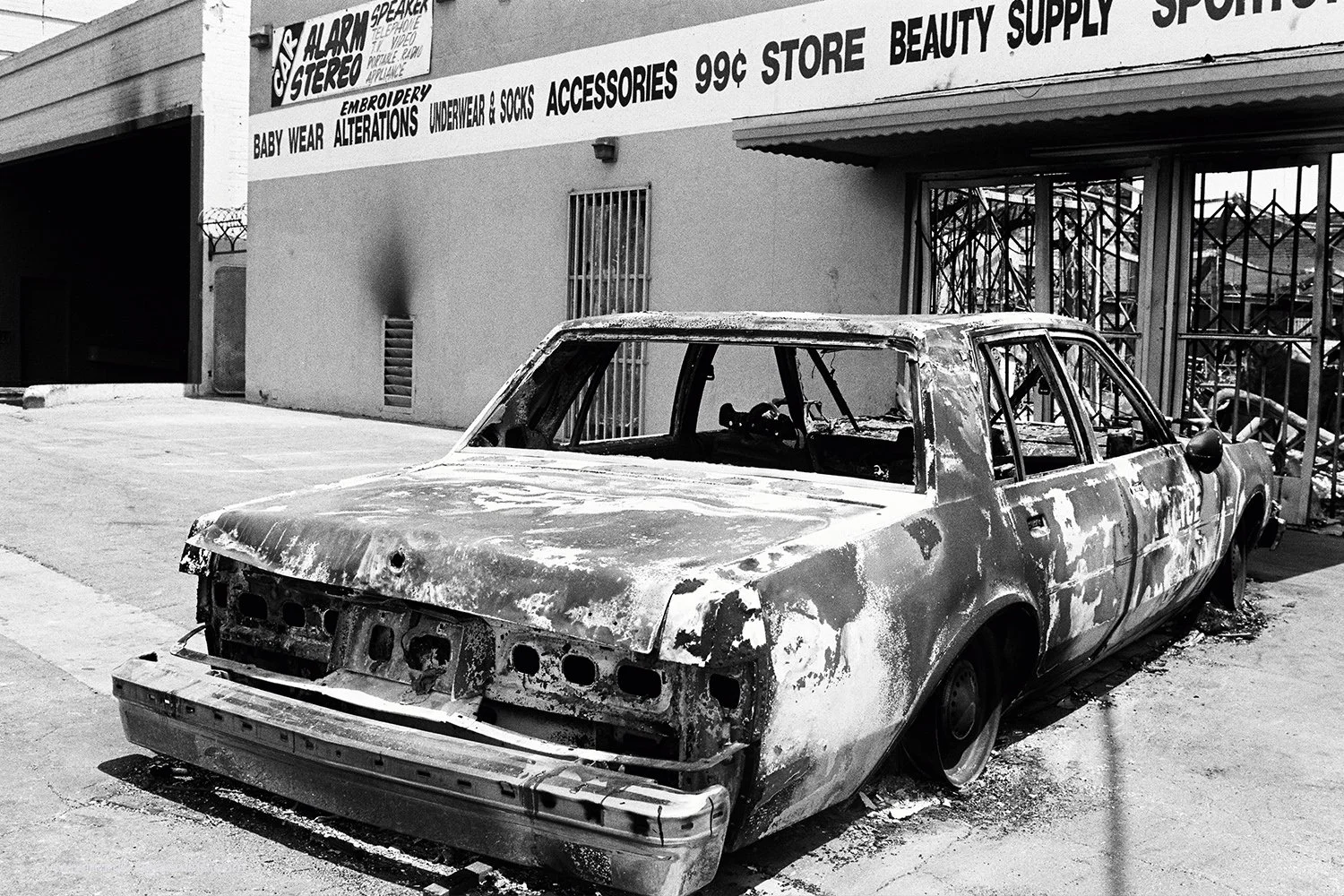
We decided to drive across Manchester Boulevard to the hotel in downtown LA.  I knew Manchester very well, having driven it hundreds of times going to Kings games at the Forum.  It was so surreal to see the area pitch black with so much damage and seemingly being the only ones out and about.  So many businesses were gone, and it seemed there was a burned-out car in the road every couple blocks.  We passed a couple armored vehicles parked on side streets then soon saw a pair of heads approaching from behind us.  We couldn’t tell who it was, so we moved to the right lane and were starting to prepare for trouble when we saw it was a convoy of 30 Los Angeles County Sheriff’s units with four deputies in each car.  Only the lead unit had headlights on every other unit behind was blacked out, we assumed they might have been out hunting for problems trying to appear as if there was just a solo vehicle. The sight of that LASD convoy passing us was so incredible, put the gravity of the situation in to perspective.

View fullsize PD-029 #16  5-02-92
View fullsize PD-029 #13  5-02-92
View fullsize PD-029 #15  5-02-92
View fullsize PD-029 #22  5-02-92
View fullsize PD-029 #29  5-02-92 - Murder victim's car
View fullsize PD-029 #36  5-02-92  Inglewood PD Unit

The next couple days we were assigned to guard the general area of Manchester and Crenshaw in Inglewood, it was mostly to show a presence and deter further unrest.  We were able to assist Inglewood PD with a few calls, a shots fired and a looting in progress, but those calls were uneventful.  It did allow us a chance to talk with the Inglewood officers about the first part of the rioting which was insane, I remember talking with Sergeant John Bell after clearing a Nix Check Cashing store which someone had reported being “re-looted”.  I knew who Bell was, he was somewhat of a legend, having survived some intense situations.  Bell told us that he was in three pursuits and two shootings on the first night of the riots.  He described driving up to the front of a liquor store he thought was just being looted only to discover it was an armed robbery in progress and having to engage the suspects.  Later that night I spoke with a couple more Inglewood officers in an unmarked unit on another call.  They said their primary assignment that night was to go to “shots fired” and “man with a gun” calls before other officers in marked units arrived.  Both officers had been in so many shootings the first two days of the riots the extra magazines on their belts were empty.  The department had apparently run out of duty ammo because officers had been in so many shootings.  They described the agency being in a “no hits no paper” mode because of how overwhelming things had been.  They said if someone shot at them, they would try to return fire and get out of the area as fast as possible then come back later with numbers and check to see if they had hit anyone.  I could tell how much stress they had been through with the looks on their faces.  One side note about Nix Check Cashing, which is a chain of check cashing storefronts still around today, while we were there a couple guys drove up and asked us if Nix was open.  We said they were closed because it had been looted.  The guys lamented that they needed to cash their welfare checks but couldn’t find anyplace open because they had all been looted or burned.  We suggested they drive out of the area, and they said they didn’t have enough gas because all the gas stations had also been looted and shut down.  This interaction highlighted the lack of thought with the rioting.  One other incredible thing I saw during the riots was the massive line of 3000 people at the main post office for South Central LA when people had to go down in person to get their welfare checks because all letter carrier service had been suspended because the area was too dangerous.

We patrolled around the neighborhoods some and interacted with people the best we could.  I consider a lot of Inglewood as middle class, definitely nicer than South Central LA, and most the residents are good people.  The neighborhoods were very well cared for, lots of older well-kept single-family homes.  The homes were in good repair, lawns were mowed, hedges trimmed, most with a decent car in the driveway, and almost everyone with security bars on the windows.  But it also seemed like every block had one house that was the local gang or crack house.  Trash in the yard, broken down car out front, and bullet holes in the stucco.  It still pisses me off to think of how many decent people were living behind bars because of the gangsters on their block, and how many more people today are subjected to crime.  It was blatant who was involved in the looting and rioting.  We stopped in front of one of those gangster houses and chatted with a guy putting a new car stereo in his ride.  The guy said he had just bought it but we all knew where it came from but there was no way to prove it.  All the stores had been closed for several days and he didn’t have a receipt.  We then drove the alley behind the house and found a pile of old furniture and an old TV, they were not even trying to hide the fact they had been out looting.  Most the people I spoke to were happy we were there and supported us.  About a quarter of the people were just pissed off.  Pissed off at how LAPD treated people they contacted but at the same time pissed off at the gangsters that committed the crime which created the law enforcement response.  They were also livid with the people who destroyed their neighborhood. The rest of the people, mostly the ones involved in crime and causing problems, just hated us and didn’t mind letting us know about it.

I was able to photograph some while I was there although I was limited in how much time I could spend doing it.  Somehow I lost one of my rolls of film, one that had images of the burned-out cars in the street, If I remember correctly from the area of Florence and Normandie, but I still have the images in my mind.  My portrait of “Bill”, who owned a laundromat, in front of burned-out business is one of my favorites.  He was such a gentleman, in talking to him I knew how much effort he put in to building his business and it made me mad they destroyed his business for something he had absolutely no responsibility for.  His faith was impressive and I assume he rebounded well. I have other photographs which document the devastation of the fires and looting.  I remember photographing a bank where the giant main steel support beam for the roof bent from the intensity of the fire being left to burn out, the only thing left inside the walls was the vault, it was insane to think how hot that fire must have been.

I knew at the time that I pretty much missed out things with the riots.  I had so many friends at other agencies who were in the middle of the fight as were a lot of press photographers at the time.  I was able to witness and document the aftermath still and have a good understanding of the atmosphere, but that was about it.

With the 30th Anniversary of the Los Angeles Riots this weekend I wanted to take a moment to share these photographs and the story of my experience.  I am fearful how history is being rewritten lately, and it is important we remember things as accurately as possible to prevent repeating previous mistakes or creating new problems.

PD-029 #07 5-02-92

In Photography, Civil Unrest Tags William Karl Valentine, Documentary Photography, LA Riots 1992, Los Angeles, LAPD, Riots
Comment

Harry Carey - HoHoKam Park - March 1983

40 years Photographing the Cactus League

April 8, 2022

2022 marked the 75th Anniversary of the Cactus League, Spring Training in Arizona, and the 40th Anniversary of my first trip to Arizona to watch, and photograph, Cactus League games.

In 1983 my buddy Steve DeWitt suggested we road trip to Arizona to go see some Cubs Spring Training games.  Two other friends also went along.  I think I drove us out there in my small Toyota truck, and I know we stayed at the Motel 6 in Scottsdale.  That “Six” was in even worse condition than you would expect from that motel chain, the pool was solid green, and the room was dated, so it was ideally suited for a low budget road trip by 20-year-old males. 

CL-094 #33 3-28-87

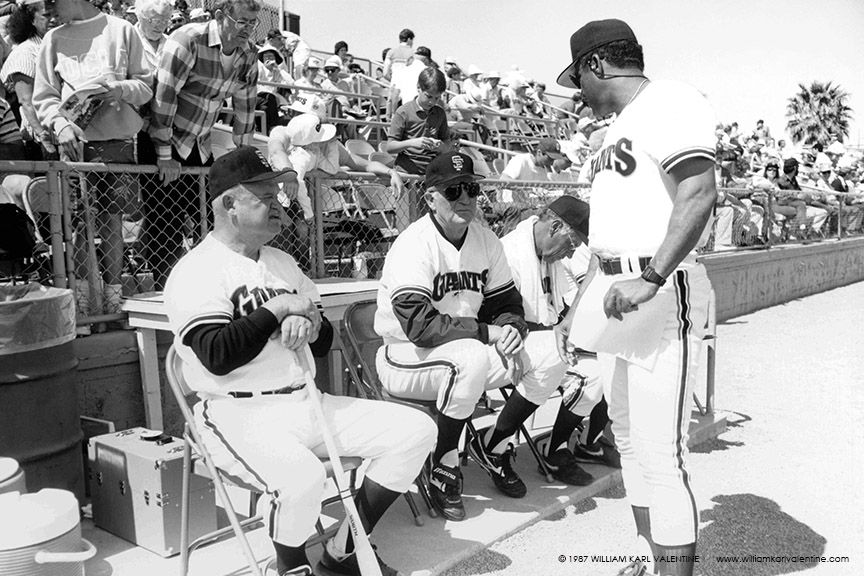
Don Zimmer, Manager Roger Craig, Bob Lills, and Jose Morales - Old Scottsdale Stadium

Spring Training then was nothing like it is today.  Back then the teams didn’t count on the games as revenue sources like they do today.  Teams seemed happy with whatever ticket sales they picked up to cover some of the training costs, it wasn’t a production like it is now.  Most tickets were $5, the stadiums were very simple, and they would even let you bring in your own coolers of beer.  When we went to see the Cubs at HoHoKam Park we sat right under the press box, behind home plate, and we could literally stand up on the bench seating and talk to the announcers who were eye level on the other side of their worktables (as you can see with the lead photograph of this post).  We sat there specifically to be close to the legendary announcer Harry Caray who was starting his second season calling Cubs games.  We infuriated long time Cubs radio broadcaster Lou Boudreau by asking him to get Harry’s attention for us. Lou was already in the Hall of Fame as a player by then and he hated the fact we were more interested in Harry than him.  Lou was also probably upset that we had passed a few Budweisers from our cooler to Harry by then too; he wasn’t supposed to drink during the game but then it was Harry. Harry was famous for leading the crowds in the singing of the 7th Inning Stretch, especially since joining the Cubs in Wrigley.  Harry was not supposed to lead the crowd during that spring training game, but everyone encouraged him to sing it and he did.  Afterword he leaned over towards our section and said “I remember the first time they asked me to sing the 7th inning stretch in Comiskey (The White Sox home park, Harry had called White Sox games for ten years before joining the Cubs and the White Sox started the tradition of Harry singing the stretch).  They asked me what “key” I wanted it in, and I told them the only “key” I’m familiar with is “whiskey”!”  Then he bellowed out laughing with the rest of us. Access to the players and personalities back then is what made Cactus League so special. It was an epic road trip at the start of my love for the Cactus League.

I transferred to Arizona State University in 1984 and spent each March I was in school going to as many Cactus League games as I could.  Being a photography major I started to photograph games as another school project, a portfolio that now documents 40 years.  Things were so relaxed then that I often would be able to put my 500 mm Mirror lens on a monopod and just walk out on to the field and photograph from the photography wells without anyone questioning me.  At Scottsdale Stadium when games were over-sold, they even let fans sit on the field in foul territory beyond the bullpen mounds.  It would never happen in today’s world but back then the fence for the stands was only about three feet tall and no one cared.  People respected the players, and no one was on a cellphone, so people paid attention to the game.  One day the Giants Assistant Director of Public Relations Dave Aust finally noticed me on the field and asked who I was and how I got there.  I told him I was a student at ASU documenting Cactus League games, and I didn’t really admit that I knew I wasn’t supposed to be on the field.  Dave got me off the field but told me to meet him at his office before the next game.  Dave was just starting out in his career, we talked, and I think he respected how hard it was to get established and he liked the idea of my project.  He issued me a photo credential for the rest of the season and for a couple years after that too.  Tempe Diablo Stadium was another favorite of mine when I was in school because they always left the service gate on the third base side unlocked so I never had to pay for games there.  A plus being a college student needing all the extra cash I had to buy film and paper.

When I was photographing Cactus League in the mid 1980’s there were only 8 teams that I remember. In the Phoenix area the Oakland A’s played at Phoenix Municipal, the Milwaukee Brewers were at Compadre Stadium in Chandler, The Chicago Cubs were at HoHoKam in Mesa, the Seattle Mariners at Tempe Diablo, and the Giants were at Scottsdale Stadium.  The San Diego Padres were in Yuma, Arizona, the Cleveland Indians were in Tucson, and the California Angels were still based in Palm Springs, California.  Today there are 16 teams in the Cactus League, playing in 10 state of the art Phoenix area facilities.  Scottsdale Stadium, originally built in 1956, was rebuild in 1992 and Tempe Diablo Stadium, built in 1969, are the only two remaining Cactus League parks from when I started (Phoenix Municipal still exists but it is now the home of ASU Baseball).  Modernization of the Cactus League really began in 1994 with the opening of the Peoria Sports Complex for the Seattle Mariners and San Diego Padres.  Peoria is still a great facility to watch baseball in, and probably has the friendliest staff. Most all the stadiums are surrounded by multiple training fields and training facilities now.  The newest stadium is Sloan Park, the Chicago Cubs home in Mesa, which opened in 2014.

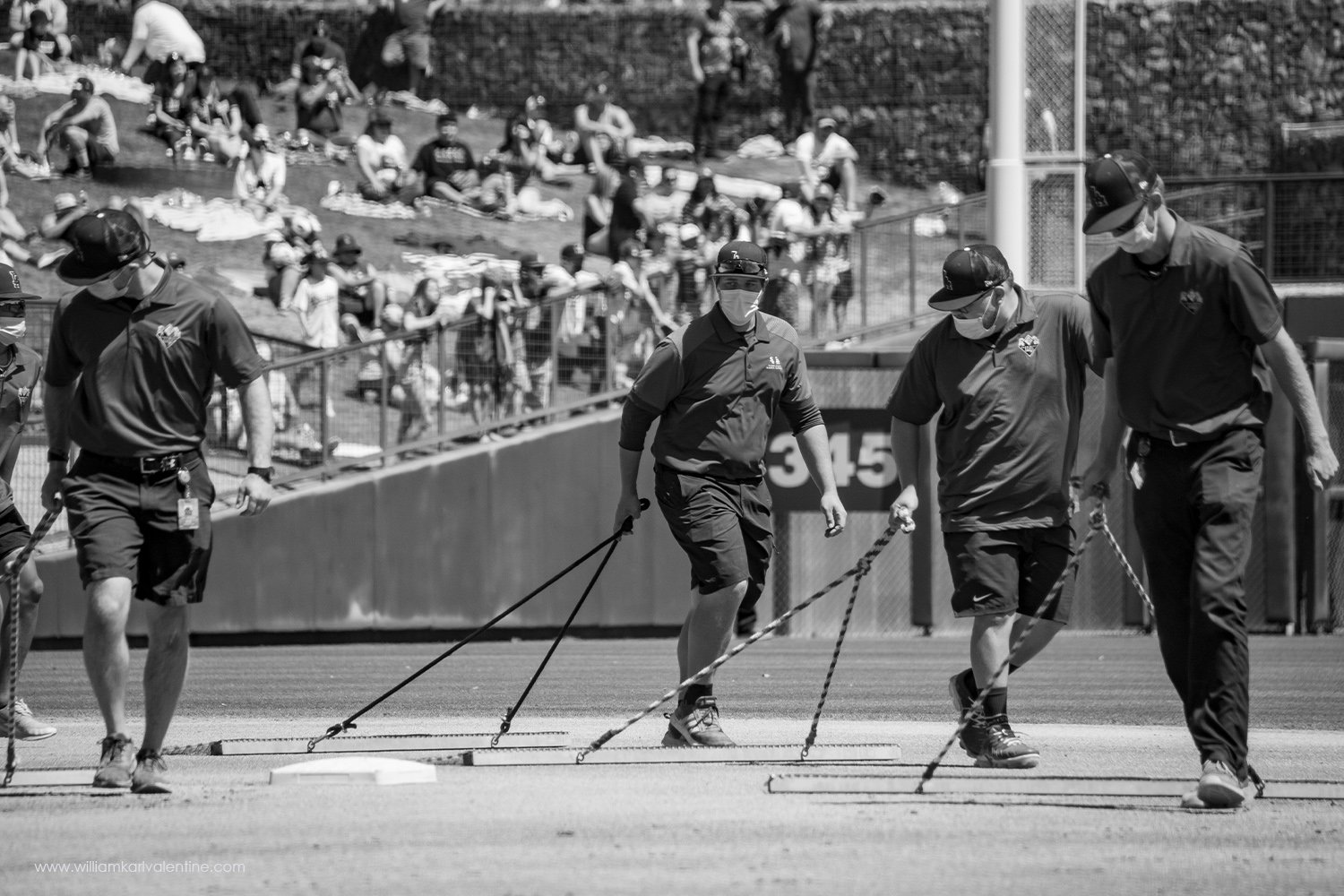
I see Baseball as a Metaphor for American Society, that is one of the reasons I like photographing it so much.  Spring Training is baseball in its purest form.  You have the current players getting prepared for the season, aging stars trying to find one of those last roster spots, and young players chasing the dream to get to “The Show”.  It is a rebirth, signaling that the new season approaches.  It is casual experience for the fans, since all games don’t count, it is easy for spectators to relax and just enjoy being at a ballpark.  A popular component of every stadium now is lawn seating beyond the outfield fences. Players have more time to interact with fans and don’t have the demands of the regular season schedule.  It is unfortunately changing though, as is our society.  Safety netting at Camelback Ranch, the Dodgers and White Sox home stadium, now goes the entire length of the field so the interaction between fans and players is harder now.  I assume attorneys worried of liabilities championed changes like this, but then when I see how many people attend games now with the eyes glued to their cellphones, I guess I can understand the reasoning.  Pricing has also changed, and Spring Training is now as much of a business venture as the regular season is.  I am admittedly a romantic and I not usually a fan of change. My Cactus League portfolio has documented these changes fairly well, and because baseball is such an integral part of American society I think this portfolio also speaks to the changes in our society these past 40 years.

Even though Spring Training was cut short this year with the MLB lockout, I made it out to Phoenix last week to photograph a couple days of Cactus League games in honor of both anniversaries.  Included below in this blog are a selection of my photographs from the trip. I also authored this post honor of Major League Baseball’s Opening Day yesterday.

View fullsize CL DSC 0557  04-01-22
View fullsize CL DSC 0509  04-01-22
View fullsize CL DSC 1281  04-01-22
View fullsize CL DSC 00458  04-01-22
View fullsize CL DSC 00482  04-01-22
View fullsize CL DSC 00574  04-01-22
View fullsize CL DSC 0650  04-01-22
View fullsize CL DSC 1986  04-01-22
View fullsize CL DSC 00628  04-01-22
View fullsize CL DSC 01196  04-02-22
View fullsize CL DSC 01215  04-02-22
View fullsize CL DSC 2665  04-02-22
View fullsize CL DSC 3160  04-02-22
View fullsize CL DSC 01291  04-02-22
View fullsize CL DSC 1907  04-01-22
View fullsize CL DSC 1909  04-01-22
View fullsize CL DSC 1885  04-01-22
View fullsize CL DSC 2280  04-01-22
View fullsize CL DSC 00669  04-01-22
View fullsize CL DSC 2975  04-02-22
View fullsize CL DSC 1156  04-01-22
View fullsize CL DSC 1175  04-01-22
View fullsize CL DSC 1840  04-01-22
View fullsize CL DSC 2261  04-01-22
View fullsize CL DSC 2432  04-01-22
View fullsize CL DSC 2498  04-01-22
View fullsize CL DSC 01180  04-02-22
View fullsize CL DSC 00859  04-02-22
View fullsize CL DSC 01205  04-02-22
View fullsize CL DSC 2694  04-02-22
View fullsize CL DSC 3292  04-02-22
View fullsize CL DSC 2783  04-02-22
In Photography, Spring Training Baseball Tags Cactus League, Spring Training, Baseball, Documentary Photography, William Karl Valentine, Arizona State University, Arizona, Los Angeles Dodger, Los Angeles Angels, Cincinnati Reds, Seattle Mariners, San Francisco Giants, Milwaukee Brewers, Cleveland Indians, Tempe, Palm Springs, Tempe Diablo Stadium, Bobby Witt Jr, Mike Trout, Yazstremski, Harry Caray, Peoria Sports Complex, Camelback Ranch
Comment

Brianna Kupfer was stabbed to death inside her work on 1-13-22, the suspect was arrested on 1-19-22 in Pasadena several hours before I photographed this memorial at the murder scene.

Brianna Kupfer Murder Scene - 326 N. La Brea, Los Angeles

January 22, 2022

I remember standing over a guy once who had just been shot in his apartment.  There was a drive-by on the street out front and instead of taking cover he went to the bedroom window to look and caught what appeared to be a stray round meant for someone else.  He was a “Veterano” so I was somewhat surprised he did that, I expected he would know better.   We had arrived on scene right after it happened, and paramedics were close behind us. Medically there wasn’t anything I could do for him beside encourage him to keep fighting to stay alive.  His breathing was shallow, and he was not saying anything.  His color started to fade and by the time the paramedics transported him his skin was turning grey, I knew he was going to die, and he did soon after reaching the hospital.  I have seen a few murder victims die; most I guess were in shock because they were not saying much.  I have also seen someone who was shot and made it, he was scared and calling out for his mother as he was laying there on the ground.  Watching someone in the process of dying an unnatural death is surreal.  I’ve sensed some people giving in to their wounds and death’s call, while seeing others fighting with all they had to survive.  I have sensed fight, fear, regret, loneliness, and calm witnessing the dying process.

I went to the Croft House to photograph Brianna Kupfer’s memorial because I saw it as opportunity to document an incident which represents our society today, raging crime and the deterioration of safety in our communities.

What happened to Brianna showcases everything that has and is going wrong with the new approach to the American criminal justice system in a supposed “woke” society.  It is beyond unacceptable that Shawn Laval Smith, the murder suspect, was still roaming the streets after at least 11 previous arrests and his obvious mental health issues.  At a minimum he should have been in a mental health facility years ago, instead, somehow, he was most likely shipped to California from South Carolina so they could get rid of their problem quickly.  Based on all his criminal history Law Enforcement did their job, they arrested him and brought him before the courts. The system from there obviously did not do their part by putting Mr. Smith in some type of custody where he could not harm others.  Every day there are incidents of violent attacks on innocent people by unstable persons living on our streets.  This past week the victims included a nurse at a Los Angeles bus stop and an accounting consultant on a New York subway platform, plus who knows how many others. 

I feel my images from the Croft House accurately convey my feelings about Brianna’s murder and allow for thought and interpretation by other viewers.  I see them as powerful documents of what happened, even though they do not actually document the criminal act or crime scene. I hope these photographs allow some viewers the ability to consider the reality of such a horrific loss and contemplate society’s approach to public safety moving forward. I think there are many layers for the viewers to deal with in these images. 

When I photograph, I try and be respectful of the people within my frames and not exploitative. With an incident like this, I was looking for images with deeper meaning, not just a press image where I was looking for dramatic shot to illustrate a story before moving on. 

Here are some of my thoughts on specific images:

The wide-angle view of the entire store worked well. The lead image in this blog captured how intimate this furniture store is by documenting its scale. I used a 14-24mm Nikon Aspherical lens for this since the sidewalk is so narrow and news vans were parked all in front of Croft House. For me I see the outside of the building with all the big windows as a location I would never expect a violent crime to occur. The wide-angle lens also captured the volume of flowers well. In the image above the young man walking past the wanted poster of Smith symbolizes much of society for me. Something horrific happened here, I want everyone to take notice and be enraged about it, but this man appears to be walking by as if he is oblivious to that fact. I imagine him saying to himself: “Oh well something bad happened here, thankfully it wasn’t me, bad things happen all the time, just accept it, I have things to do, it’s nothing I have to deal with.”. Obviously, I don’t know this young man’s thoughts, nor do I know if he has already walked by here multiple times and has already stopped to experience the moment. His presence in the frame, although a documented fact, is really only symbolic of life going on and people passing by. I also think his attire helps with the documentation of the area and the people who live here.

This image is intense for me. The arrangement is so beautiful, as was Brianna Kupfer, the flowers are representative of her. The interior of the store is organized and clean. There is order in the display and the designs of the pieces are awesome, the space looks cool, normally I would love to check out. But then there is the reality that order was shattered by the blade of the murderer’s knife. The reflection of the news van and the wanted poster in the window tell the horrific truth. Having seen the coverage of the murder on television I know the suspect had walked right where I was now standing to make this photograph. Perhaps he peered into this same window before he entered Croft House. He interacted with Brianna in such a way that she became so scared of him she texted a friend about him, he then savagely murdered Brianna, before comely walking out the back door of the store and North up the ally. The most chilling part is the rear door of the store is so clearly visible in this image and positioned just to the left of the wanted flyer for the suspect. This image brings to my mind the terror Brianna must have endured at the end of her life, how alone she must have felt.

I assume this image above is pretty obvious for most viewers. Televised news is so influential today. Here I have the production crew for the live shot, masks documenting the period, and mobile equipment which reminds the viewer that the crew is only on scene temporarily before moving on to the next story. Society’s focus on this event will quickly fade, and then I think of her family who will carry the scars of this loss forever. I am angered with the thought that victims, and their families are not the focus today. The slight view of the memorial in the background wanted poster giving context to their story. The reporters practiced speaking their copy while the crews checked their lighting and camera angles. They were doing their jobs, they were not being disrespectful, but the reality was obvious this wasn’t personal for them, it was just another tough story, it probably has to be that way in their business. Maybe this image also represents public desensitization to crime.

View fullsize web CA DSC_0109 01 19 2022 - Kupfer Murder on La Brea c.jpg
View fullsize web CA DSC_0130 01 19 2022 - Angie Crouch - Kupfer Murder on La Brea c.jpg
View fullsize web CA DSC_4582 01 19 2022 - Kupfer Murder on La Brea c.jpg

A few more images of the news crews, I specifically liked the woman casually walking by NBC’s Angie Crouch as she prepared for her segment, again symbolic of the acceptance of the reality of our society today.

I personally have no respect for District Attorney Gascon so when I found this sign here when I arrived, I was happy someone else had made this statement. It is good that there is an element of anger along with celebrating the Brianna’s life and mourning her loss. The old metal security gate is also an important element in all these images, adds to the layers.

The powerful element in this image is subtle but strong. Just before I photographed it someone came up and asked a couple questions about the murder. He seemed like he didn’t want to believe such a violent act could have happened there, I assume he lived in that Hancock Park neighborhood. He read the wanted poster, then put his hands up to the glass so he could get a better view of the store’s interior. It was obvious he was trying to comprehend what had happened, I assume he felt compassion for the victim and quite possibly fear for his own well-being. It would have been a great photograph of him peering in the window, but I didn’t take it. I guess I wanted to let him have his moment to himself. The smudges on the window are a good representation of everyone who had stopped and peered inside. I am sure many were fearful they would see a bloody crime scene but at the same time they were too curious to not look. From that point I can imagine people thinking thank God that wasn’t me or my daughter.

View fullsize web CA DSC_0106 01 19 2022 - Kupfer Murder on La Brea.jpg
View fullsize web CA DSC_0108 01 19 2022 - Kupfer Murder on La Brea c.jpg

I liked the image of the vigil flyer; it is a simple document that gains value with the Christian candles. The note in the right-side image stood out to me. It isn’t the typical card you write on when you send flowers. It’s a page ripped from a small personal notebook. I don’t know any facts about who wrote this, but I can envision someone who stopped to view the memorial feeling the emotion of the loss and having a need to do something to share with others how they felt. For me the note is so genuine and personal, I love it, especially with the shapes and forms of the image, the beautiful, delicate flowers, and their contrast to the iron security gate. More layers of interpretation with this image than are initially obvious.

This may be the most powerful of my images that day, even though it was such an obvious image. I was lucky to be there when the sunlight was at a perfect angle to illuminate Brianna’s portrait and the wanted flyers taped to the window. The light also gave me interesting hard shadows in the store with an interesting element of a reflection of a security fence in the top of the frame; for me those elements allude to the darkness of the crime. Again, the staging of the portrait reminds me how unexpected it was to have a homicide occur at a location like Croft House. I don’t know who photographed the actual portrait, it is a solid portrait which I assumed captured Brianna’s personality. I felt a little weird photographing someone else’s photograph but with all the other elements in my frame I knew it was totally appropriate.

Hopefully I will find fewer things like this to photograph in the future and that I will never have to fully comprehend the pain Brianna Kupfer’s family is experiencing now. I will keep documenting my world because that is how I experience life and I trust these images will also have an impact on everyone who views them.

In Photography, Street Photography Tags Croft House, Brianna Kupfer, 326 N. La Brea, Los Angeles, California, 187 PC, Murder, Crime Scene, Gascon, Shawn Laval Smith, Documentary Photography, Photography, Street Photography, Crime Scene Photography
Comment

Screen Shot of KQED article

Photographer Ted Pushinsky

November 13, 2021

While working on another post today I came across the work of documentary photographer Ted Pushinsky which I was not familiar with before. It caused me to take a detour and explore some of his images. I enjoyed his photographs and related well to most of his subject matter. The fact he photographed with Garry Winogrand on the street and photographed Andre the Giant in the ring definitely makes me a fan.

This is a quick post to give some links to his work so others can also discover his work.

It started with this Mother Jones article on Garry Winogrand with a Pushinsky photograph of Winogrand on the street photographing.

From there I went to his website which is a little rough in design but showed the range of his work.

I also found this KQED article which is memorialized his passing in 2018.

In Photographer, Photography Tags Ted Pushinsky, KQED, Mother Jones
Comment
Lensculture Screenshot.jpg

Lensculture Street 2021

September 30, 2021

One of the images I submitted to the 2021 Lensculture Street Photography Awards was recently selected by the editors to be featured in the Street Photography Awards 2021 Competition Gallery. This on-line gallery is visible to everyone who visits the Lensculture’s website. Lensculture describes their Competition Gallery as a highly curated group of images selected by their editors to showcase some of the best submissions in the competition.

I am thankful that the above image was featured in this on-line gallery and would encourage you to visit the link above to see all the other great images that the editors have chosen to showcase. This image is standing out as one of my top images from last year. Sarah Kennel, Curator of Photography at the High Museum, also selected the photograph for a group exhibition in Alabama which just concluded this week.

In Galleries, Photography Tags Sarah Kennel, High Museum, lensculture, lensculture street photography, Documentary Photography, Street Photography
Comment
P.C.622 Gallery  - The Old Pasadena Police Station at 142 North Arroyo Parkway

P.C.622 Gallery - The Old Pasadena Police Station at 142 North Arroyo Parkway

The P.C. 622 Gallery

September 27, 2021

California Penal Code Section 622 states the following: Every person, not the owner thereof, who willfully injures, disfigures, or destroys any monument, work of art, or useful or ornamental improvement within the limits of any village, town, or city, or any shade tree or ornamental plant growing therein, whether situated upon private ground or on any street, sidewalk, or public park or place, is guilty of a misdemeanor.

The first time I exhibited any of my photographs was in April 1985 at the Northlight Downstairs student gallery at Arizona State University. it was a small space near the darkrooms but it had lots of traffic and great visibility with my peer group. It also gave me my first experience editing and sequencing an exhibition. I exhibited some early images from my Pasadena Police Department series , which to this day is still my strongest body of work.

I began photographing the Officers of the Pasadena Police Department during Spring Break in 1985 as a class project while studying at Arizona State University. My father was a well-respected Reserve Police Officer, and he arranged the opportunity. I rode with Sergeant Tom Oldfield the first night who was one of my dad’s close friends. Being a Sergeant, Tom had the ability to respond to any interesting call to try and get me as much action to photograph as he could. The most eventful thing was a woman named Tina Hart who committed suicide in the middle of a street by shooting herself.  The rest of the week I rode with individual officers and photographed whatever incidents they were involved in.  When my professor, Tamarra Kaida saw my early images she realized how good the series was and encouraged me to continue photographing the department beyond the class assignment. Another professor, Bill Jenkins (best known for curating the important New Topographics exhibition) also liked the early images in this series.  Bill gave me some outstanding advice when he suggested I start using a wide-angle lens to photograph this series.  Initially I had used a 50mm lens and in some instances, I had stood back from incidents to stay out of the way.  Bill explained that using a wide-angle lens would force me to get closer to my subjects and make the images more powerful.  The combination of putting on a 35mm lens and gaining more trust from the officers I was photographing to my images to another level.  Using wide angel lenses has helped me capture most of my best images.

During the first few weeks of the summer of 1985, I started to develop good rapport with most all the officers. I knew how to stay out of the way and not let my photographing interfere with their job even though I was usually making exposures at night in low light conditions using a large off camera flash. I would make prints for the officers, and everyone liked seeing photographs of themselves working. Early in the summer of 1985, I become a Level 3 Technical Reserve Police Officer, which allowed me to volunteer in Police Department’s own photo lab most days before going on ride a longs with officers at night to photograph. It was an ideal situation because it gave me darkroom access while I was away from ASU.

One day I noticed a large empty bulletin board in the main hallway of the Police Station. The area had lots of foot traffic, department personnel as well as public visitors. I recognized the bulletin board could be a decent gallery space to showcase my photographs. I figured my photographs would be good for department morale as well as having a public relations benefit for public visitors. I asked for permission to turn the bulletin board into a gallery and it got approved. The photograph above it from the first group of prints I exhibited. I tried to change out images on a regular basis to keep interest.

I named the space the P.C. 622 Gallery to discourage any of the officers from adding comments to the prints or vandalizing them. Being around the officers I knew how much banter and teasing went on. Lockers were routinely written on highlighting recent exploits or mistakes and I knew officers started doing similar things to my photographs I would lose the space. I searched the Penal Code for sections which would cover that and discovered P.C. 622 which specifically covered destroying or defacing artwork. For the year plus the gallery was up we only had one instance where a print was written on and that was when the group of prints were not changed out for three months during a spring semester. I came across the above photograph of the gallery this week while organizing files and decide to share the story of the gallery.  I also think this post also pairs well with my post on the opening of the exhibition at the Atlanta Airport Exhibition space this week, I, like most photographers, always enjoy seeing my photographs exhibited in traditional gallery and museum spaces, But I also love showing my images and prints in non-traditional spaces that have high traffic volume.  There is always value in having images seen and experienced by others, especially in print form.

In Photography, Galleries Tags William Karl Valentine, Pasadena Police Department, Pasadena, Photography, black and white photography, Documentary Photography
Comment

CCP's "Why Photography?" Video Presentation 6-24-21

June 27, 2021

I watched the on-line video event by the Center for Creative Photography’s titled “Why Photography” on Thursday.  The 45-minute presentation was a collection of video interviews where different people talked about why photography was important to them.  The group was varied, photographers, curators, collectors, and educators.  What I enjoyed most was hearing a diverse group of people describing why photographing was important to them and saying time and again to myself “me too” when they described why photography was important to them.  I have included the link to the presentation here and I will highlight some of the comments I really connected with below:  CCP “Why Photography” 6/24/21

Curator Susan Bright and Art Collector / Retired Dance Professor Douglas Nielsen were the first pair to discuss photography.

Nielsen spoke how he was often photographed while he was dancing and that he would tell photographers to “Catch me in the Act”.  He went on to say “Any photography that is interesting is catching someone doing something, not just sitting there”.  He continued, saying “Knowing Dance evaporates the second you see it I wanted proof I existed”, which photographs provided him.  Nielsen went on, “A photograph tries to defeat time, death.  It captures a second in time and its there.  But with Dance, its just gone”.

I completely understand his comments.  I respect portraiture photography, and it seems to be trending now in galleries and museums, but it rarely speaks to me.  I really began to understand photography when I started seeing the images by the great documentary photographers.  For me I love being able to capture a moment in time, and know that image is completely factually accurate for that 1/500th of a second.  As a child I loved to draw but I was frustrated because my pictures weren’t perfect.  Features were distorted, the perspective was slightly off, they just didn’t look exactly how I saw something.  Photography fixed that problem for me.  I am also a romantic and I am constantly wanting to preserve memories and freeze moments in time forever, the camera allows me to do that.

Nielsen made an interesting comment about his collection that I loved: “When I collected photography, it kind of collected me”.

I get it, in life we gravitated towards things which catch our interest and draw us in.  His statement is dead on.  I was fortunate to have dinner at the home of a prominent wealthy art collector a couple years ago.  The house was amazing on its own and everything I saw on the walls was museum grade, mostly paintings but also an installation piece, and some of Cindy Sherman’s prints.  As he gave me the tour of his collection he spoke about was why that piece of artwork was important to him, why he connected to it, and why he liked that artist’s work.  He never mentioned price or collectability, every work spoke to him and wife personally.  It was an incredible opportunity for me to get that insight.  I should also say it was a great night socially too, good people there.

Susan Bright spoke of her background and how when she was studying Art History in the late 1980’s to early 1990’s that photography was not considered “Art”.  She described when she was nearing the completion of her studies how she felt when she realized she had just spent three years only studying art by men.  She also told us she had not seen a Fine Art Photographic Print without glass in front of it until after she graduated.  She was shocked with how beautiful  a well-crafted print looked in person and wonderful the experience was.

I know exactly what Susan meant about the wonder in seeing a good print.  I was lucky to see fantastic prints when I was Arizona State University.  I was on the Northlight Gallery staff when we exhibited works by photographers like Mary Ellen Mark and William Christenberry.  After graduating I went to one of the first Photo LA events and I remember going over to a bin at one booth and being able to pick up a Weston print.  Holding it, examining, realizing Weston himself did the same with that print was powerful.  I believe a photographer has to spend time with really goof prints before they can fully understand the medium.  It is unfortunate that in today’s two second Instagram post view we are getting away from the concept taking our time to experience, and understand, a well-crafted print and good image.  I have been lucky to have seen as many good prints and exhibitions in person as I have, but I have also made an effort to do that including travelling to see the best exhibitions.

Bright stated, “I feel like Photography is the bastard child of the Arts, that’s why I like it”.  She went on saying when she was younger how much she enjoyed the images on album covers , and that when she went to museums she enjoyed the post cards in the gift shop more than the paintings on the wall because they were obtainable, she could collect them.

I understand her comments about photography being considered a second-class citizen in the art world, and I agree with her, and I see how that could attract her to the medium.  There is something special when you are involved in a less popular community.  The relationship you have with others in that community is often more unique, and usually a closer bond.  I feel those bonds when I am at a racetrack or an ice hockey rink.  Everyone there has a common interest in something that many people do not fully understand.  I tend to be more of an individual when it comes to photography, I truly enjoy community interaction, but the act of photographing and seeing the world is very personal and usually a solo activity.  The process of photographing is my “Why Photography”.  Being a photographer is how I experience life.

University of Arizona President Dr. Robert Robbins spoke next and said something I definitely agree with: “Photography opens questions, teaches us history, and keeps our memories.  It shows us the beauty of the world and of the universe, it shows us what we know and what we have left to discover”.

Dr. Meg Jackson Fox, The CCP’s Associate Curator for Public Programs introduced Valerie Trouet who is a University of Arizona professor in Tree Ring Research who spoke about the use of photography in relation to the study of science.  Trouet talked of the importance of “Repeat Photography” to identify changes in landscapes over time and mentioned the importance of photography being able to document and retain evidence related to scientific research.  A good reason for “Why Photography”, the same should be said for forensic photography.

I don’t ever recall hearing the term “Repeat Photography” before but I well aware of this type of work.  I know Mark Klett from my ASU days and know his Rephotographic Survey Project well.  Good for me to learn a new term.

Photograph Conservator Peter Mustardo was next up.  For his “Why Photography” he said he was drawn to how photography is ambiguous. He pointed out how photography is everywhere and most everyone has the ability to photograph.  He also noted photography’s ability to create a “preserved moment” within the passage of time.

I think it would be valuable to take a moment and focus again on the definitions of Ambiguous – “open to more than one interpretation; having a double meaning.” And “unclear or inexact because a choice between alternatives has not been made.”.   I love that characteristic of photography.  I think back to my days at ASU in Bill Jay’s class and how he was able to really demonstrate how different images have different values depending on the viewer and the  relationship the viewer has with that image and its subject matter.  With most of my street photography or city based images I usually title the work as “Untitiled” , except for a file number, because I don’t want to influence the viewer’s experience beyond having them contemplating the elements I have included in to the frame.  I know what I see and what I am trying to convey but I think it is important for the viewer to have the ability to come to their own conclusion based on their experience and perception.

Mustardo’s inference that everyone is a photographer reminds me of my favorite Photography quote, which was by László Moholy-Nagy’s in 1926: “The illiterate of the future will be those who can not photograph”.  That quote always amazes me, his foresight was dead on. We all live in a selfie and Instagram world today.

The next part of the presentation had shorter individual segments with more individual insight.  CCP Senior Registrar Megan Clancy commented how she enjoys how photography can freeze a moment in time, that split second, allowing us the ability to see something important.  CCP Chief Curator Rebecca Senf shared how she enjoys specializing in a relatively new medium with such a wonderfully short history to explore.  I think her point was its easier for a historian to have a more complete knowledge of the medium since it is only 182 years old unlike most all the other artforms.  Joan Lifton spoke of the creative process and shared a Dorothea Lange quote about her photographic process: “How do we organize the chaos of our individual experience in to a narrative that carries a collective meaning?”  This quote inspired me to look up more Lange quotes, I found a nice list on John Paul Caponigro’s site which are worth the read.

W.Eugene Smith’s widow, Aileen Smith, had a conversation with photographer, and educator, Aaron Turner next. She told how W. Eugene Smith always wanted his work to be as close to the truth as possible and how he was dedicated to have integrity in his images.  She pointed out how almost every experience is subjective not objective and I very much agree with her.  Aileen went on to say “We are subjective beings, we have subjective eyes, its not unfair, a person is subjective, that’s it”.  She also said the goal of journalism for W. Eugene Smith was to convey the reality of other people.  Aileen then recalled how people would ask W. Eugene Smith if he was an Artist or a Journalist and that he would reply “No, its just one and the same for me, to be a good journalist, and to really convey it, it has to be art”. 

I truly enjoyed the passion Aaron Turner conveyed for the medium of photography.  He spoke of love of the process of photography, especially the darkroom. He then said “I see in pictures. The act of walking around and envisioning what I see.”

I absolutely understand what Aaron meant because I am exactly the same way.  To be in a darkroom, and printing is a spiritual experience for me, I am at home in  my darkroom.  When I walk or drive around doing normal activities, I find that my eyes are constantly looking for items, grouping them, framing them, and considering what would make an interesting photograph.  I am so conditioned to look for images in the world, and have been doing it for so long, that I can not turn it off.  It is how I experience the world.  Especially as documentary photographer who photographs on the street so much, I am constantly hunting for imagery.

I will wrap this up by saying I am thankful for programs like this from the Center for Creative Photography.  When I was at Arizona State University, I was in such an amazing photo environment every day, I miss that.  But that was college, you have the experience, it is your base, and from there you go out and do what you studied (hopefully). Presentations like this one I shared allow me to get refocused on my photography and experience that education environment again.  To be good at your craft you have to know the history of your medium and stay up to date with the current trends, never skip a chance to learn or grow.

In Art Collection, Photography, Photography Collector Tags Center for Creative Photography, Arizona State University, The University of Arizona, Becky Senf, W. Eugene Smith, Aaron Turner, Aileen Smith, Peter Mustardo, Photojournalism, Journalism, Meg Jackson Fox, Valerie Trouet, Tree Ring Research, Repeat Photography, Susan Bright, Douglas Nielsen, Megan Clancy, Emily Una Weirich, Joan Lifton, Dorthea Lange
Comment
Historian Lucy Worsley with a Kodak Box Brownie from her documentary on photographing the royal family

Historian Lucy Worsley with a Kodak Box Brownie from her documentary on photographing the royal family

Lucy Worsley's Royal Photo Album

May 12, 2021

“A king, or a queen, is less mighty than the power of a camera.”

Lucy Worsley


First and foremost, I need to say I am not in to all the current television series about the British Royals or Victorian life, so that is not the reason for authoring this post.  I decided to author this post because of the solid job Lucy Worsely did showcasing how important photography has been for the British monarchy since the beginning of the medium.
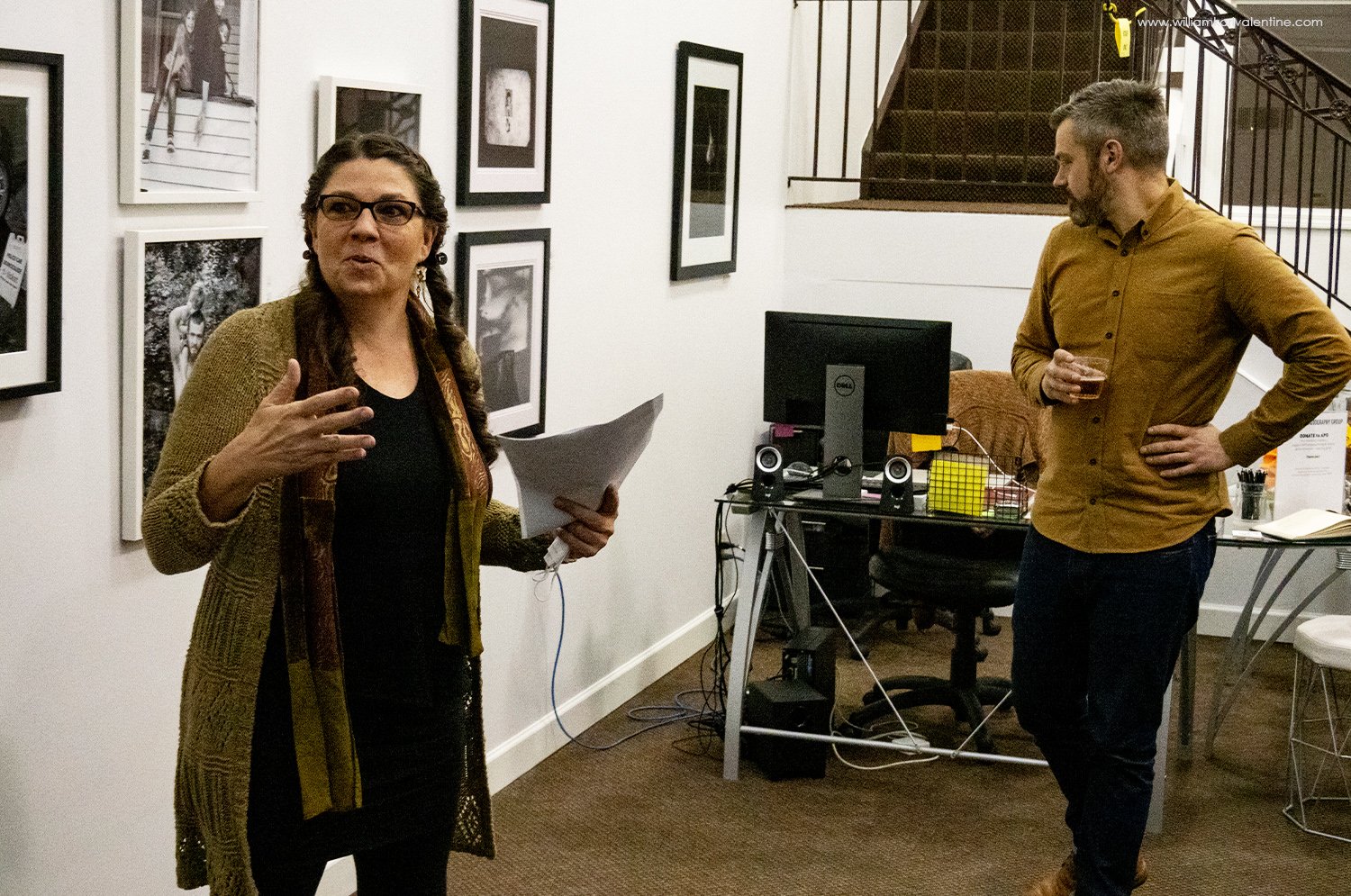
1839 is generally considered to be the year photography began.  Louis Dagueere announced his Daguerreotyope process in France and William Henry Fox Talbot announced his calotype negative and salt print process in England.   Nicéphore Niépce also needs to be recognized for his work in the mid 1820’s capturing and fixing images with a camera, although those photographs took hours and days to expose.

Photography, including videos & film, is arguably the most powerful tool for communicating.  Images can be understood universally, nothing needs to be translated, a person does not even need to literate to experience a photograph.

The saying “A photograph is worth a thousand words” is so true.  But I think it is important that we need to recognize a photograph that documents 1/400th of a second of time in history has limitations.  It often does not tell the whole story and can be taken out of context as can video clips.  We are experiencing this daily now as everything seems to be livestreamed or documented by someone.  As a quick sidenote I looked up the saying above for the history and found that in March 1911 the Syracuse Post-Standard attributed Tess Flanders as the first to say “Use a picture. It’s worth a thousand words”.  Tess was at banquet to discuss journalism and publicity at the time.

I have long been aware of photographic portraits of Queen Victoria; she most likely was photographed more than anyone else in her period.  I had not given any real thought to the fact she was using photography as a means of communicating to her people.  Lucy Worsley highlighted this fact in her PBS episode Royal Photo Album.  Lucy showed how Victoria changed how her portraits were done to reflect her life.  Emotionless face with black garments following the death of her beloved Prince Albert and the decade of morning then realizing she needed to be more personable to reengage people after that.  It was fascinating how the royal family used photography early on to maintain their public image by documenting their lives, then how photography began to damage their family brand when the royals were no longer able to control the images and subject matter.  Scandals were captured and exposed to the world.

I had no idea that Queen Alexandra was such a prolific photographer, obtaining a Kodak Box Brownie soon after it was released to the market.  Because of her access she made incredibly intimate photographs of the royal family and I had no idea she published a hugely popular book of her photographs.  Alexandra highlights the fact photography was accessible to women photographers since the beginning.  I also believe the medium has progressed since then to be the most inclusive artform.
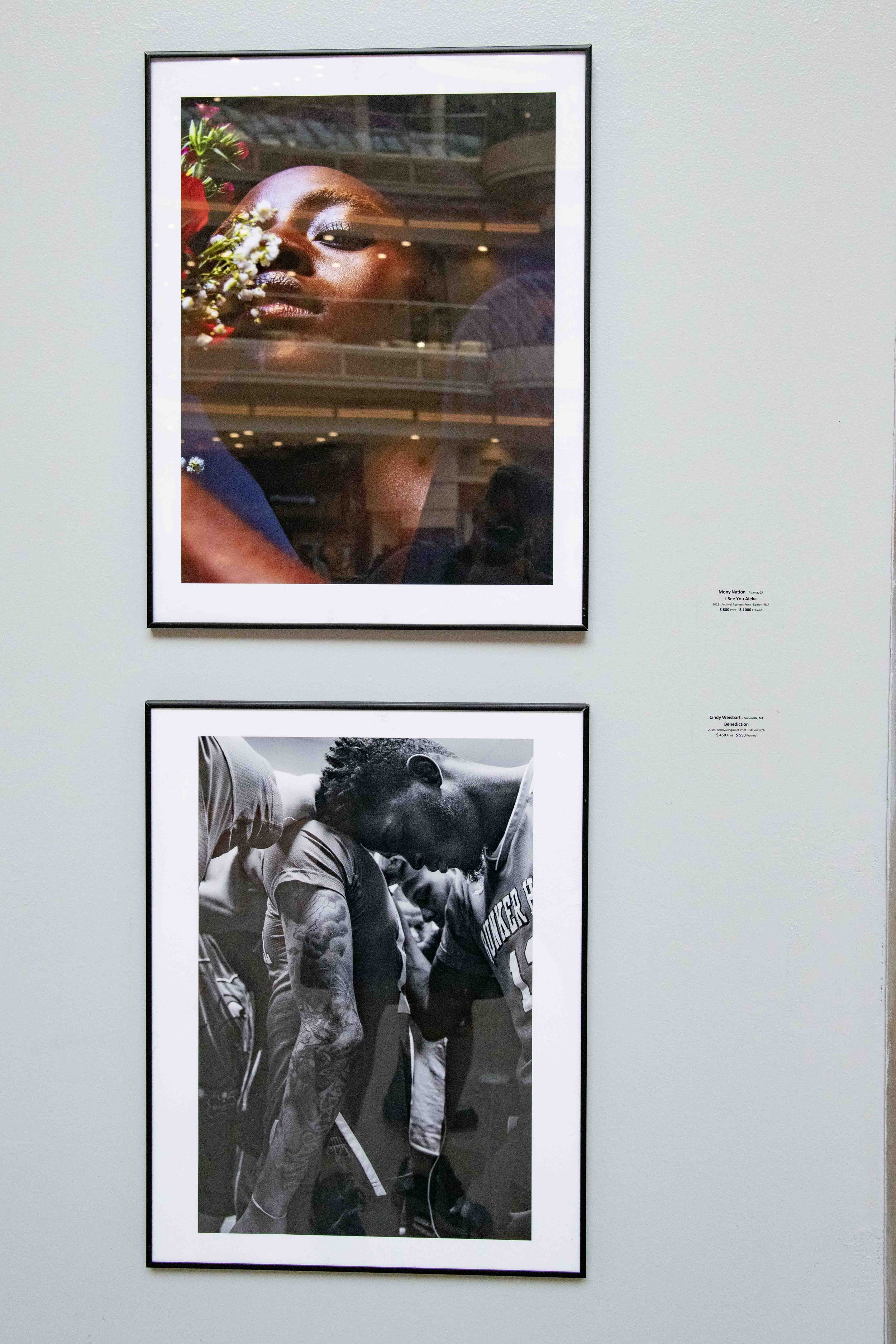
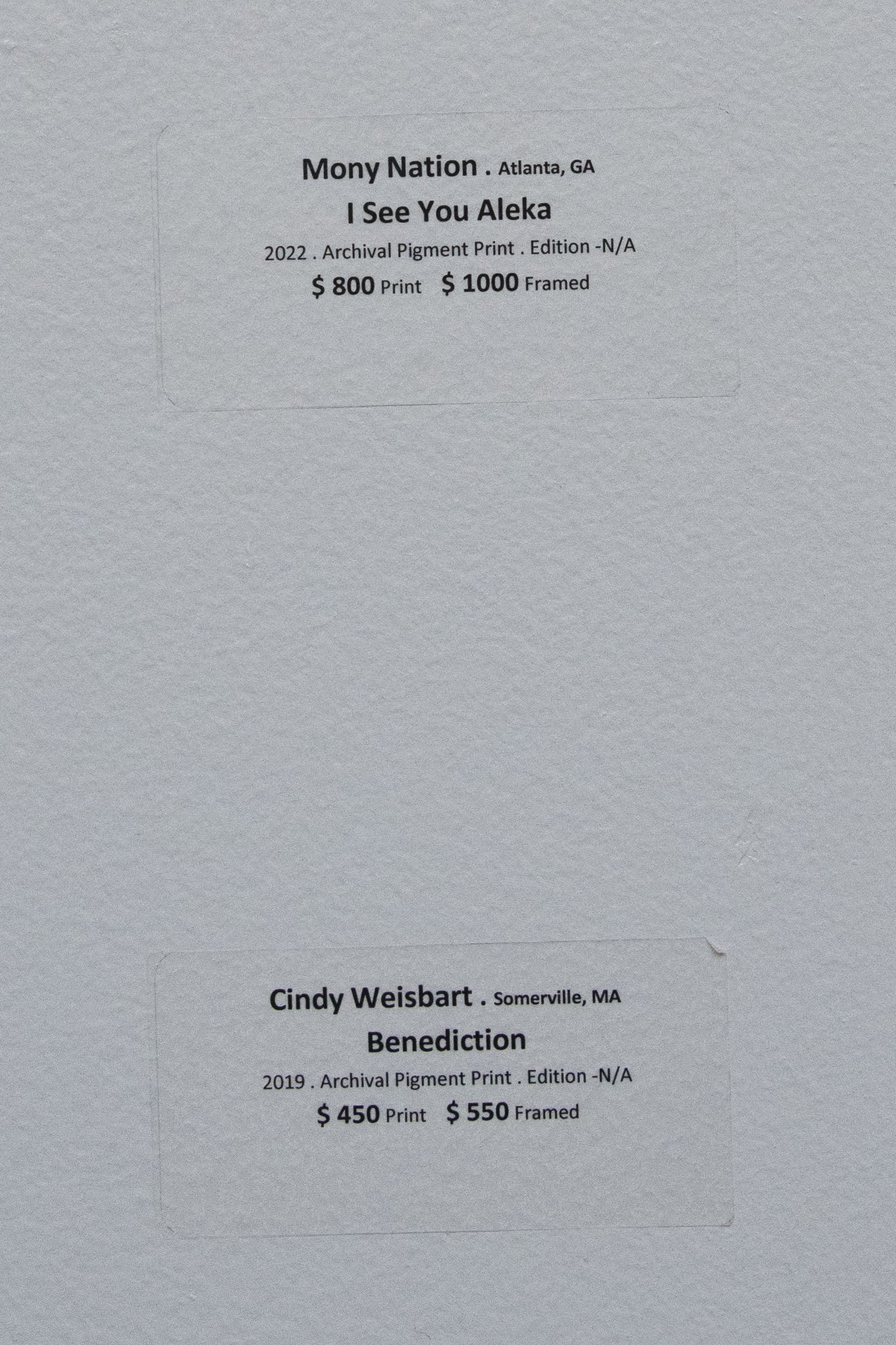
This documentary also highlighted the work of Anwar Hussein, a long time official royal photographer, and some of Cecil Beaton’s images including how he created Queen Elizabeth’s official coronation portrait.

I happened to see this 2020 documentary this morning by accident while changing channels.  It is on PBS, if you have a membership, you can access it online, otherwise I would encourage you to check TV listings for the next airing.  For anyone with an interest in the history of photography, the history of the royal family, or the impact imagery has on our world it is well worth the time to watch this program.

Queen Alexandra with one her of cameras

Queen Alexandra with one her of cameras

In Documentary Films, Photography Tags Queen Elizabeth, Lucy Worsley, PBS, Anwar Hussein, Cecil Beaton, Queen Alexandra, Royal Photography, Documentary Films, Documentary Photography, Kodak
Comment
Ponyhenge  -  Lincoln, Massachusetts                                                                                                      March 6th, 2021

Ponyhenge - Lincoln, Massachusetts March 6th, 2021

PONYHENGE

March 20, 2021

Ponyhenge - Lincoln, Massachusetts a final home for rocking horses and a memorial for those gone too soon

Read More
In Photography Tags Ponyhenge, Lincoln, Massachusetts, William Karl Valentine, Roadside, America, Documentary Photography, Rocking Horse, ponies
1 Comment
web - Sony A1.jpg

Sony A1 and Sony RX 100 VII

January 28, 2021

SONY A1

I have often been asked by friends looking to buy a camera, “What’s the best camera to get?”.  My answer has always been “A camera is a tool, it depends on the job you want to do”.  I sometimes relate cameras to cars, if you have a heavy load you want a truck, you want to go fast get a sports car, or if you have a tight budget look at a used car.  It is no different with a camera, what do you want to photograph? Sports, landscapes, portraits? How will you use the images? Are you making large prints, posting to the web, publishing them? Finally what is your budget? No camera has ever done it all, and perfection really does not exist in life.  Then this week Sony just announced the A1 which comes as close to the perfect camera as I have seen and appears capable of doing it all.

I have not seen one in person yet, and have not seen many image examples from it, but after seeing the release videos and hearing the specifications the A1 sounds utterly amazing, and if it is all they claim it to be I will be getting in line to get one.  Sony appears ro be justified for reserving the A1 name for this model.

I will put some links in this post about the camera so I won’t go in to much detail about all the features.  For my photographic needs I am interested in some of the following features:

-        30 fps

-        50 MP

-        Superior autofocus

-        The ability to use high end SD cards for storage

-        a flash sync at 1/400th

It’s not a camera for everyone.  It is a professional camera body so it doesn’t fit in your pocket and it has a $6500 price tag.  I foresee this camera crushing the Nikon D6.  Other than if you have Nikon lenses you love I don’t see why you would buy a D6 now?  A D6 has 20.8 MP, only 14 fps, only uses XQD type media storage and weighs 44.8 oz which I am sure is heavier than an A1, both are currently the same price (expect a price drop in the D6 as the A1’s hit the marketplace).  The D6 may have a superior battery life, because Sony has lagged behind there some, but with the extra battery pack you can put on the A1 that should hardly be an issue.

As I said above, I have not seen image examples yet, but knowing how good Sony sensors are I expect the A1 images to be amazing.  This camera will be a game changer and it will force Canon and Nikon to counter it.  I have also heard the Sony A1 is now the official camera of AP.  One rumored delivery date is March 4th 2021 and I assume lots of reservations are being placed.

LINKS:

DP Review - Sony A1

DP Review on YouTube

FroKownsPhoto

SONY RX 100 VIII

One of my go to cameras is a Sony RX 100 VI which fits in my pocket and I get great results with it.  I did not upgrade to the Sony RX 100 VII because there were not enough improvements on the camera but I will most likely upgrade to the Sony RX 100 VIII which is rumored to be released soon.  The improved autofocus, an f/2.8 aperture for all focal lengths are my primary reasons plus I like the hot shoe addition as well as it being a little wider lens.  Below are the rumored specifications:

Rumored Sony RX100 VIII Specs

  • Sensor remain the same as 20MP sensor

  • New 10x zoom lens (two versions of the lens is in rumors a 20-200mm f2.8 and a 16-50mm f1.4) *

  • 4k@60p for 5min

  • The camera will have the newest AF modes

  • USB-C connection

  • Hot shoe

  • Announcement expected in CES 2021


*The current Sony RX 100 VII has a ZEISS® Vario-Sonnar T* 24–200 mm2 F2.8–4.5 high-resolution zoom lens

In Photography Tags Sony, Sony A1, Sony RX 100, Sony RX 100 VIII, Sony RX 100 VI, Sony RX 100 VII, Best Camera
Comment
← Newer Posts Older Posts →
Blog Index

Instagram

https://www.instagram.com/williamkarlvalentine/


Twitter

@Valentinephotog


Powered by Squarespace